Crochet Rose Pattern: Easy Rolled Rose with Stem and Leaves
Crochet a realistic rose from one flat strip with petals that grow from small to large, then roll and sew it. Includes a rosebud, calyx, leaves, a wire stem and bouquet ideas.
By AlixaPublished 10 min read
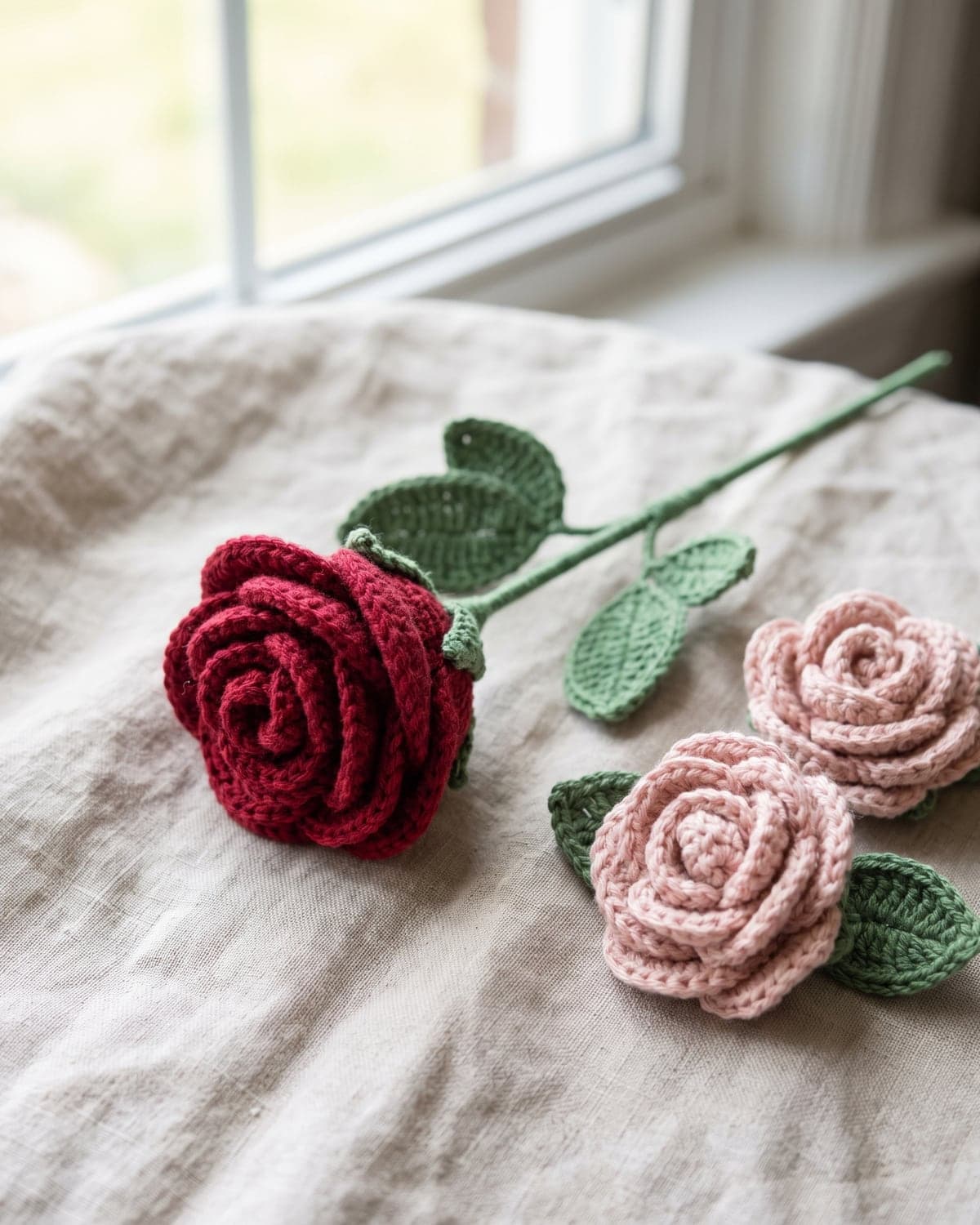
A crochet rose looks like the work of an expert, and it's one of the simplest flowers to make. There's no shaping and no working in the round. You crochet one flat strip with a row of scalloped petals along its edge, roll it up, and sew the base. The petals in this pattern grow from small to large along the strip, so the finished rose has a tight centre and open outer petals, like a real one.
This guide gives you the rose, a bud, a calyx, a leaf and a wire stem, with every stitch count checked. It also covers how to roll and sew the flower so it holds together, and what to do with your roses once they're made.
Terms used here: US crochet terms. Single crochet (sc) is UK double crochet, double crochet (dc) is UK treble, and treble crochet (tr) is UK double treble.
About this pattern: it's a simple design written for this guide. The stitch counts have been checked so the numbers add up. The finished size is approximate.
At a glance
| Skill level | Beginner (comfortable with double crochet) |
| Stitches | Chain, single, half double, double and treble crochet |
| Yarn | DK cotton (weight 3) in a rose colour and green |
| Hook | 3.5 mm (US E-4) |
| Finished size | Rose head about 5 to 6 cm (2 to 2.5 in) across |
| Construction | A flat strip, rolled and sewn; calyx and leaves made separately |
What you need
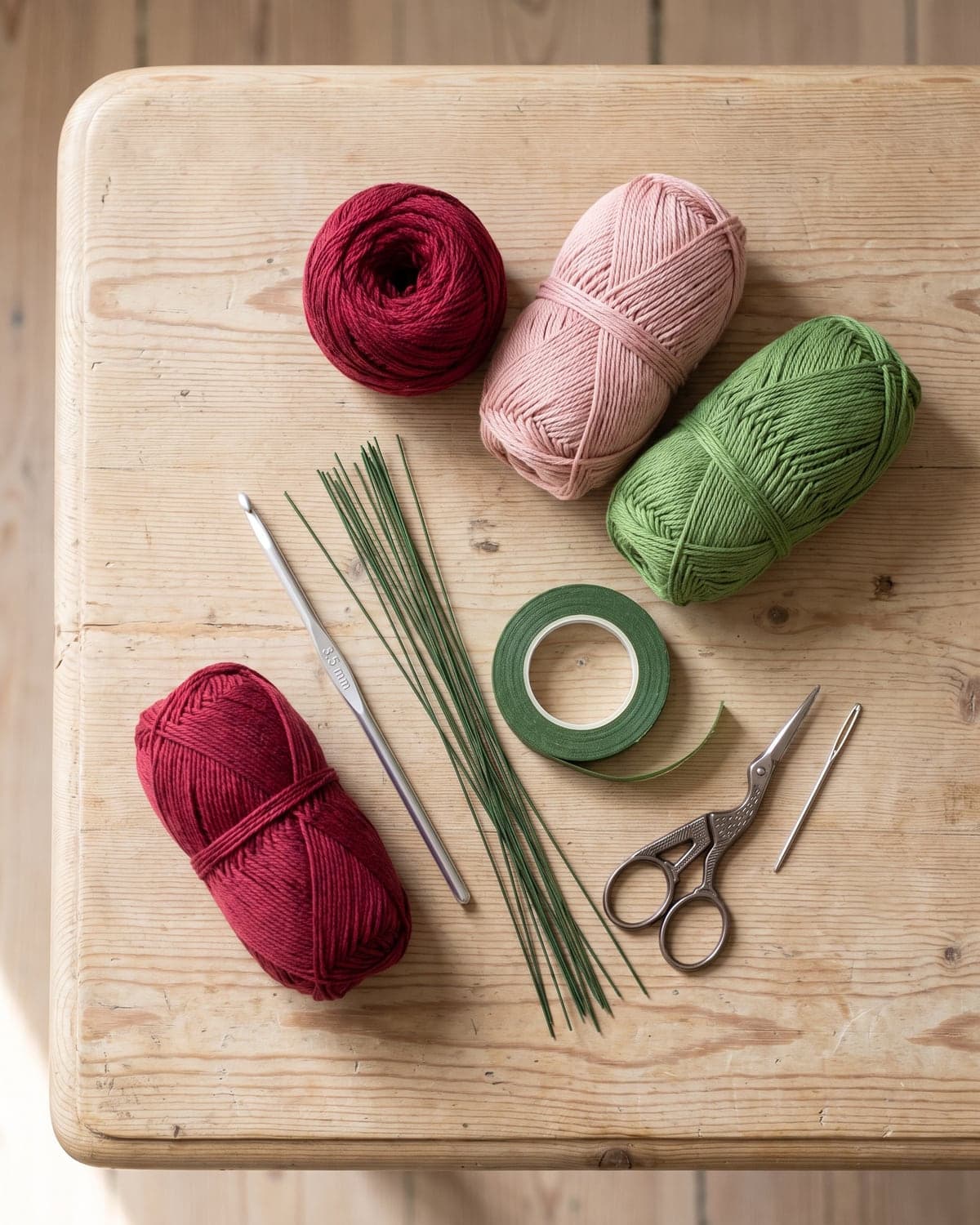
- DK cotton yarn in your rose colour, about 20 m (22 yd) per rose, and green, about 8 m (9 yd) for a calyx and two leaves.
- A 3.5 mm (US E-4) hook.
- A tapestry needle and scissors.
- Pins, to hold the roll while you sew.
For a stem:
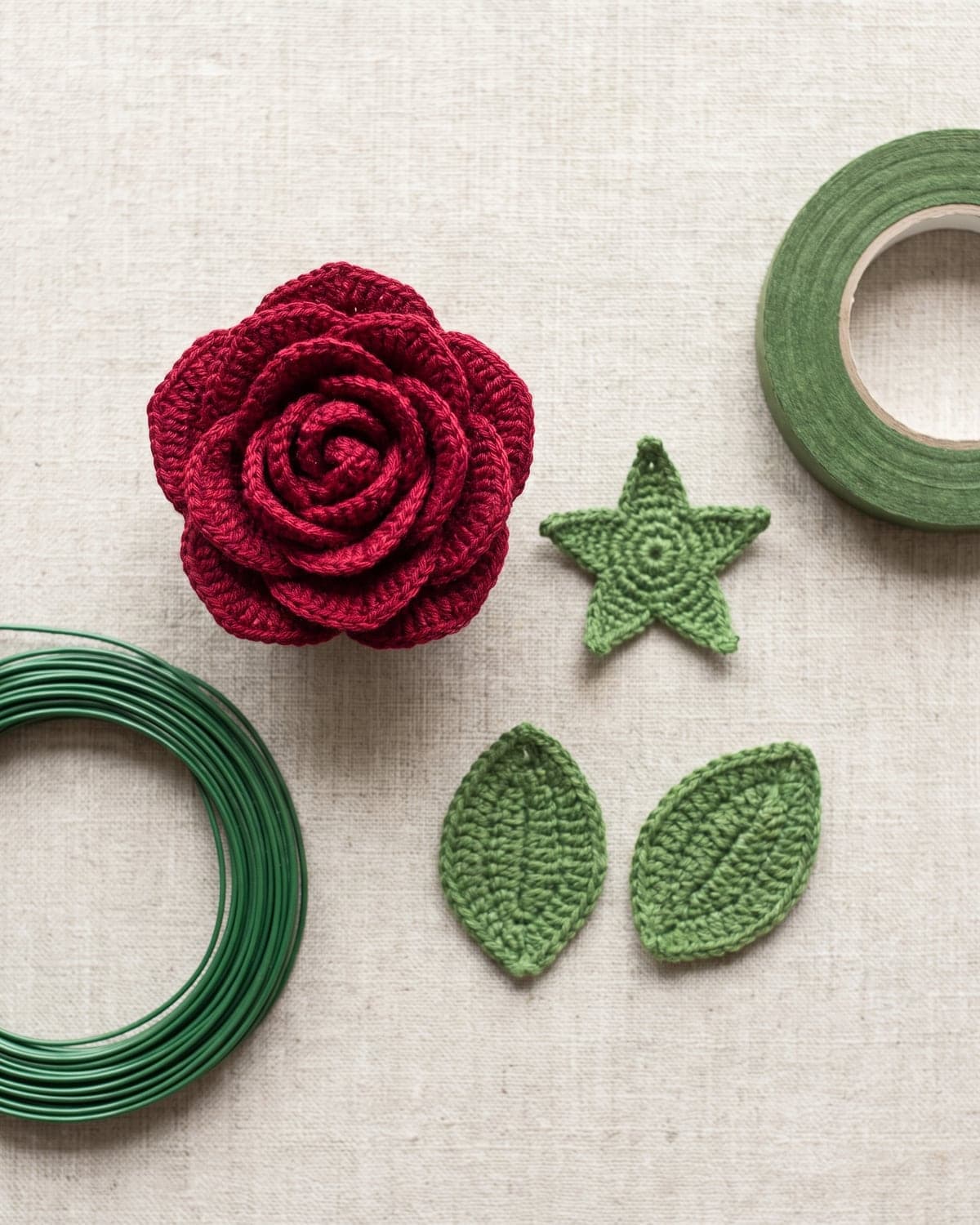
- Floral wire, 18 gauge, about 25 to 30 cm (10 to 12 in). A wooden skewer also works.
- Green floral tape, or green yarn and craft glue.
- Small pliers.
Cotton gives a crisp rose with clearly defined petals. Acrylic gives a softer, fuller flower. Velvet and chenille yarns make a plush rose, though the stitches are hard to see while you work.
Stitches you'll use
- Double crochet (dc): yarn over, insert the hook, pull up a loop, then (yarn over, pull through two loops) twice.
- Treble crochet (tr): yarn over twice, insert the hook, pull up a loop, then (yarn over, pull through two loops) three times. It's a taller double crochet, and it makes the big outer petals.
- Shell: several stitches worked into the same stitch, so they fan out. Every petal of this rose is a shell.
The basic stitches are explained in easy crochet stitches for beginners, and shells in the shell stitch tutorial.
Rose pattern
Row 1: the base
- Chain 43.
- Double crochet in the 4th chain from the hook and in each chain across. (41 stitches, counting the skipped chains as the first double crochet)
This band becomes the hidden base of the rose. Keep the chain relaxed, so the strip doesn't pull into a tight curve.
Row 2: the petals
Chain 1 and turn. Single crochet in the first stitch. Then work the petals in three groups.
Three small petals (the centre):
- Skip 1 stitch, 5 dc in the next stitch, skip 1 stitch, sc in the next stitch. Work this 3 times.
Four medium petals:
- Skip 1 stitch, 7 dc in the next stitch, skip 1 stitch, sc in the next stitch. Work this 4 times.
Three large petals (the outside):
- Skip 1 stitch, 9 tr in the next stitch, skip 1 stitch, sc in the next stitch. Work this 3 times.
Your last single crochet goes into the top of the turning chain. You have 10 petals, and each one uses 4 stitches of the base: 40 stitches, plus the single crochet at the start, makes 41.
Fasten off, leaving a tail of about 50 cm (20 in). You'll sew the rose together with it.
Rolling the rose
- Lay the strip flat, right side up, with the petals at the top and the small petals on your left.
- Start at the small end. Roll the first petal tightly around itself to make the centre bud. Keep the bottom edge of the base level as you roll.
- Keep rolling, a little more loosely with each turn. The medium petals wrap around the centre, and the large petals wrap around those. Let each new petal sit between two petals of the layer inside it.
- Check the shape from the top. If it looks like a cabbage, you've rolled too loosely. If it looks like a tight cone, loosen the outer layers.
- Pin it. Push two pins straight through the base from side to side, in a cross.
Sewing the base
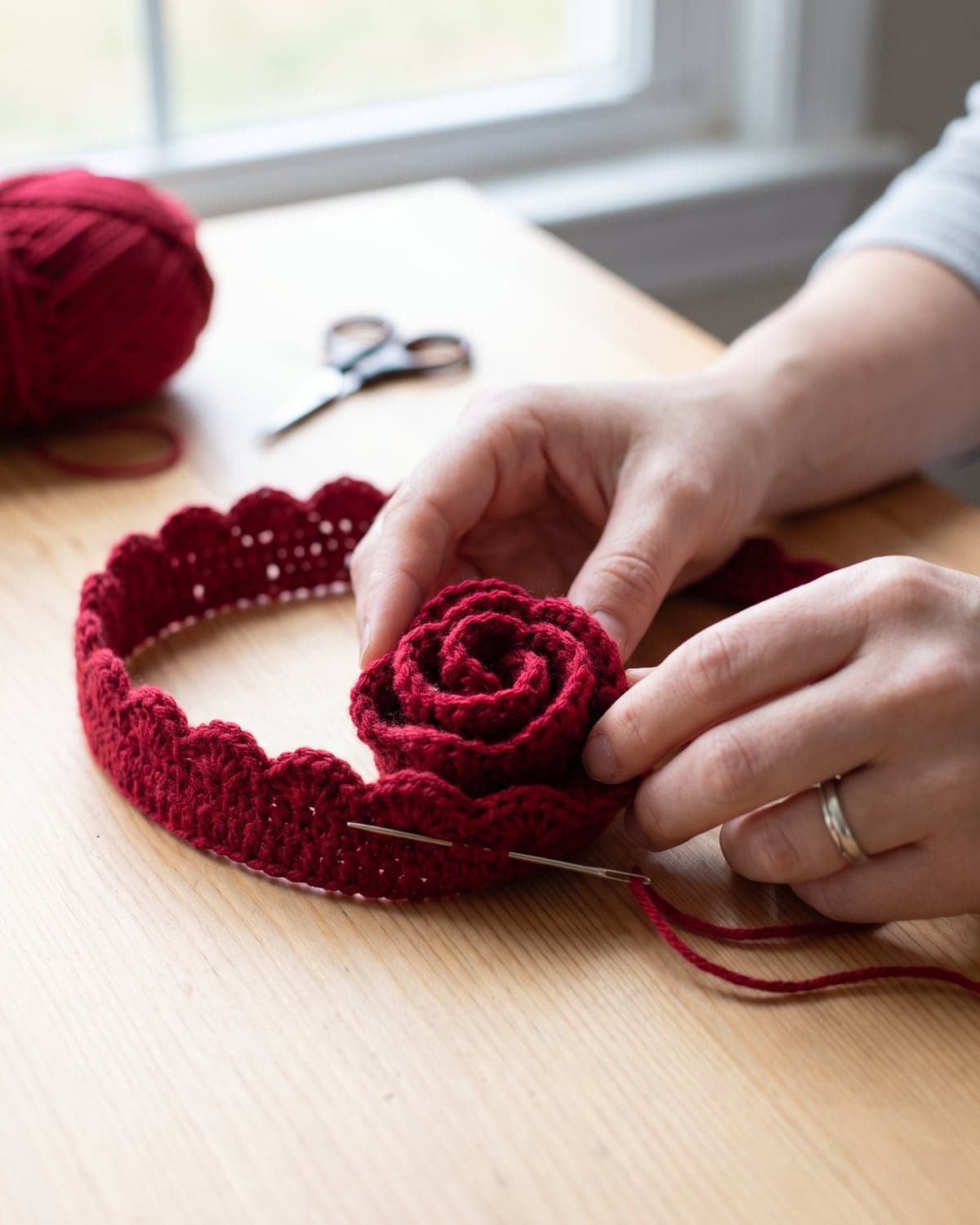
Thread the long tail onto your tapestry needle. Sew straight through the base from one side to the other, going through every layer. Turn the rose a little and sew through again. Repeat six or eight times, working around the base like the spokes of a wheel, then make a few stitches across the bottom to close any gap.
Knot the yarn against the base. Leave the rest of the tail if you're adding a calyx, and trim it if you aren't.
Take your time here. A rose that's only caught at the outer edge will telescope out of its centre the first time someone handles it.
Finally, shape the petals. Roll the edge of each outer petal back over your finger, so it curls outwards.
The calyx
The calyx is the green star under the flower. It hides the sewn base and makes the rose look finished.
Use green.
- R1: 5 sc in a magic ring. Slip stitch into the first stitch to join. (5)
- R2: chain 1, 2 sc in each stitch around. Slip stitch to join. (10)
- R3: (slip stitch in the next stitch, chain 4, sc in the 2nd chain from the hook, hdc in the next chain, dc in the next chain, skip 1 stitch of round 2) × 5.
You have five points, each using two stitches of round 2. Slip stitch into the base of the first point and fasten off, leaving a 25 cm (10 in) tail.
If the magic ring is new to you, see how to crochet a magic ring.
The leaf
Use green. Make two for each rose.
- Chain 9.
- Side 1: starting in the 2nd chain from the hook, work sc, hdc, dc, dc, dc, hdc, sc into the next 7 chains. Work 3 sc in the last chain.
- Side 2: along the other side of the chain, work sc, hdc, dc, dc, dc, hdc, sc.
- Slip stitch into the first single crochet.
Fasten off with a 15 cm (6 in) tail.
For a serrated edge, like a real rose leaf, add a round of (sc, chain 2, slip stitch in the first chain) in every second stitch.
A rosebud
A bud uses the same method on a shorter strip.
- Chain 19.
- Row 1: dc in the 4th chain from the hook and in each chain across. (17 stitches)
- Row 2: chain 1, turn, sc in the first stitch, (skip 1 stitch, 5 dc in the next stitch, skip 1 stitch, sc in the next stitch) × 4.
Roll it tightly all the way and sew the base. Add a calyx and pull its points up around the bud.
How to add a stem
- Bend the wire. With pliers, fold the top 1 cm of the wire into a small closed hook.
- Thread the calyx. Push the straight end of the wire down through the centre of the calyx, from the top.
- Attach the rose. Put a dab of glue on the hooked end and push it up into the base of the rose, between the layers. Or sew over the hook several times with the rose's yarn tail to trap it.
- Sew on the calyx. Slide the calyx up against the base of the rose. With the green tail, stitch each point to the outer petals, and take a few stitches around the centre.
- Wrap the stem. Starting at the calyx, wind floral tape down the wire at an angle, stretching it slightly so it grips. For a yarn-covered stem, run a thin line of glue down the wire and wind green yarn around it, with each wrap touching the last.
- Add the leaves. Hold the base of a leaf against the stem and wrap over its tail. Place the two leaves at different heights.
Wire ends are sharp, and small parts can come loose. Stemmed roses are decorations for adults and older children, not toys.
What to do with crochet roses
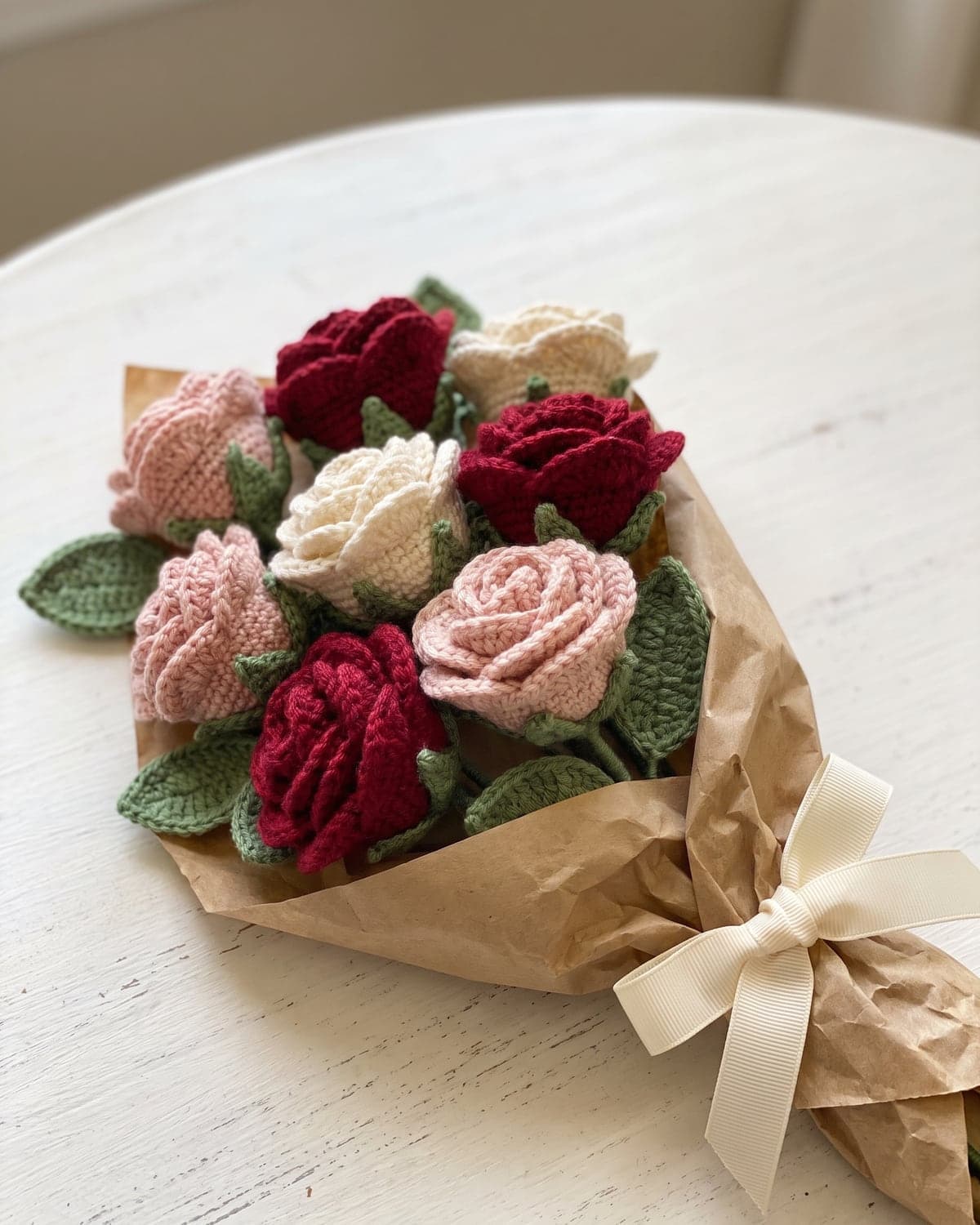
- A bouquet. Five or seven roses, some buds and a few leaves make a gift that lasts. The crochet flower bouquet guide covers arranging and wrapping.
- A single rose for Valentine's Day, Mother's Day, a birthday or a teacher.
- Wedding flowers. Buttonholes, corsages and bouquets that can be kept afterwards.
- Appliqués. Without a stem, sew roses onto hats, bags, headbands, cushions and blankets.
- Brooches and hair clips. Stitch or glue a brooch pin or clip to the calyx.
- Gift toppers and napkin rings.
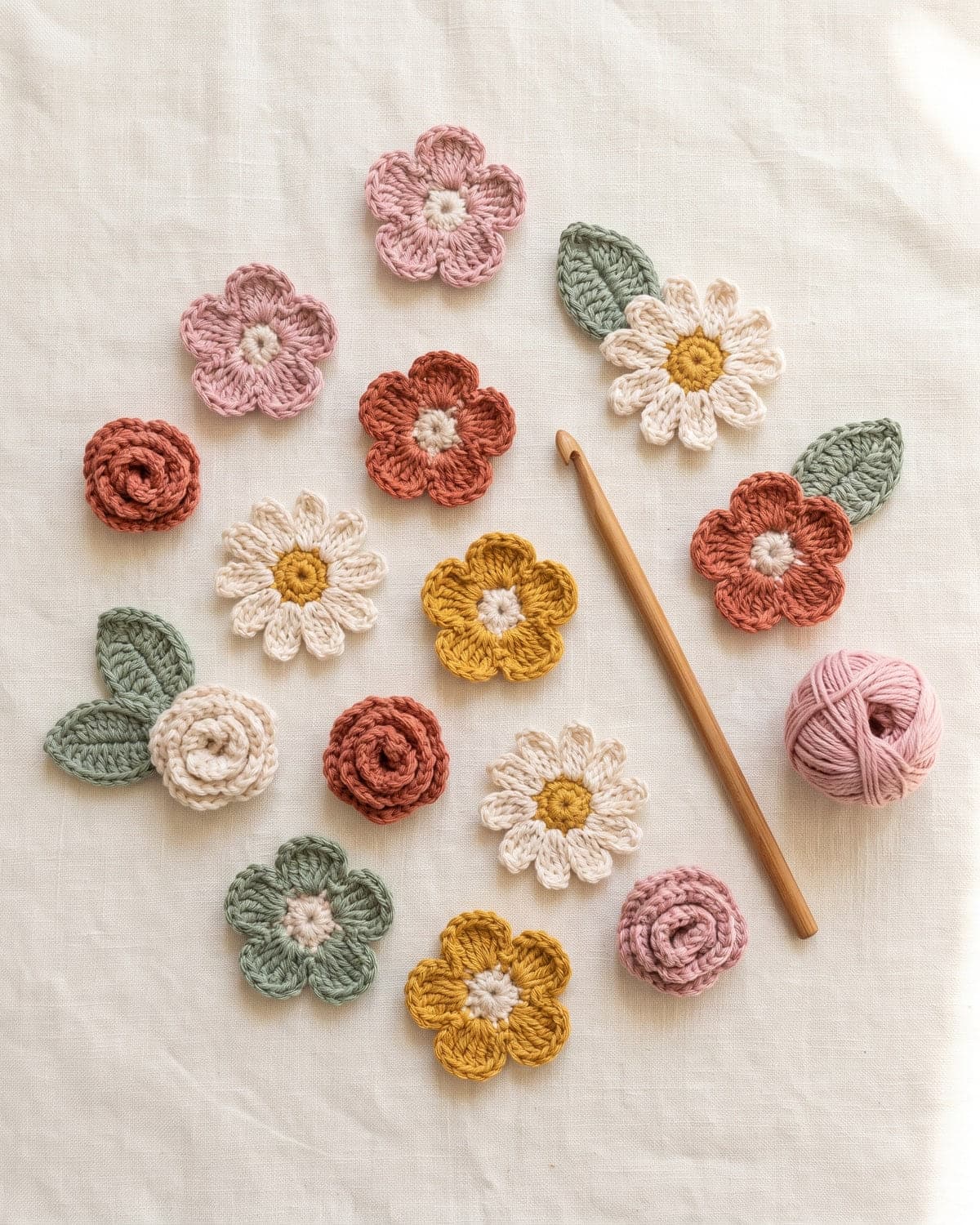
Mix them with other blooms: the crochet sunflower, and the daisies and leaves in easy crochet flowers.
Changing the size and shape
- Bigger rose. Add petals. Each petal needs 4 more chains. For three more large petals, chain 55.
- Smaller rose. Chain 31 and work 3 small and 4 medium petals. Leave out the large ones.
- Fuller petals. Work the medium petals as 9 dc and the large ones as 11 tr.
- Flatter, open rose. Roll loosely and press the outer petals down. Good for appliqués.
- Different yarn. Worsted yarn and a 4.5 mm hook give a rose about 8 cm across. Fine cotton thread and a 2 mm hook give a miniature for jewellery.
Choosing colours
- Classic red, with dark green leaves.
- Blush and cream, for weddings and nurseries.
- Two-tone. Work row 1 in a deeper shade and row 2 in a lighter one. The petal edges will be pale, with a darker heart.
- Tipped petals. Finish the rose, then work a row of slip stitches in a contrast colour along the petal edge.
- Yellow, peach or lilac, for a mixed bouquet.
Tips for a better rose
- Roll with the right side facing in. Whichever side of the petals you find prettier should face the centre, because that's the side you see from above.
- Keep the base level. If the roll spirals upwards, the centre pokes out. Line up the bottom edge at every turn.
- Tight in the middle, loose outside. That one habit makes the biggest difference.
- Sew through everything. Every pass of the needle should come out the other side.
- Shape after sewing. Curl the outer petals back and pinch the inner ones up.
- Steam lightly to set the shape. Hold the iron above the rose and don't touch acrylic with it.
Common problems and fixes
The strip curls into a spiral by itself. Good. That means it wants to roll. Just guide it.
The centre sticks out. The base wasn't kept level, or the stitching missed the centre. Push it down and sew straight through it.
The rose is loose and floppy. Roll more tightly at the start, and add more stitches through the base.
The petals all look the same size. Check that the outer petals were made with treble crochet, with two yarn-overs at the start.
The rose looks flat. It was rolled too loosely. Unpick the sewing and roll again.
The base is bulky. That's normal for a rolled rose. The calyx covers it.
The calyx points curl. Stitch each tip down to a petal.
Frequently asked questions
Is a crochet rose easy for beginners? Yes. It's two rows and some sewing. If you can double crochet, you can make it.
How long does it take? About 30 to 40 minutes for the rose, and a little longer with a calyx, leaves and a stem.
How much yarn does one rose need? Roughly 20 metres of DK yarn, plus about 8 metres of green.
What's the best yarn for crochet roses? Cotton, for crisp, defined petals. Acrylic gives a softer result.
How many roses make a bouquet? Five to seven roses with a few buds and leaves look full. Odd numbers are easier to arrange.
Can I wash crochet roses? Roses without wire can be hand washed and reshaped. Dust wired flowers with a soft brush or a hairdryer on its cool setting.
Can I sell roses made from this pattern? Yes. You're welcome to sell what you make.
More flowers
- Four quick patterns for a first flower: easy crochet flowers.
- A bright bloom in three parts: the crochet sunflower pattern.
- Tulips, lavender, stems and wrapping: the crochet flower bouquet.
There are more patterns in the flowers section. If any shorthand is unfamiliar, the Craft Yarn Council lists standard crochet abbreviations.
Save it for later
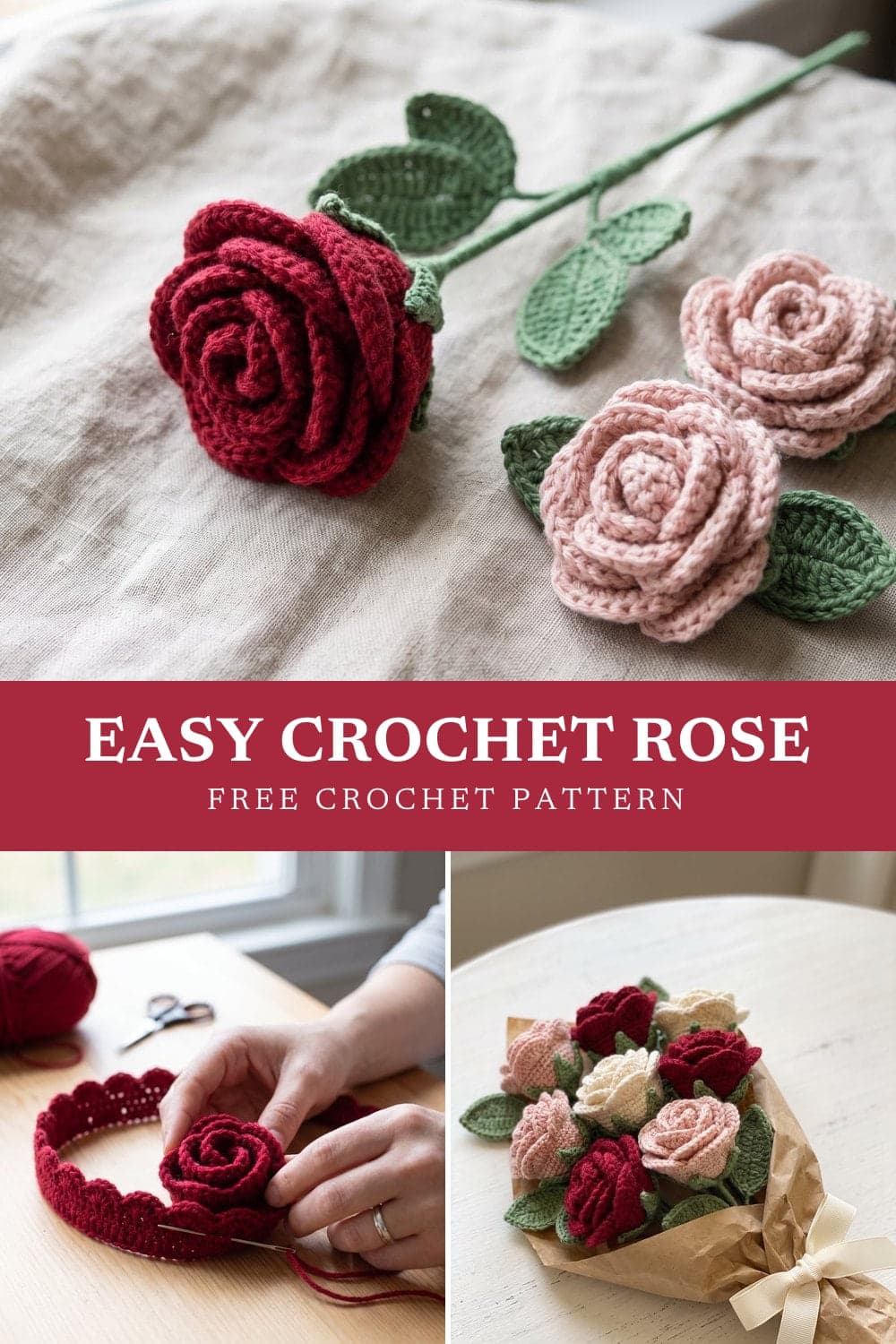
Pin this to your Pinterest board so it's there when you're ready to stitch.
Keep stitching
Related crochet projects
Flowers Crochet Sunflower Pattern: Easy Free Tutorial in 3 Simple Parts
11 min read
Flowers Easy Crochet Flowers: 4 Simple Patterns for Beginners
11 min read
Clothing Easy Crochet Beanie for Beginners: Free Pattern in 4 Sizes
11 min read
Home decor Easy Crochet Coasters: Round and Square Patterns for Beginners
10 min read