Easy Crochet Flowers: 4 Simple Patterns for Beginners
Four easy crochet flower patterns for beginners: a five-petal flower, a daisy, a rolled rose and a leaf, plus how to add stems, make a bouquet and use them as appliqués.
By AlixaPublished 11 min read
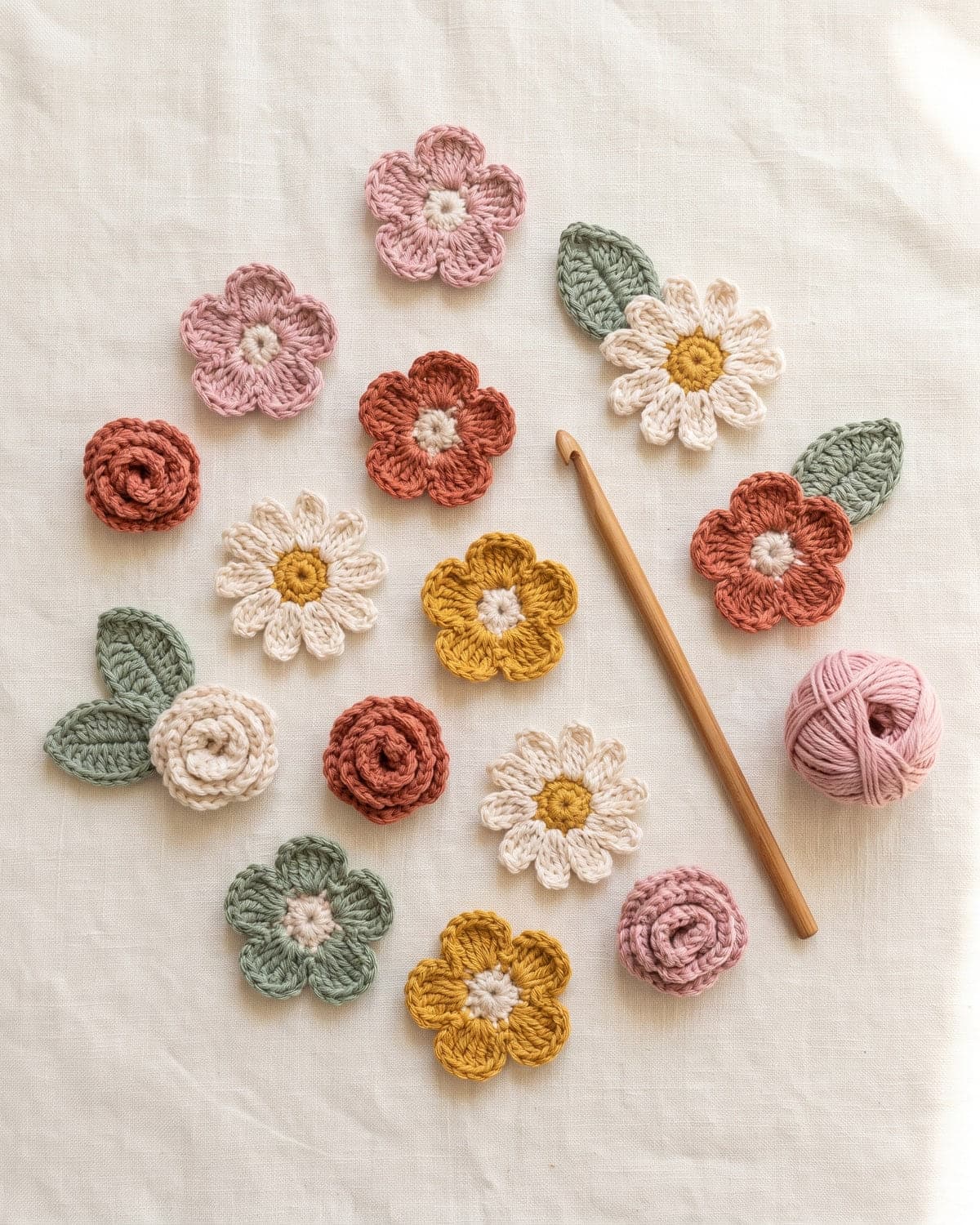
Crochet flowers are small, quick, and a wonderful way to use up scraps of yarn. Each one takes a few minutes, uses only basic stitches, and can be sewn onto a hat, tied to a gift, or wired into a bouquet that never wilts.
This tutorial has four patterns: a simple five-petal flower, a daisy, a rolled rose and a leaf. They're ordered from easiest to slightly more involved, and the last sections show how to turn them into stems, bouquets and decorations.
Terms used here: US crochet terms. In UK terms, single crochet (sc) is double crochet, half double (hdc) is half treble, and double crochet (dc) is treble.
About these patterns: they are simple, traditional constructions written out in our own words. The stitch counts are checked so that every round adds up. Sizes are approximate because they depend on your yarn and hook.
What you need
- Yarn. Cotton in DK or worsted weight (weight 3 or 4) gives crisp petals that hold their shape. Scraps are fine: each flower uses only a few metres.
- A crochet hook one size smaller than the yarn label suggests, so the petals are firm. For worsted cotton, 3.5 mm or 4 mm (US E-4 or G-6) works well.
- A tapestry needle and scissors.
- For bouquets: floral wire or wooden skewers, green floral tape or green yarn, and craft glue.
Skills you'll use
All four patterns use the chain, slip stitch, single crochet, half double crochet and double crochet. If any of those are new, the stitch guide for beginners explains each one. Two extra techniques come up:
The magic ring
A magic ring (also called a magic circle or adjustable ring) lets you close the centre of a round completely.
- Lay the yarn tail across your palm and wrap the working yarn around two fingers to make a loop, crossing over the tail.
- Insert the hook under the loop, catch the working yarn and pull it through.
- Chain 1 to secure it.
- Work the first round of stitches over both the loop and the tail.
- Pull the tail to close the hole.
If the magic ring frustrates you, there's an easy substitute: chain 4, join with a slip stitch to make a ring, and work the first round into that ring. The centre hole will be a little bigger.
Working several stitches into one
Petals get their curve from putting two or more tall stitches into a single stitch. When a pattern says "2 dc in the next stitch", make one double crochet, then make another in exactly the same place.
Pattern 1: Simple five-petal flower
This is the classic flat flower, and it's the best one to start with. In worsted cotton with a 4 mm hook it comes out roughly 5 to 6 cm (2 to 2.5 in) across.
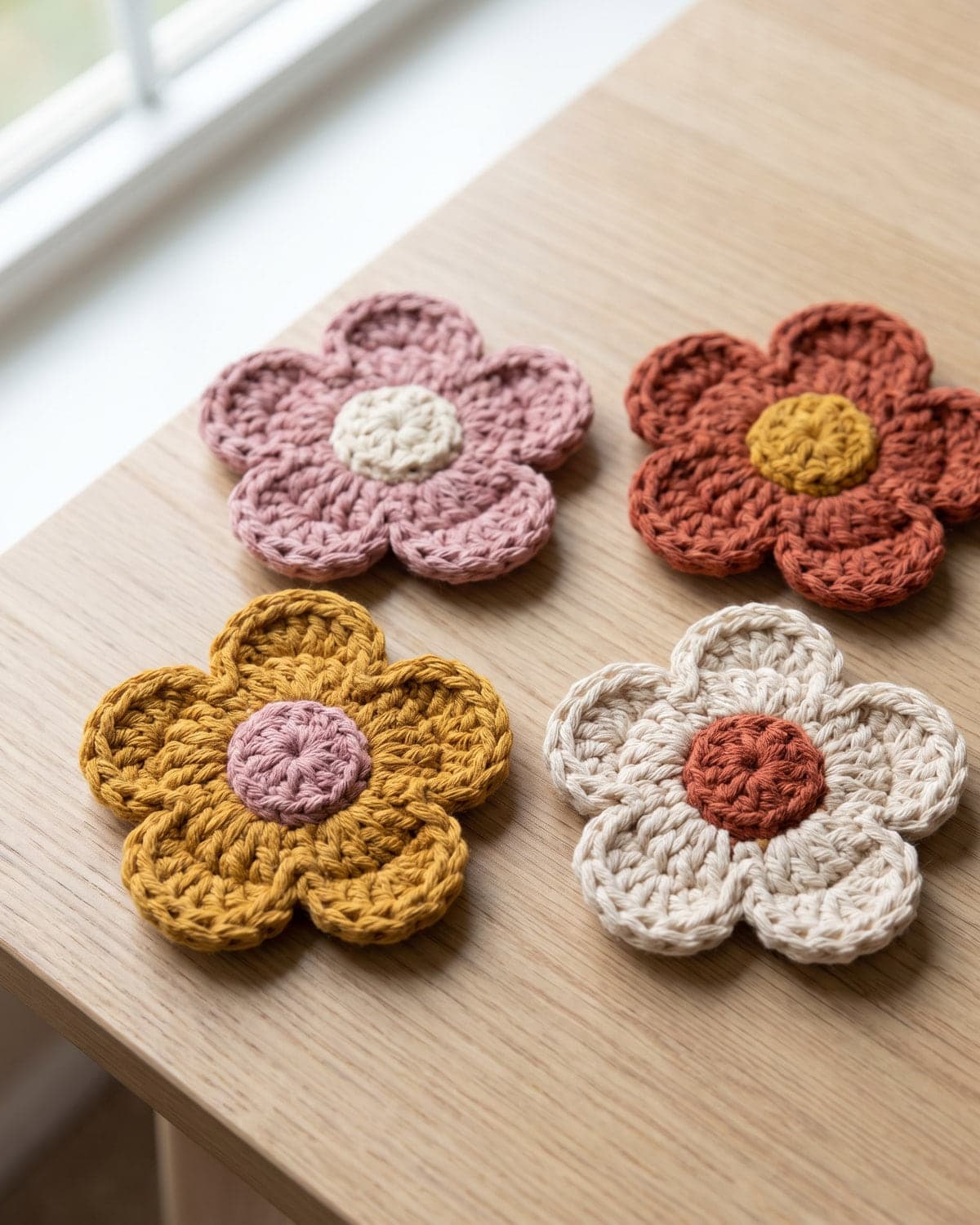 Round 1 (centre): Make a magic ring. Chain 1, then work 10 sc into the ring. Pull the ring closed and join to the first sc with a slip stitch. (10 stitches)
For a contrasting centre, fasten off here and join a new colour in any stitch.
Round 2 (petals): Each petal is worked over two stitches.
Chain 2. Work 2 dc in the same stitch. Work 2 dc in the next stitch. Chain 2, then slip stitch in that same stitch. Slip stitch in the next stitch.
Repeat the section between the asterisks four more times, for five petals in total. The last slip stitch lands in the stitch where the round began.
Fasten off and weave in the ends. Use the starting tail to tighten the centre before you weave it in.
To make it bigger: use thicker yarn and a larger hook, or swap the double crochets for treble crochets and the chain 2 for chain 3.
Pattern 2: Crochet daisy
Daisies have many narrow petals around a round yellow centre. Each petal here is a short chain with stitches worked back down it.
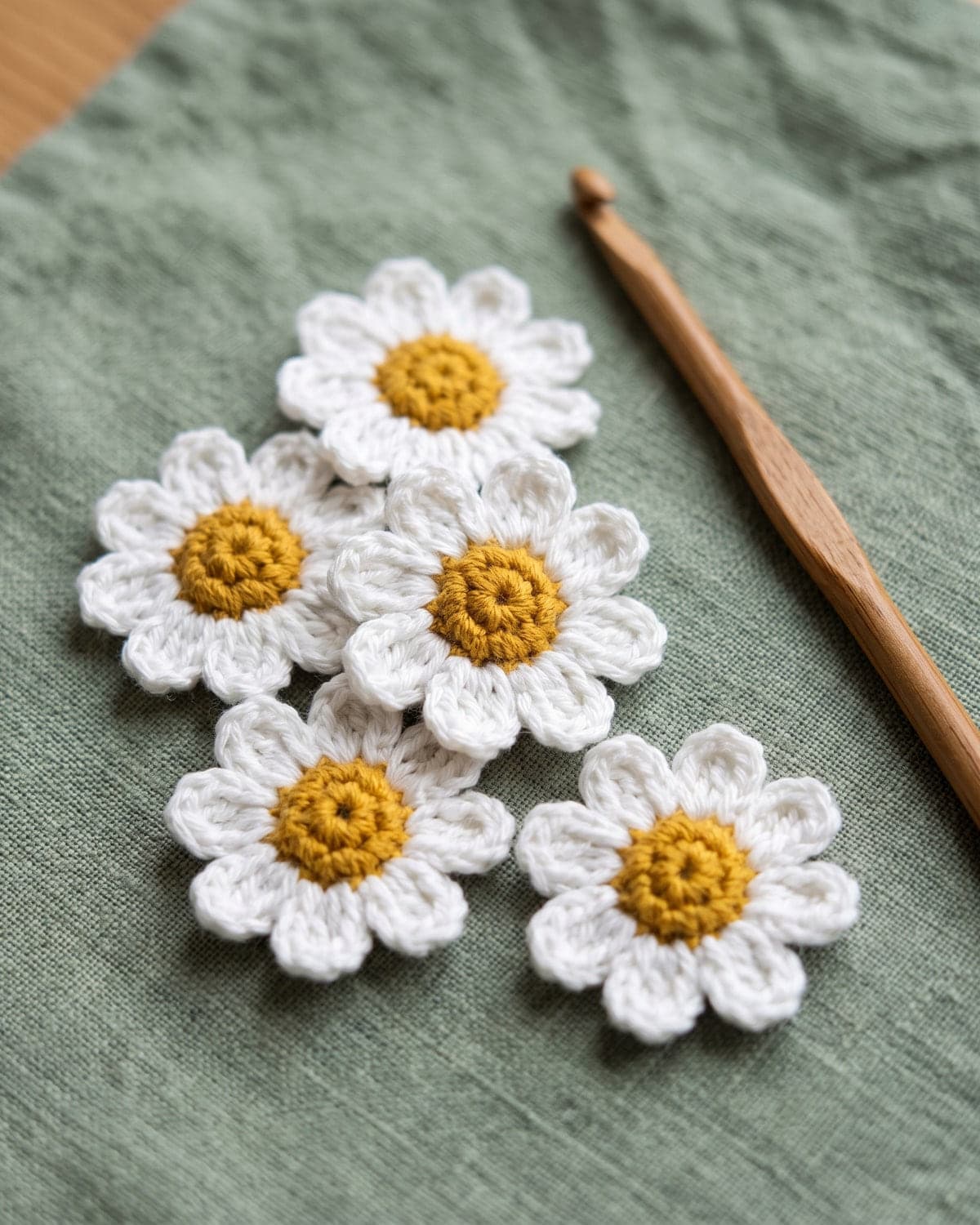 Round 1 (centre, yellow): Make a magic ring. Chain 1 and work 6 sc into the ring. Pull closed. Join with a slip stitch to the first sc. (6 stitches)
Round 2 (yellow): Chain 1. Work 2 sc in each stitch around. Join with a slip stitch to the first sc. (12 stitches) Fasten off the yellow.
Round 3 (petals, white): Join white yarn with a slip stitch in any stitch.
Chain 6. Working back down the chain: slip stitch in the 2nd chain from the hook, sc in the next chain, hdc in each of the next 2 chains, sc in the last chain. Slip stitch in the next stitch of the centre.
Repeat between the asterisks 11 more times, for 12 petals. The last slip stitch goes into the stitch where you joined the white yarn.
Fasten off and weave in the ends. If the petals curl, press the daisy flat under a damp cloth and let it dry.
For shorter petals, chain 5 instead of 6 and work only one hdc.
Pattern 3: Rolled rose
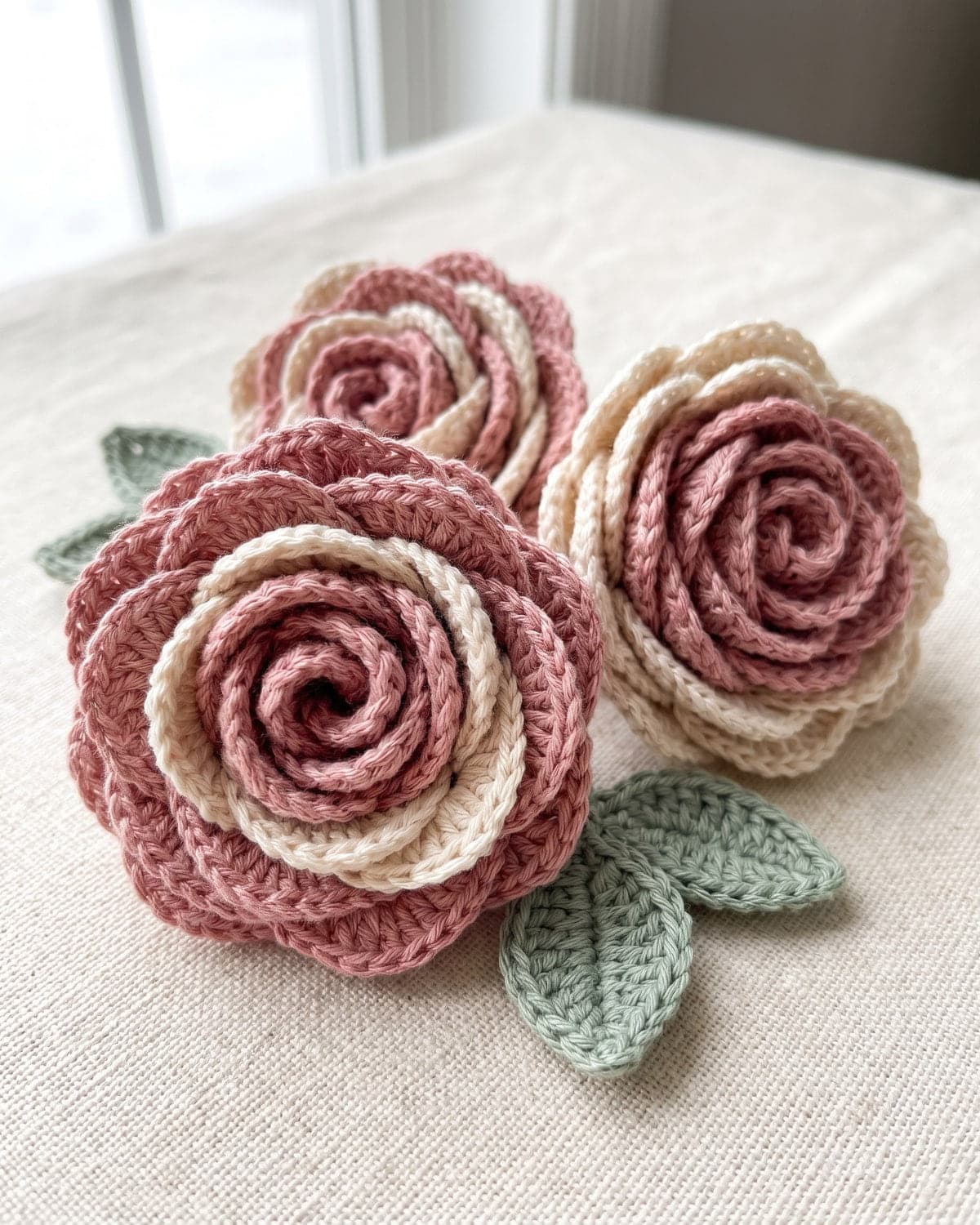
The rolled rose is worked as a flat strip of scallops, then rolled up and stitched at the base. It looks impressive and it's much simpler than it appears.
 Foundation: Chain 34.
Row 1: Sc in the 2nd chain from the hook and in each chain across. (33 stitches)
Row 2 (petals): Chain 1 and turn. Slip stitch in the first stitch. Then:
- Three small petals: Skip 1 stitch, work 5 hdc in the next stitch, skip 1 stitch, slip stitch in the next stitch. Work this three times.
- Five large petals: Skip 1 stitch, work 5 dc in the next stitch, skip 1 stitch, slip stitch in the next stitch. Work this five times.
You'll have eight petals, and the last slip stitch lands in the final stitch of the row. Fasten off, leaving a tail about 30 cm (12 in) long for sewing.
Rolling the rose:
- Start at the end with the small petals. Roll the strip up tightly for the first two petals to form the bud.
- Keep rolling, a little more loosely, letting the larger petals wrap around the outside.
- Keep the straight bottom edge level as you roll, so the base is flat.
- Thread the long tail onto your needle and sew back and forth through all the layers of the base, in several directions, until nothing shifts.
For a bigger, fuller rose, start with a longer chain. Each extra petal needs 4 more chains.
Pattern 4: A simple leaf
Leaves make flowers look finished. This one is worked around both sides of a short chain.
Foundation: Chain 8.
Round 1: Working down the chain: sc in the 2nd chain from the hook, hdc in the next chain, dc in each of the next 2 chains, hdc in the next chain, sc in the next chain, then 3 sc in the last chain. This turns the corner at the tip.
Now work back along the other side of the chain, into the unused loops: sc in the next chain, hdc in the next, dc in each of the next 2, hdc in the next, sc in the last. Join with a slip stitch to the first sc.
Fasten off, leaving a tail for sewing. The leaf is about 4 cm (1.5 in) long in worsted cotton.
How to add stems and make a bouquet
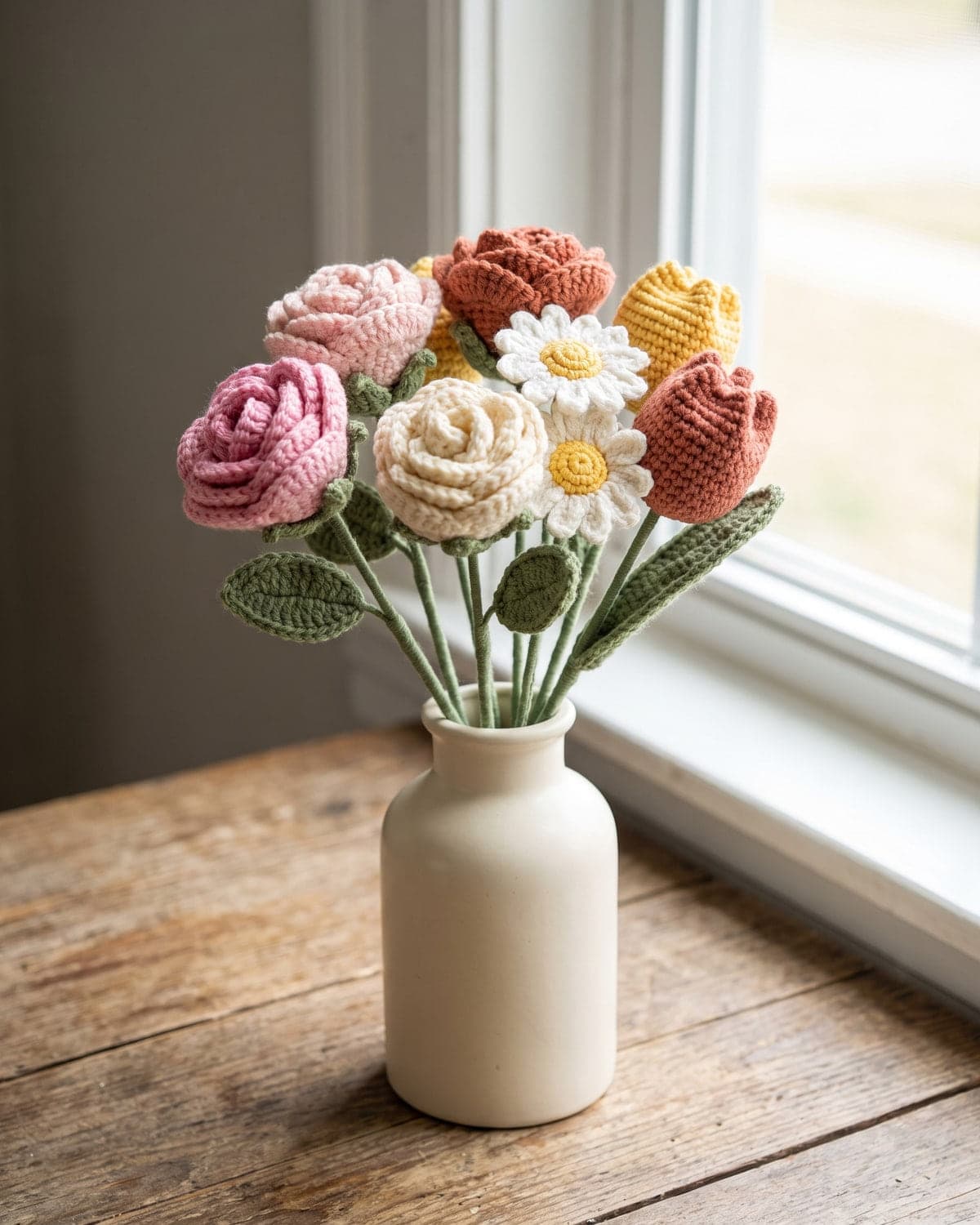
Crochet flowers on stems last for years and make a thoughtful handmade gift.
- Prepare the stem. Cut floral wire or a thin wooden skewer to length. If you're using wire, bend a small closed loop at the top so the flower can't slide off and no sharp end pokes through.
- Attach the flower. Push the stem up through the centre of the flower from the back. For a rose, push it into the rolled base. Add a dot of craft glue where the stem meets the flower and let it set.
- Cover the stem. Wrap green floral tape down the stem, stretching it slightly as you go so it sticks to itself. Or wrap green yarn tightly around the stem with a little glue at the top and bottom.
- Add leaves. Hold the base of a leaf against the stem and wrap the tape or yarn over its tail to catch it in.
- Arrange. Put the tallest flowers in the centre and tie the stems together with twine or ribbon.
Vary the flower sizes and use an odd number of stems for a natural look. A bouquet with five or seven flowers is plenty for a small vase.
If the bouquet is for a young child, skip the wire and skewers. Sew the flowers to a crocheted cord or a soft fabric band instead.
Ways to use crochet flowers
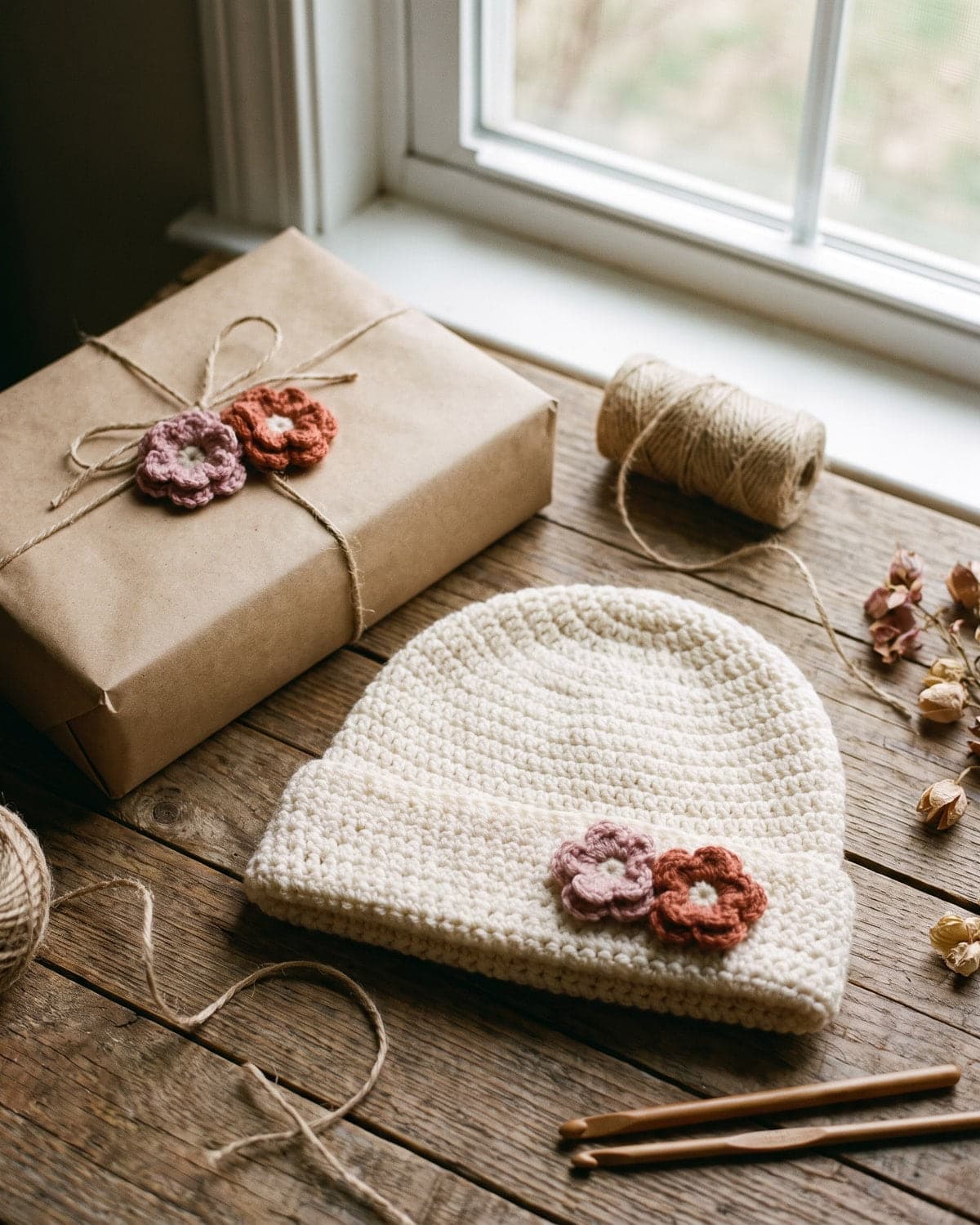
- Appliqués. Sew one to a hat, headband, cardigan pocket, tote bag or cushion.
- Gift toppers. Tie a flower onto a wrapped present with twine. It becomes a small extra gift.
- Brooches and hair clips. Stitch or glue a flower to a brooch back or a flat hair clip.
- Garlands. Chain a long cord and attach a flower every 10 cm (4 in).
- Blanket decoration. A row of daisies along the edge of a baby blanket. For babies, sew them on very securely and leave off beads and buttons.
- Bookmarks. Crochet a chain about 25 cm (10 in) long and sew a flower to one end.
- Seasonal decorations. Flowers in spring colours make an easy table scatter. More ideas for holidays are in the seasonal section.
Tips for neat flowers
- Use a smaller hook than usual. Firm stitches make petals that stand up instead of flopping.
- Choose cotton for definition. It shows each stitch and doesn't fuzz. Acrylic is softer and slightly fluffier.
- Leave long tails. They're useful for sewing the flower in place, so you don't need to join new yarn.
- Close the centre firmly. Pull the magic ring tail tight, then weave it around the ring in the opposite direction before trimming.
- Block flat flowers. Pin them to shape on a towel, mist with water, and let them dry. Blocking is the difference between a curled petal and a crisp one.
- Stiffen if needed. For decorations that need to hold a shape, brush the back with diluted craft glue or fabric stiffener and dry flat.
Common problems and fixes
The centre hole won't close. Pull the starting tail harder, and make sure you worked the first round over both the loop and the tail. If the ring still gapes, stitch across it with the tail on the back.
My five-petal flower has four or six petals. The stitch count in Round 1 was off, or a slip stitch between petals was missed. Count ten stitches before you start the petals, and say the petal out loud as you go: two in this stitch, two in the next, slip, slip.
The petals look thin and gappy. The hook is too large for the yarn. Go down half a millimetre.
The daisy petals twist. That's normal straight off the hook. Blocking flattens them. Working the petal stitches into the back bump of the chain also gives a smoother edge.
The rose won't stay rolled. Sew through all the layers at the base, not only the outer one, and take stitches in several directions like the spokes of a wheel.
The rose looks flat. Roll the first two petals more tightly to make a raised bud, and keep the bottom edge level so the outer petals sit lower than the centre.
My flower is much bigger or smaller than expected. Size follows the yarn and hook. The same pattern in fine cotton thread makes a tiny flower for a card; in bulky yarn it makes one big enough for a cushion.
Choosing colours
Real flowers are a good guide. A few combinations that always work:
- Daisy: white petals, yellow centre.
- Wild rose: pink petals, yellow or cream centre.
- Poppy: red petals, black centre.
- Forget-me-not: pale blue petals, yellow centre.
- Vintage rose: dusty pink, cream or terracotta, with sage green leaves.
For a bouquet, pick three flower colours and one green, and repeat them. Too many colours can look busy.
Frequently asked questions
What's the easiest crochet flower for a beginner? The five-petal flower. It's two rounds and uses only single and double crochet.
What yarn is best for crochet flowers? Cotton or a cotton blend, in DK or worsted weight. It gives clear, firm petals.
How do I stop my flower curling? Block it: pin it flat, dampen it and let it dry. Slight curl in petals is natural and often looks more realistic.
How much yarn does a flower need? Only a few metres. Flowers are an ideal scrap project.
Can I sell flowers made from these patterns? Yes. These are basic traditional shapes, and you're welcome to sell what you make from them.
Can I make them without a magic ring? Yes. Chain 4, join into a ring with a slip stitch, and work Round 1 into the ring.
Keep going
Once you can make these four, you can make most crochet flowers: they're nearly all variations on petals worked around a centre or along a strip. Find more patterns in the flowers section.
If you enjoyed working in small rounds, amigurumi for beginners uses the same magic ring to make toys, and easy crochet coasters turns it into something for your table.
Save it for later
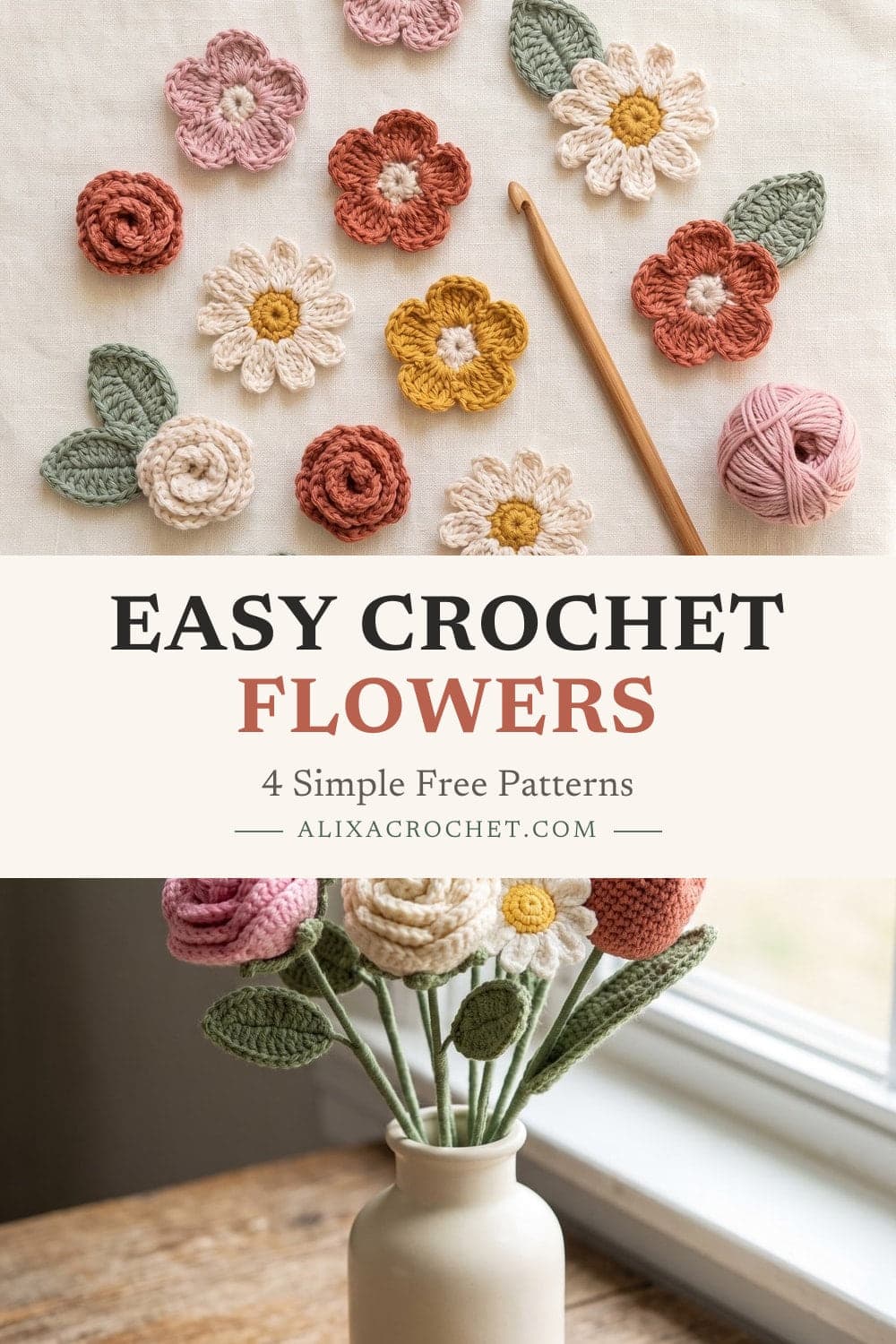
Pin this to your Pinterest board so it's there when you're ready to stitch.
Keep stitching
Related crochet projects
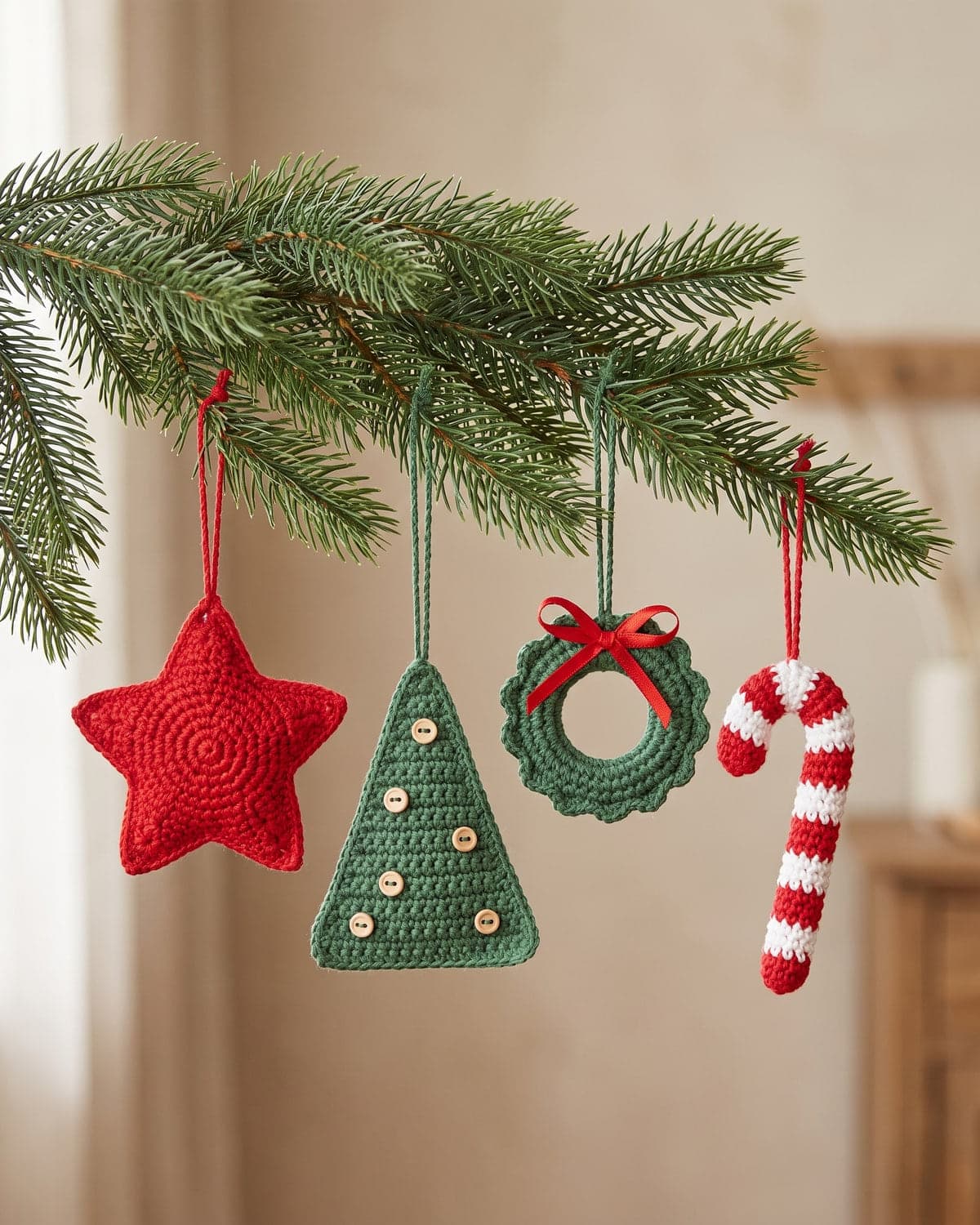
Seasonal Crochet Christmas Ornaments: 4 Easy Patterns for Beginners
12 min read
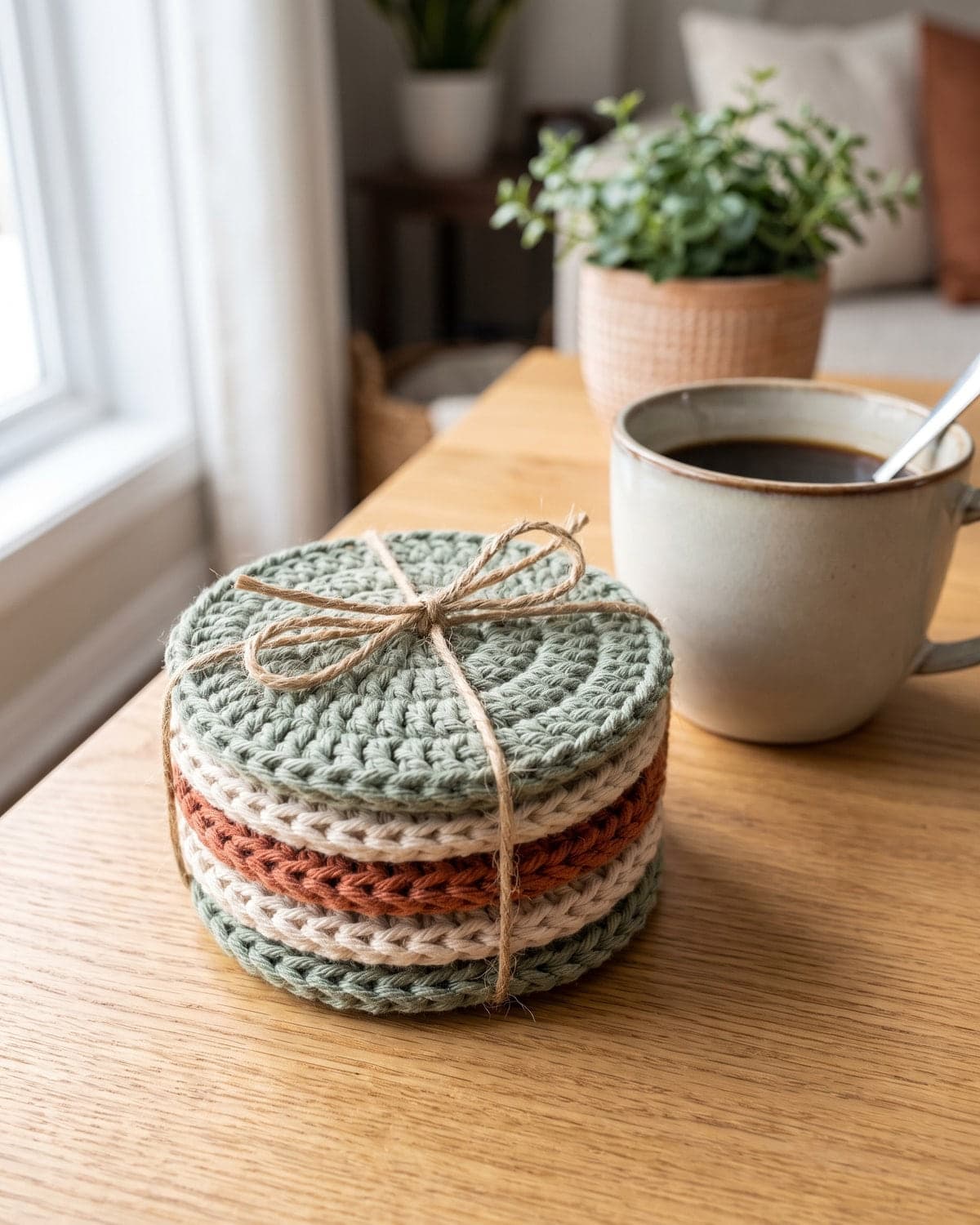
Home decor Easy Crochet Coasters: Round and Square Patterns for Beginners
10 min read
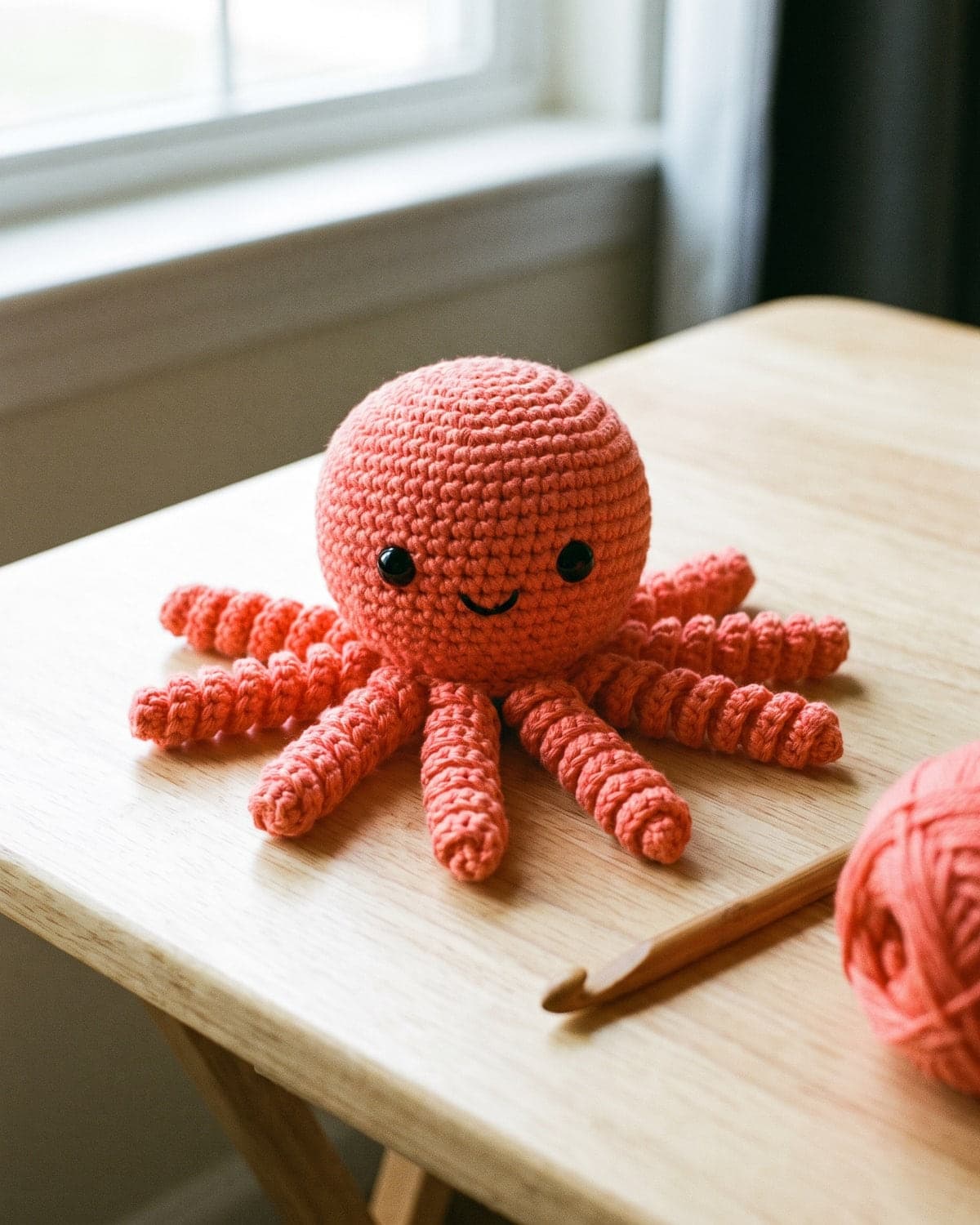
Amigurumi Easy Crochet Octopus: Free Amigurumi Pattern for Beginners
10 min read
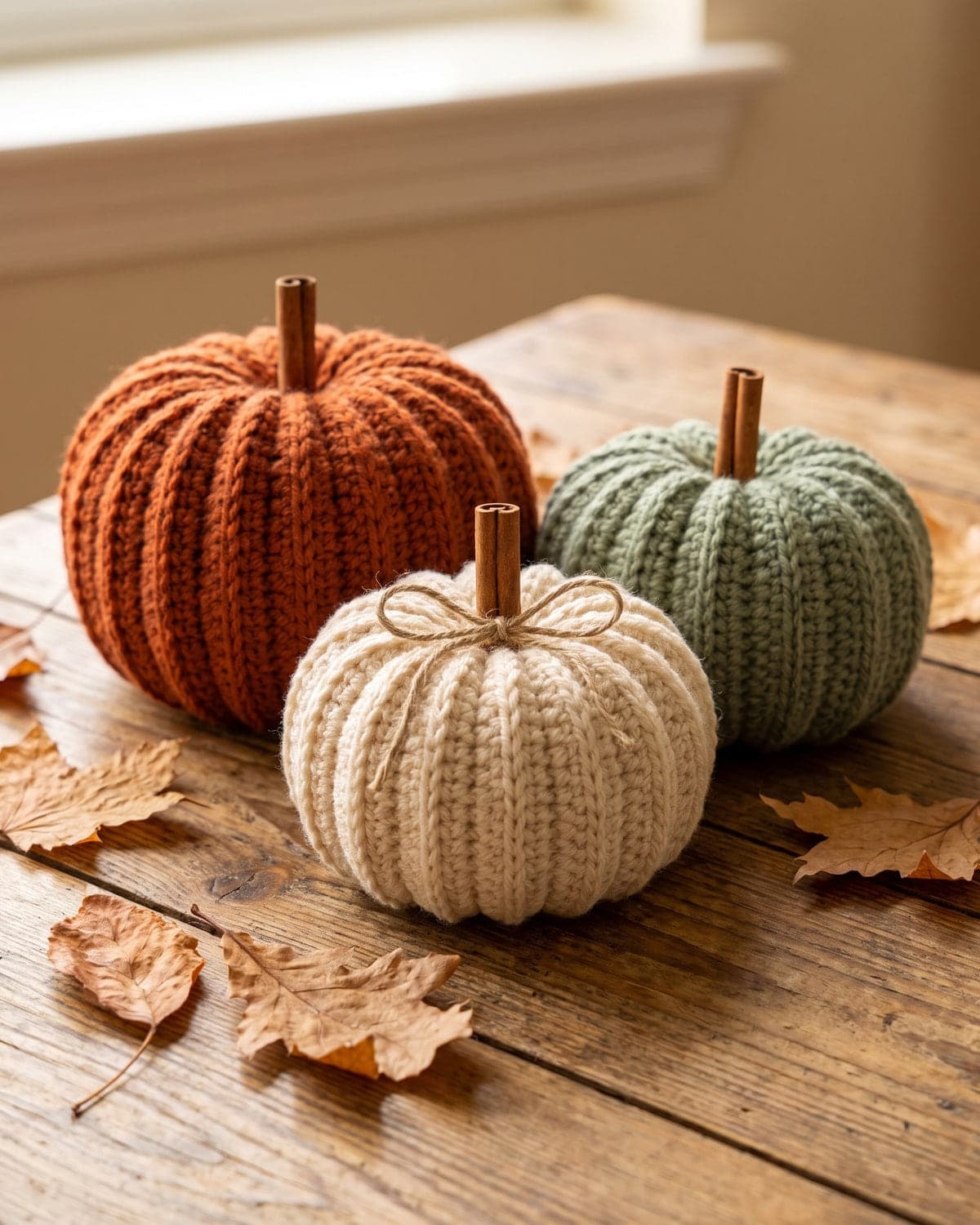
Seasonal Easy Crochet Pumpkins: Beginner Pattern in Three Sizes
10 min read