Easy Crochet Octopus: Free Amigurumi Pattern for Beginners
Crochet a cute amigurumi octopus with a simple ball head and eight curly tentacles that spiral by themselves. Step-by-step rounds, safety notes, size and colour variations and finishing tips.
By AlixaPublished 10 min read
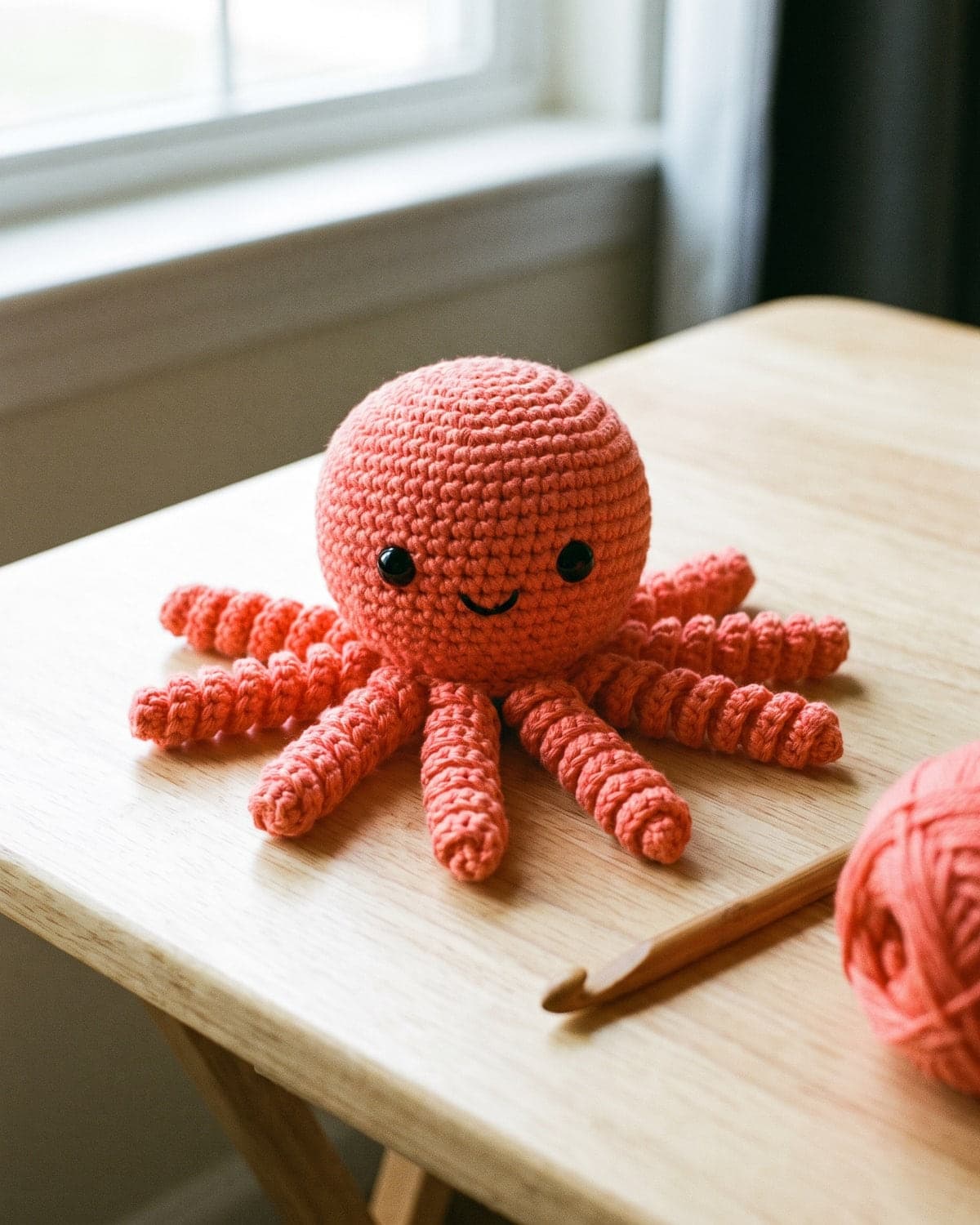
A crochet octopus is one of the friendliest amigurumi projects there is. The head is a simple ball, and the eight curly tentacles are nothing more than chains with two stitches worked into each one. They spiral all by themselves. There's very little sewing, the shaping is gentle, and the result has a lot of personality for an evening's work.
This tutorial gives you the full pattern for a small octopus, explains each technique as it comes up, and finishes with ways to change the size, the face and the colours.
Terms used here: US crochet terms. Single crochet (sc) is called double crochet (dc) in UK terms.
About this pattern: it's a simple design written for this guide. Each round's stitch count has been checked so the numbers add up. The finished size is approximate, because it depends on your yarn, hook and how firmly you stuff.
At a glance
| Skill level | Beginner (confident with single crochet) |
| Stitches | Magic ring, single crochet, increase, decrease, chain |
| Yarn | DK or worsted cotton (weight 3 or 4) |
| Hook | 3 mm (US D-3) for DK, 3.5 mm (US E-4) for worsted |
| Finished size | Head about 6 to 7 cm (2.5 in) across in DK cotton |
| Construction | Head worked in a spiral, eight tentacles sewn on |
What you need
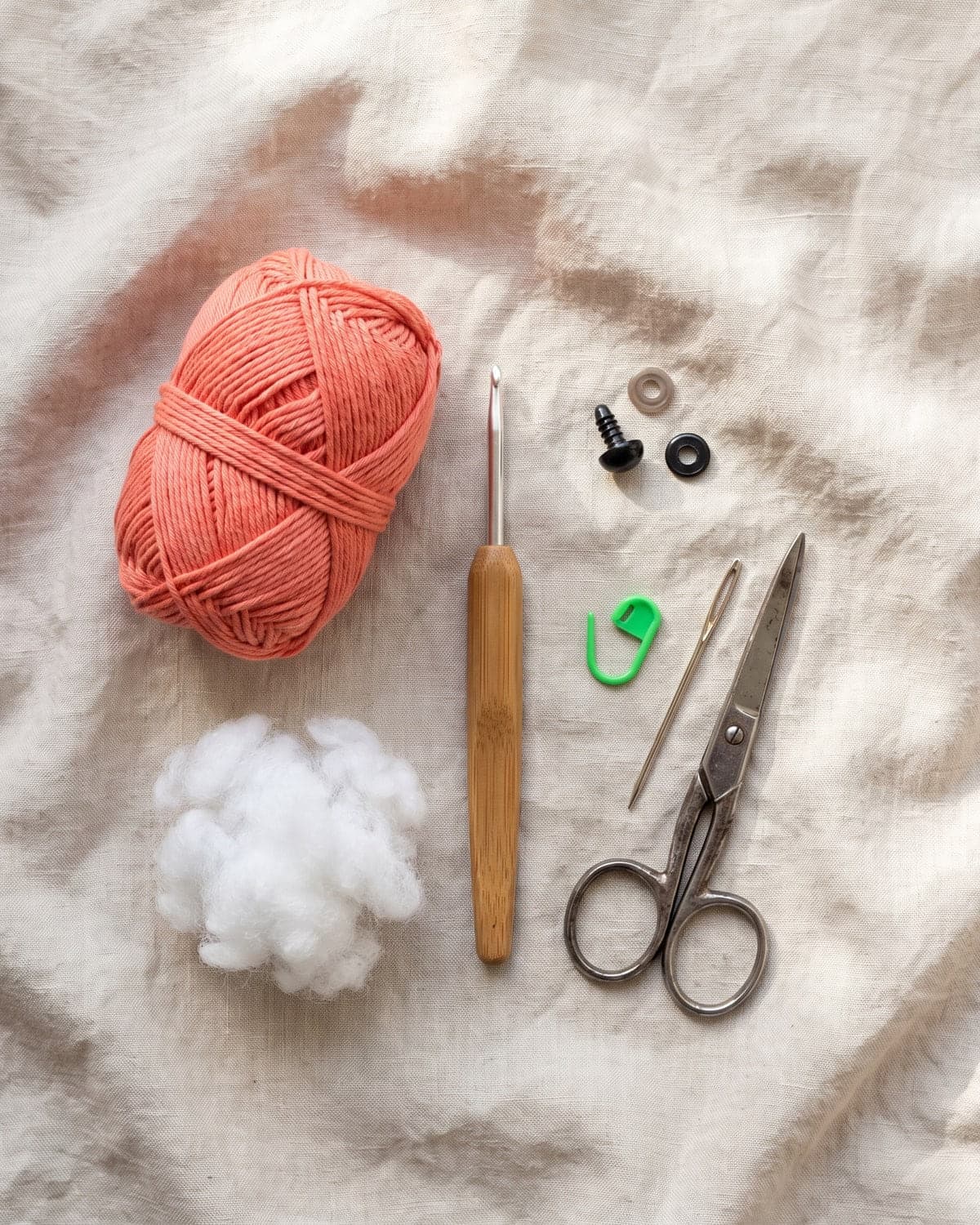
- Cotton or acrylic yarn in one main colour. A small ball is plenty. A second colour for the underside of the tentacles is optional.
- A crochet hook two or three sizes smaller than the yarn label suggests, so the fabric is tight.
- Polyester fibrefill stuffing.
- Two safety eyes (6 or 8 mm), or black yarn to embroider them.
- A locking stitch marker.
- A tapestry needle, scissors and a few pins.
A safety note before you start
This octopus has long, thin tentacles and may have plastic eyes. Both are a concern around babies and young children: small parts can come off, and long cords are a hazard. Make it as a decoration, a desk companion or a gift for older children and adults. If a child under three might handle it, embroider the eyes, keep the tentacles short (see the variations), and sew every piece on very firmly. The US Consumer Product Safety Commission publishes guidance on small parts in toys.
You may have seen crochet octopuses made for premature babies in hospitals. Those are made to strict rules about yarn, tentacle length and washing, set by the hospitals and volunteer groups that run the schemes. This pattern is not written to those rules, so please don't use it for that purpose.
Techniques used
If you've made the practice ball in amigurumi for beginners, you already know everything here. A quick recap:
- Magic ring: an adjustable loop that closes the centre of the first round completely.
- Working in a spiral: rounds aren't joined. You keep going, and a stitch marker in the first stitch of each round shows where it starts.
- Increase (inc): two single crochets in the same stitch.
- Invisible decrease (dec): insert the hook under the front loops only of the next two stitches, yarn over, pull through both front loops, yarn over and pull through the two loops on the hook.
Reading the pattern
R4: (2 sc, inc) × 6 (24) means: single crochet in each of the next two stitches, then increase in the next stitch. Do that six times. You'll finish the round with 24 stitches. If the shorthand is unfamiliar, how to read crochet patterns explains it.
Octopus pattern
Head
Work in a continuous spiral. Move your stitch marker up at the start of each round.
- R1: 6 sc in a magic ring (6)
- R2: inc in each stitch around (12)
- R3: (sc, inc) × 6 (18)
- R4: (2 sc, inc) × 6 (24)
- R5: (3 sc, inc) × 6 (30)
- R6 to R11: sc in each stitch around, for 6 rounds (30)
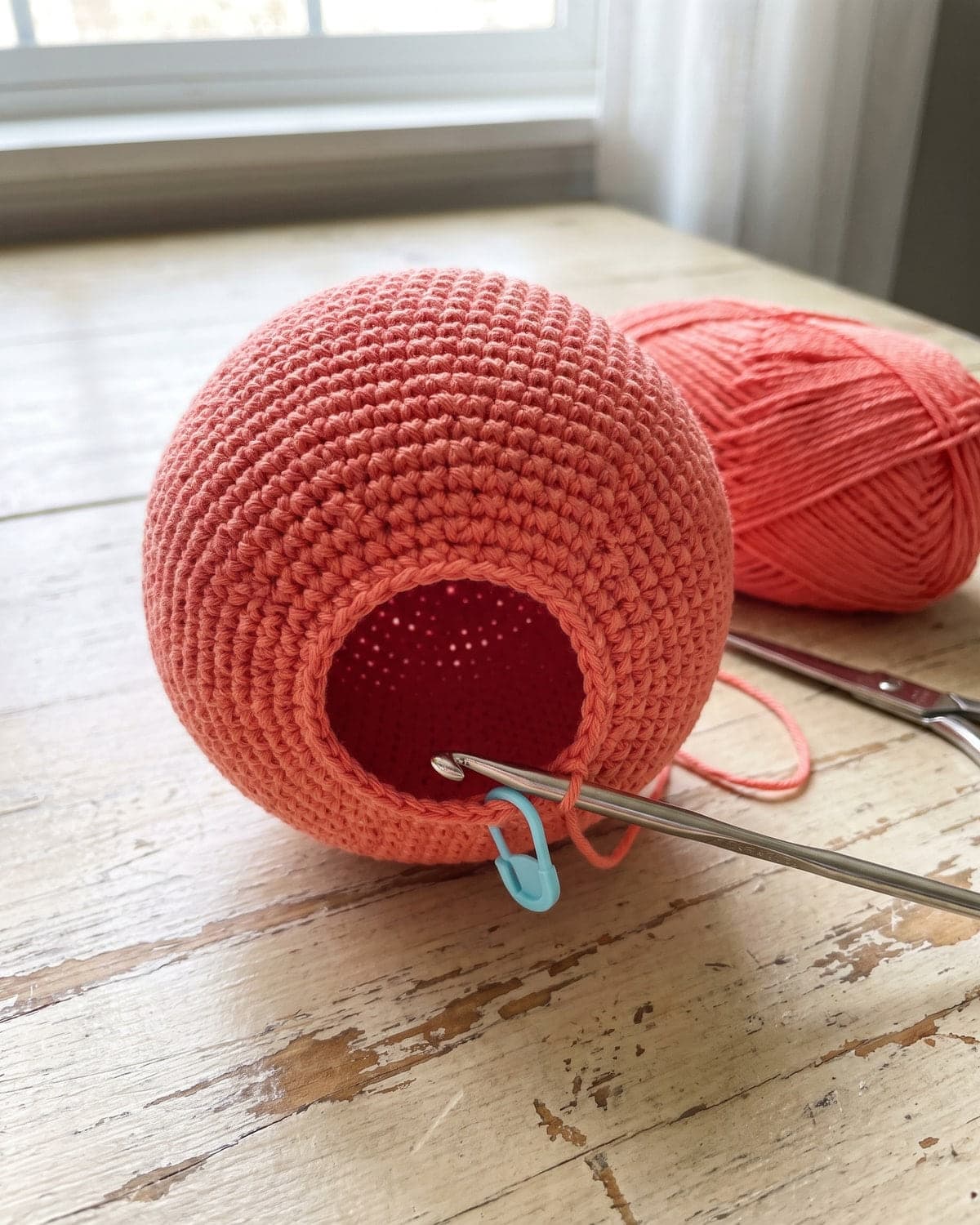 Eyes: if you're using safety eyes, fit them now. Place them between rounds 9 and 10, about six stitches apart. Push each post through the fabric and look at the face before you commit. Once the washer clicks on, it doesn't come off. Press the washers on firmly from the inside.
- R12: (3 sc, dec) × 6 (24)
- R13: (2 sc, dec) × 6 (18)
Stuff the head firmly now. Add the stuffing in small tufts and push it out to the sides, so the head is round and not lumpy.
- R14: (sc, dec) × 6 (12)
Add a last bit of stuffing.
- R15: dec × 6 (6)
Fasten off, leaving a tail of about 20 cm (8 in). Thread it onto your needle and pass it through the front loop of each of the six remaining stitches. Pull tight to close the hole, knot, and push the needle through the head to hide the end inside.
The closed end is the bottom of the octopus, where the tentacles attach. The magic ring is the top of its head.
Tentacles (make 8)
Each tentacle is a chain with two single crochets in every chain. The extra stitches force the strip to curl into a spiral.
- Chain 26.
- Row 1: work 2 sc in the 2nd chain from the hook, and 2 sc in each chain across (50 stitches).
Fasten off, leaving a tail of about 20 cm (8 in) for sewing.
As you work, the strip will start to twist. Help it along by turning it gently with your fingers in the direction it wants to go. If a tentacle curls unevenly, wind it around a pencil for a moment.
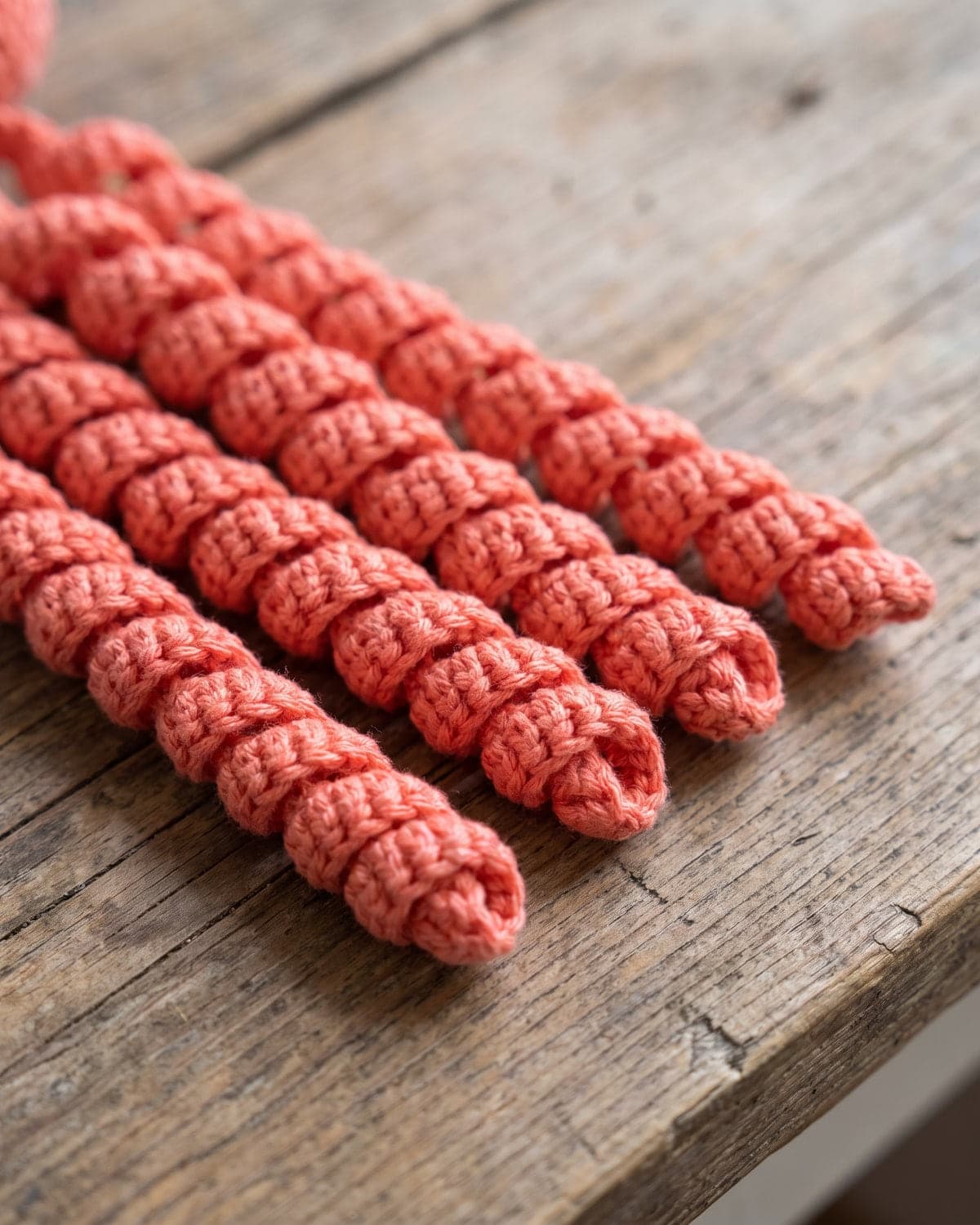 Two-colour tentacles: make the chain in a lighter colour, then change to the main colour for the row of single crochets. The lighter colour shows on the inside of the curl, like the underside of a real tentacle.
Assembly
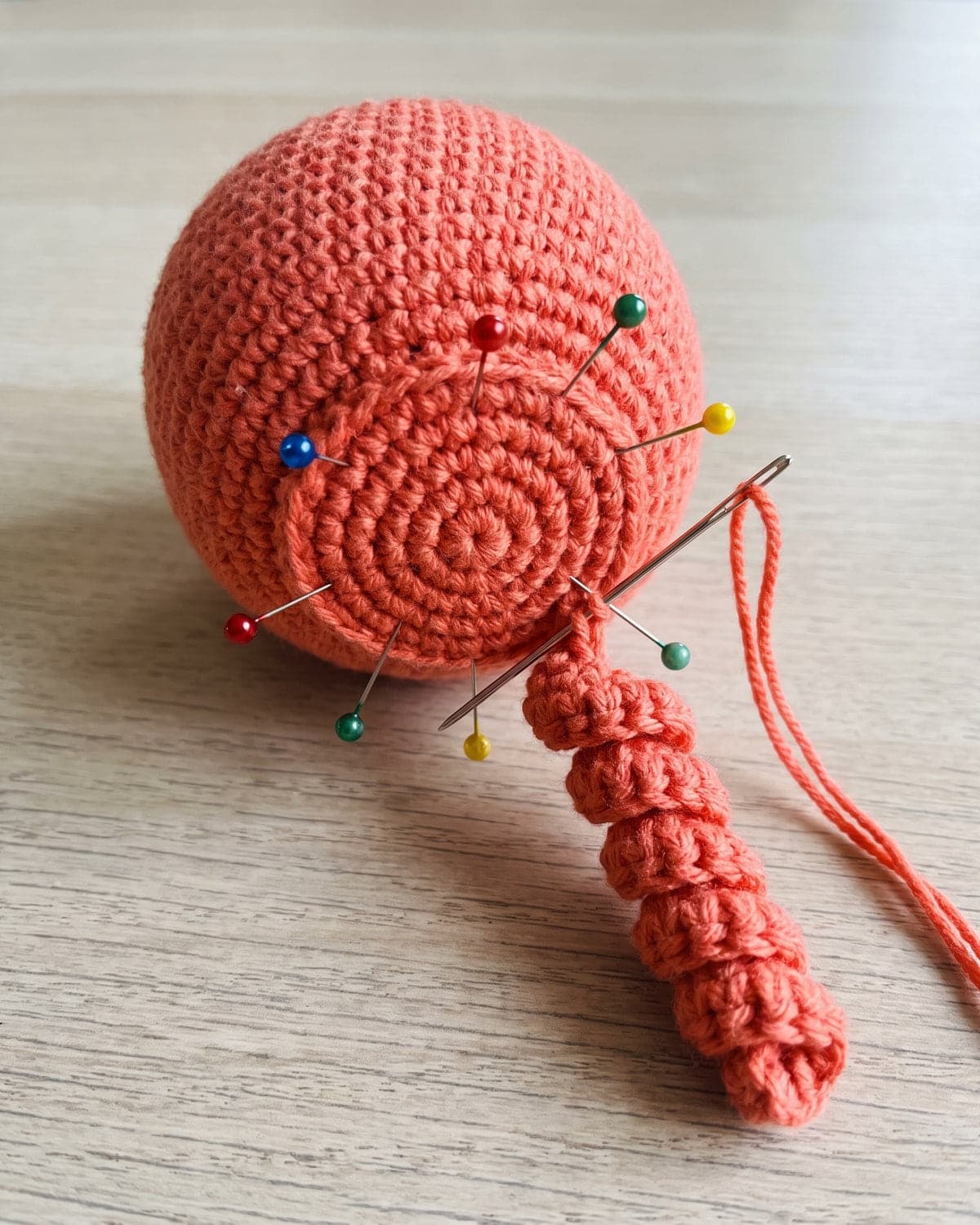
- Mark the positions. Turn the head upside down. The tentacles sit in a ring around the closed bottom, roughly on round 13. Put eight pins around that circle, evenly spaced: one at the front, one at the back, one at each side, and one between each of those.
- Sew on each tentacle. Thread the tail of a tentacle onto your needle. Stitch the top of the tentacle to the head at a pin, going through the head and back through the tentacle two or three times. Knot, and hide the end inside the head.
- Check the spacing after the first four, the front, back and sides, before filling in the gaps.
- Embroider the face if you like: a small V or curved line of black yarn between and just below the eyes makes a smile. Two short stitches of pink under each eye make cheeks.
 Stand the octopus up and arrange the curls. It should sit on its tentacles with its head upright.
Variations
Short tentacles
For a sturdier toy with shorter curls, chain 14 for each tentacle and work 2 sc in each chain (26 stitches). The octopus sits lower and the tentacles are much less likely to tangle.
Straight legs instead of curls
For a sitting octopus with stubby legs, make eight small tubes. Work 6 sc in a magic ring, then sc around for 6 rounds (6). Don't stuff. Flatten the open end and sew it to the head.
A bigger octopus
To make the head larger, keep increasing: R6: (4 sc, inc) × 6 (36). Then work 8 plain rounds. Decrease in the reverse order: (4 sc, dec) × 6 (30), (3 sc, dec) × 6 (24), (2 sc, dec) × 6 (18), stuff, (sc, dec) × 6 (12), dec × 6 (6). Make the tentacles longer to match, with a chain of 36.
You can also make everything bigger without changing a single number: use chunky yarn and a larger hook. Velvet or chenille yarn makes a very soft, plush octopus, though the stitches are harder to see.
A tiny octopus
Use fine cotton thread and a 2 mm hook with the same pattern for a keyring-sized octopus. Add a split ring to the top of the head with a few stitches.
Accessories
- A bow: chain 12, work one row of sc, pinch the middle and wrap yarn around it. Sew it to the top of the head or under the chin.
- A little hat: work rounds 1 to 3 of the head pattern, then two plain rounds, and sew it on at an angle.
- A flower: add a tiny bloom from easy crochet flowers beside one eye.
Choosing colours
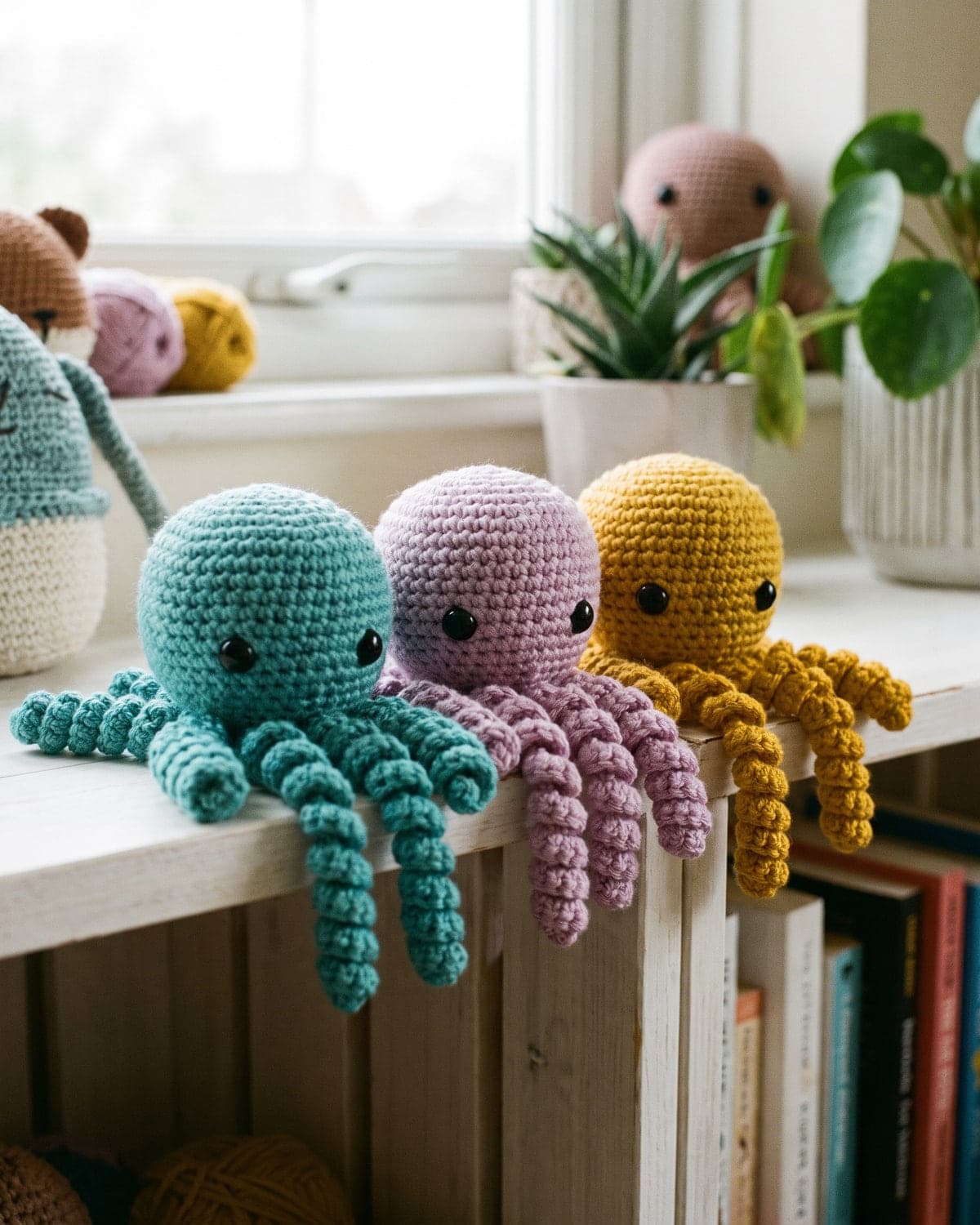
Octopuses come in every colour in real life, so there are no wrong answers.
- Classic: coral, orange or red.
- Ocean: teal, turquoise or navy with lighter undersides.
- Pastel: lilac, mint, pale pink or butter yellow.
- Rainbow: make each tentacle a different colour. It's a great way to use up scraps.
- Realistic: a variegated or speckled yarn in rusty browns.
Light colours show your stitches most clearly while you're learning. Very dark yarn makes it hard to see where the hook goes.
Tips for a neat finish
- Keep your stitches tight. If you can see stuffing through the fabric, go down a hook size.
- Count every round. Each increase round adds six stitches and each decrease round removes six.
- Use the invisible decrease. It leaves a much smoother surface than a standard decrease.
- Stuff more than you think. A firm head keeps its shape. A soft one dents.
- Work on the right side. The outside of the head should show neat Vs. If you see horizontal bars, the piece has turned inside out. Flip it.
- Pin before you sew. Eight tentacles spaced evenly look deliberate. Seven squeezed onto one side don't.
- Place the eyes low. Eyes set in the lower half of the head, fairly wide apart, look cuter than eyes placed high.
Common problems and fixes
My tentacles don't curl. Check that you worked two stitches into every chain. Working tightly also increases the curl. Twist the strip by hand to set it.
My tentacles curl in different directions. Each strip can spiral either way. Twist them all the same way by hand before you sew them on.
The head is pointed at the top. The magic ring wasn't pulled tight, or round 2 has too few stitches. Check for 12 after round 2.
The head is lumpy. The stuffing went in as one big piece. Pull it out and add it in small tufts.
There's a gap at the bottom. Thread the tail through the front loops of all six stitches and pull firmly. Then sew across the hole once.
The octopus tips over. Spread the tentacles evenly around the base. For a decoration, a few dried beans or plastic pellets in a small fabric pouch at the bottom of the head add weight. Don't use loose pellets in anything a child will handle.
The eyes are uneven. Count the stitches between the eyes, and check both are in the same round before fitting the washers.
Frequently asked questions
Is a crochet octopus easy for beginners? Yes. It's a ball and eight simple strips. If you can single crochet in the round, you can make it.
How long does it take to crochet an octopus? The head and eight tentacles are an evening's work for most people, including sewing.
How much yarn do I need? A small ball. The tentacles use more yarn than you'd expect, because every chain holds two stitches, so make sure you have enough of the main colour before you start.
What yarn is best? Smooth cotton or acrylic in DK or worsted weight. Cotton shows the stitches clearly and holds its shape.
Why do the tentacles curl? Working two stitches into each chain makes one edge of the strip longer than the other, so it's forced to spiral.
Is it safe for babies? Not as written. Long tentacles and plastic eyes aren't suitable for babies. See the safety note above.
Can I sell octopuses made from this pattern? Yes. You're welcome to sell what you make.
What to make next
The octopus teaches the three things every amigurumi needs: a tight spiral, even shaping and tidy assembly.
- For a toy with separate arms, legs and ears, try the bear in amigurumi for beginners.
- For a stuffed project with no shaping at all, make these easy crochet pumpkins.
- New to working in rounds? The easy crochet coasters are a flat, forgiving place to practise.
More toys and patterns are in the amigurumi section. The history of the craft is covered in Wikipedia's article on amigurumi.
Save it for later
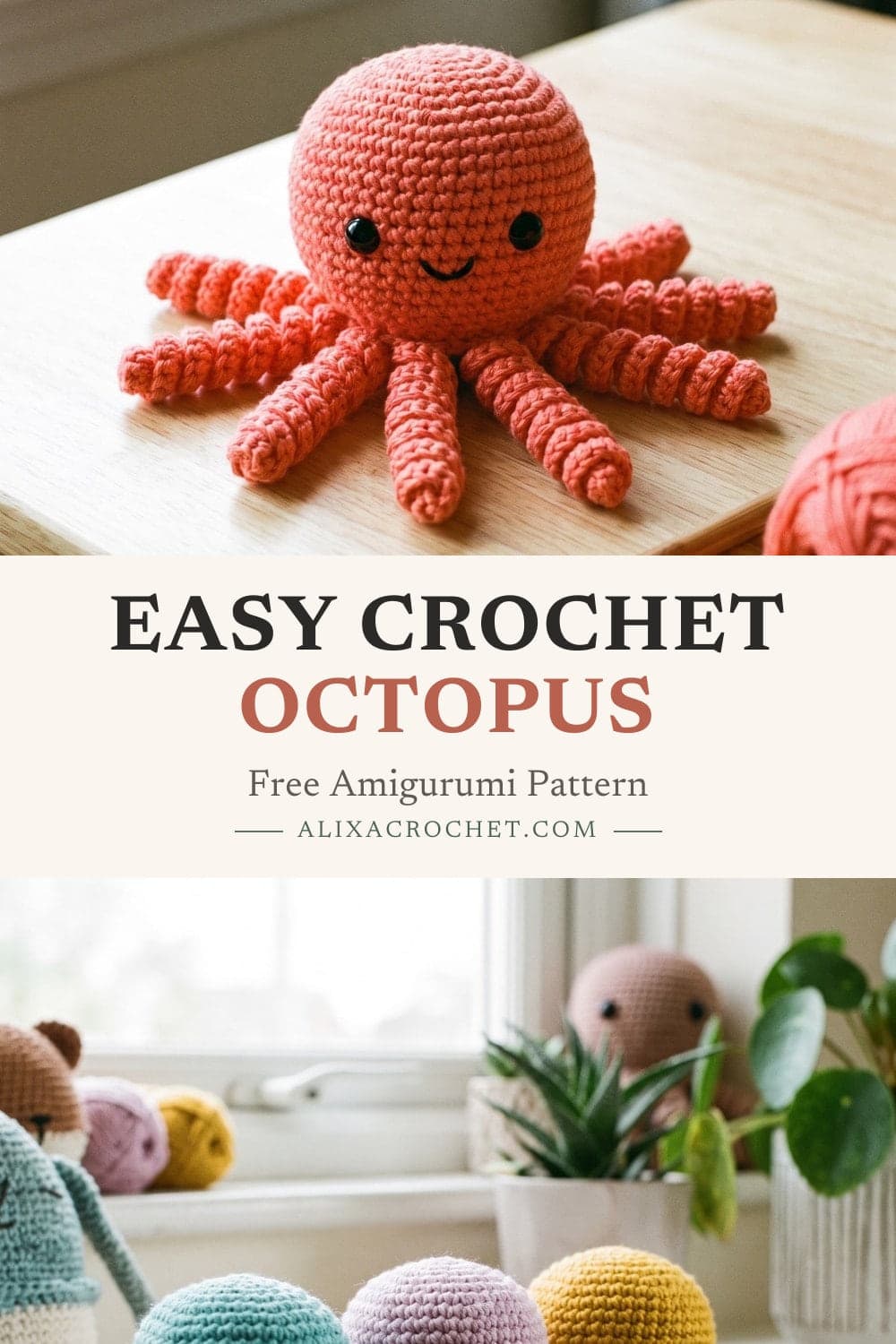
Pin this to your Pinterest board so it's there when you're ready to stitch.
Keep stitching
Related crochet projects
Seasonal Crochet Christmas Ornaments: 4 Easy Patterns for Beginners
12 min read
Flowers Easy Crochet Flowers: 4 Simple Patterns for Beginners
11 min read
Home decor Easy Crochet Coasters: Round and Square Patterns for Beginners
10 min read
Seasonal Easy Crochet Pumpkins: Beginner Pattern in Three Sizes
10 min read