How to Read Crochet Patterns: A Beginner's Guide
Crochet patterns look like code until you know the rules. Learn the abbreviations, what asterisks and brackets mean, how rows and rounds work, where the stitch count hides, and how gauge and sizes are written.
By AlixaPublished 12 min read
A crochet pattern can look like a secret code the first time you open one: Rnd 3: *Sc in next st, 2 sc in next st; rep from * around (18). It isn't a code. It's shorthand, and it follows the same few rules almost everywhere. Once you know the abbreviations, the punctuation and where the stitch count hides, you can follow nearly any beginner pattern.
This guide explains how to read crochet patterns one piece at a time: the information at the top, the abbreviations, brackets and asterisks, rows and rounds, stitch counts, gauge and sizes. It finishes with a real line of pattern translated into plain English.
Terms used here: US crochet terms. UK equivalents are given in the conversion table below.
The parts of a crochet pattern
Most written patterns have the same sections, in roughly this order. Read all of them before you pick up a hook.
- Skill level. Usually beginner, easy, intermediate or experienced. The Craft Yarn Council describes what each of its project levels involves.
- Finished size. The measurements of the completed item, sometimes for several sizes.
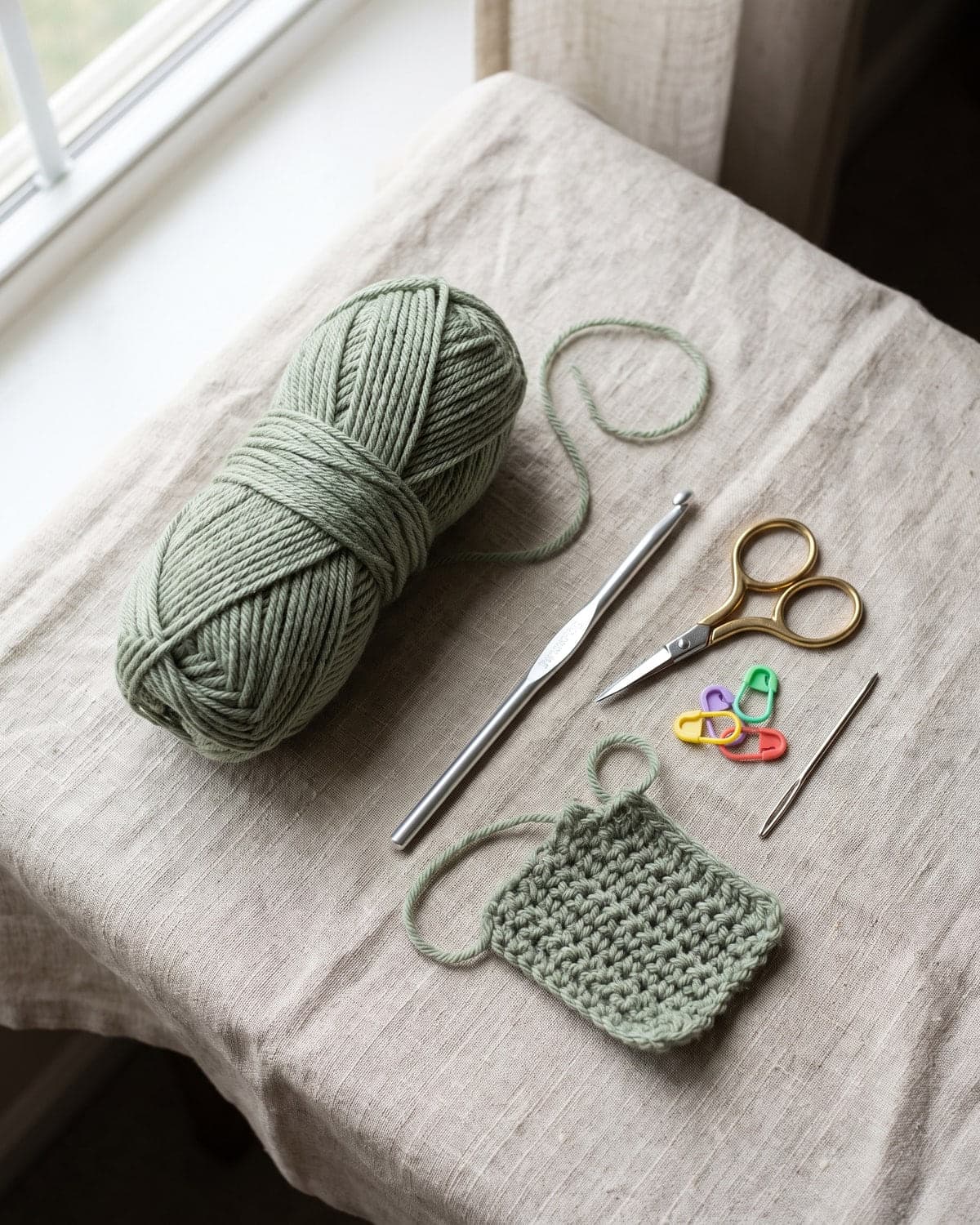
- Materials. Yarn weight, fibre and amount; hook size; and extras such as stitch markers, a tapestry needle, buttons or stuffing.
- Gauge. How many stitches and rows fit in a measured square. More on this below.
- Terms. Whether the pattern uses US or UK crochet terms. This matters more than anything else on the page.
- Abbreviations. A list of the shorthand used.
- Special stitches. Instructions for any stitch that isn't one of the basics.
- Pattern notes. Rules for the whole pattern, such as "the turning chain does not count as a stitch". Beginners often skip these, and they answer most questions before you have them.
- Instructions. The row-by-row or round-by-round steps.
- Finishing. Seaming, blocking and weaving in ends.
US or UK terms: check this first
The same stitch has different names in US and UK patterns, and the name "double crochet" refers to two different stitches. Follow a UK pattern with US stitches and everything comes out too tall.
| US term | UK term |
|---|---|
| slip stitch (sl st) | slip stitch (ss) |
| single crochet (sc) | double crochet (dc) |
| half double crochet (hdc) | half treble (htr) |
| double crochet (dc) | treble (tr) |
| treble crochet (tr) | double treble (dtr) |
| skip | miss |
| gauge | tension |
If the pattern doesn't say which it uses, look for clues. The words single crochet or half double crochet only exist in US terms. The words half treble or miss point to UK terms.
Common crochet abbreviations
These cover most beginner patterns.
| Abbreviation | Meaning |
|---|---|
| ch | chain |
| sl st | slip stitch |
| sc | single crochet |
| hdc | half double crochet |
| dc | double crochet |
| tr | treble crochet |
| st(s) | stitch(es) |
| sp | space |
| ch-sp | chain space |
| sk | skip |
| yo | yarn over |
| inc | increase (two stitches in one stitch) |
| dec | decrease (two stitches joined into one) |
| sc2tog | single crochet two together (a decrease) |
| BLO / FLO | back loop only / front loop only |
| RS / WS | right side / wrong side |
| rep | repeat |
| rnd | round |
| beg | beginning |
| prev | previous |
| tog | together |
| MR | magic ring |
The Craft Yarn Council's master list of crochet abbreviations has the rest. If you need a refresher on how the stitches themselves are made, see easy crochet stitches for beginners.
How to read the punctuation
The symbols in a pattern do as much work as the words.
Commas separate steps
Ch 1, turn, sc in each st across is three steps: chain one, turn your work, then single crochet in every stitch.
Asterisks mark a repeat
*Sc in next st, ch 1, sk 1 st; rep from * across means: work everything after the asterisk, then go back to the asterisk and do it again, and keep going until you reach the end of the row.
Sometimes a pattern says rep from * 3 more times. That means four times in total: the first time you worked it, plus three more.
Two asterisks, * … **, mark a section that ends early on the last repeat: rep from * around, ending last rep at **.
Parentheses group stitches
Parentheses have three jobs, and the context tells you which.
- Stitches worked into the same place:
(2 dc, ch 2, 2 dc) in next ch-spmeans all of those stitches go into that one space. This is how corners and shells are made. - A group to repeat:
(sc in next st, inc) 6 timesmeans do the bracketed part six times. - Extra information:
(18)or(18 sts)at the end of a line is the stitch count.(counts as first dc)is a note.
Square brackets
Square brackets work like parentheses, and are used when one group sits inside another: [sc in next 2 sts, (sc, ch 2, sc) in corner] 4 times.
"In next st" and "in each st"
Small words carry a lot of meaning:
sc in next stis one stitch.sc in next 3 stsis three stitches, one in each of the next three.3 sc in next stis three stitches all in the same stitch, which is an increase.sc in each st acrossmeans one in every stitch to the end of the row.
Mixing up sc in next 3 sts and 3 sc in next st is one of the most common beginner mistakes, and it changes your stitch count straight away.
Rows and rounds
Rows go back and forth. At the end of each row you turn the work and chain up to the height of the next row. That chain is the turning chain: one chain for single crochet, two for half double, three for double, four for treble.
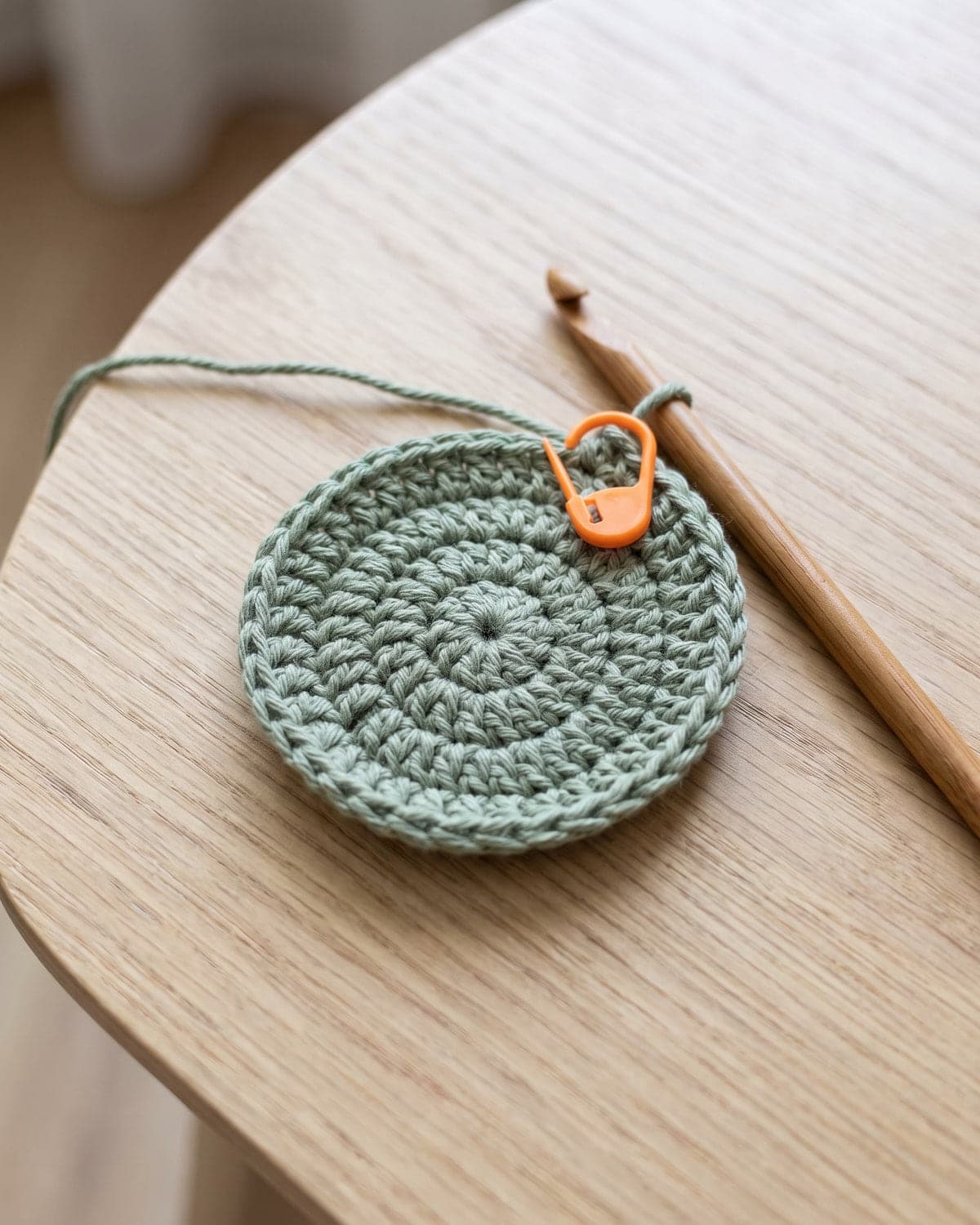
Rounds go in a circle, usually without turning. They're either joined (each round ends with a slip stitch into its first stitch) or worked in a continuous spiral (no join; you use a stitch marker to see where the round starts). Hats, coasters and baskets are usually joined. Amigurumi is usually a spiral.
Does the turning chain count as a stitch?
This single detail causes more wonky edges than anything else, so patterns normally state it in the notes.
- If the chain counts as a stitch, skip the first stitch at its base, and work the last stitch of the next row into the top of that chain.
- If it doesn't count, work your first stitch into the very first stitch, and don't work into the chain at the end of the next row.
When the pattern says nothing, the usual convention is that chain 1 for single crochet doesn't count and chain 3 for double crochet does.
The stitch count is your safety net
The number in brackets at the end of a line is how many stitches you should have when that row or round is finished.
Row 4: Ch 1, turn, sc in each st across (20)
Count after every row until the pattern feels familiar. If the number is wrong, the mistake is in the row you just made, and that's far easier to fix now than twelve rows later.
 Tips for counting:
- Count the Vs along the top edge. Each V is one stitch.
- Don't count the loop on your hook.
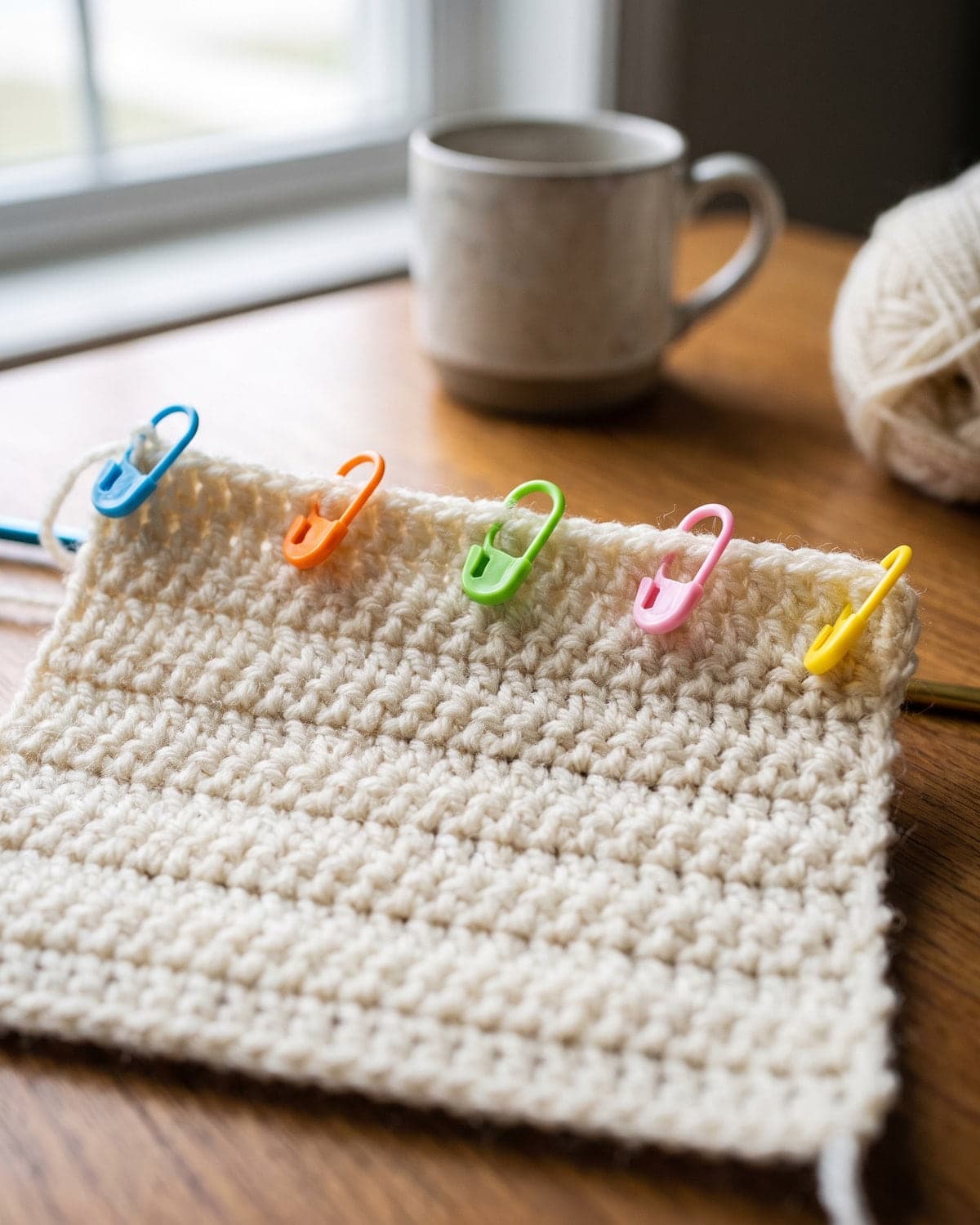
- Use stitch markers every 10 or 20 stitches on long rows.
- In rounds, put a marker in the first stitch and move it up each round.
Gauge and why patterns include it
Gauge (called tension in UK patterns) is the number of stitches and rows in a measured area, written like this:
Gauge: 14 sc and 16 rows = 4 in (10 cm) with a 5 mm hook
It tells you how tightly the designer crocheted. If your stitches are tighter, your project comes out smaller. If they're looser, it comes out bigger and uses more yarn.
To check it: crochet a swatch a little larger than 10 cm (4 in) in the stated stitch. Lay it flat and count the stitches and rows across 10 cm in the middle.
- Too many stitches? Your work is tight. Try a larger hook.
- Too few stitches? Your work is loose. Try a smaller hook.
Gauge matters for anything that has to fit, such as hats, garments and slippers. For dishcloths, scarves and most blankets you can relax about it. The easy crochet cardigan for beginners shows gauge being used for real, turning a swatch into stitch counts.
Patterns with more than one size
Sized patterns give the numbers for every size in one line, with the smallest first and the others in brackets:
Ch 61 (67, 73, 79)
If you're making the second size, you use the first number inside the brackets: 67. It helps to go through the pattern before you start and highlight or circle your size every time it appears. When only one number is given, it applies to all sizes.
Yarn and hook information
The materials list tells you the yarn's weight category, usually with a number from 0 (lace) to 7 (jumbo). The Craft Yarn Council's standard yarn weight system shows what each number means and which hook sizes suit it.
If you substitute a different yarn:
- Match the weight category first.
- Compare metres or yards per ball, not just the number of balls, because ball sizes differ.
- Think about fibre: cotton behaves very differently from wool or acrylic.
- Always make a gauge swatch for fitted projects.
Hook sizes may be given in millimetres, US letters and numbers, or both. Millimetres are the reliable measurement. The Council's hook size chart converts between systems.
A pattern line, translated
Here are a few lines from a simple flat circle, with a translation.
Rnd 1: Make a MR, ch 1, 6 sc in ring, sl st to first sc to join (6)
Make a magic ring. Chain one. Work six single crochets into the ring. Close the ring, then slip stitch into the first single crochet to join the round. You have six stitches.
Rnd 2: Ch 1, 2 sc in each st around, join (12)
Chain one. Put two single crochets into every stitch. Join with a slip stitch. You have twelve stitches.
Rnd 3: Ch 1, *sc in next st, 2 sc in next st; rep from * around, join (18)
Chain one. Single crochet in the next stitch, then put two single crochets in the stitch after that. Repeat that pair of actions all the way around. Join. You have eighteen stitches.
Notice the rhythm: each round adds six stitches, and the count at the end confirms it. That's the pattern checking your work for you. If you'd like to try a circle like this, the easy crochet coasters are a good first project in rounds.
What about crochet charts?
Some patterns come with a symbol chart, a diagram in which each stitch is drawn as a symbol.
- An oval or small circle is a chain.
- A dot or filled oval is a slip stitch.
- A plus sign or X is a single crochet.
- A T is a half double crochet.
- A T with one slash through its stem is a double crochet.
- A T with two slashes is a treble crochet.
Charts for rows are read from the bottom up: right-side rows from right to left, wrong-side rows from left to right. Charts for rounds are read from the centre outwards, anticlockwise. Left-handed crocheters read each row in the opposite direction.
Charts show at a glance where every stitch goes, which makes them especially good for lace, motifs and granny squares. Many people use the written pattern and the chart together.
Habits that make any pattern easier
- Read the whole pattern first. You'll spot unfamiliar stitches before you're in the middle of a row.
- Read one comma at a time. Don't try to hold a whole line in your head. Do the step, then read the next.
- Keep your place. Use a sticky note, a row counter, or tick each row off with a pencil.
- Mark your repeats. Put a stitch marker at the start of each repeat on long rows.
- Count. Every row at first, then every few rows.
- Trust the stitch count over your memory. If the number is right, you're fine.
- Check for corrections. Designers often publish corrections, called errata, on their websites.
- Practise on something small. A coaster or a flower lets you finish a whole pattern in one sitting.
Common problems and what they mean
My stitch count is one short. You probably missed the last stitch of the row, or the stitch into the turning chain.
My stitch count is one over. You may have worked into the base of a turning chain that counts as a stitch.
The repeat doesn't fit at the end of the row. Check that the foundation chain was the right multiple. Stitch patterns often say "chain a multiple of 6, plus 2": any number that divides by six, with two added.
The pattern says "turn" but I'm working in rounds. Some rounds are turned on purpose, to keep a seam straight or a texture even. Follow it.
I don't know a stitch. Look in the special stitches section first. Then search for that stitch's name together with "US terms" or "UK terms".
My piece is the wrong size. That's gauge. Change your hook size, not the pattern.
Frequently asked questions
Are crochet patterns hard to read? They look hard because they're abbreviated. After two or three small projects the shorthand becomes automatic.
What does an asterisk mean in a crochet pattern?
It marks the start of a section to repeat. Rep from * sends you back to it.
What do the numbers in brackets at the end of a row mean? They're the stitch count: how many stitches you should have when the row is done.
What does "sc in next 3 sts" mean? One single crochet in each of the next three stitches. It isn't the same as "3 sc in next st", which puts three in one stitch.
What does "ch 3 counts as dc" mean? The three chains at the start of the row stand in for the first double crochet. Skip the stitch at their base, and work into the top of the chain at the end of the next row.
How do I know if a pattern is in US or UK terms? It should say so. If it doesn't, "single crochet" means US terms.
Start with an easy pattern
The fastest way to learn to read patterns is to follow one. Pick something short, read the notes, and count as you go.
- Easy crochet flowers: four tiny patterns, each a few lines long.
- Easy crochet coasters: rounds, joins and a stitch count that grows by the same number each time.
- Chunky crochet blanket for beginners: one row repeated, with pattern notes that matter.
If you haven't crocheted before, begin with how to crochet for beginners. More step-by-step lessons are in the beginner tutorials section.
Save it for later
Pin this to your Pinterest board so it's there when you're ready to stitch.
Keep stitching
Related crochet projects
Beginner tutorials How to Crochet for Beginners: A Step-by-Step Guide
11 min read
Crochet stitches Textured Crochet Stitches: 5 Easy Patterns for Beginners
11 min read
Crochet stitches Easy Crochet Stitches for Beginners: 6 Basics to Learn First
10 min read
Clothing Easy Crochet Tote Bag for Beginners: One-Piece Pattern
11 min read