Easy Ripple Crochet Blanket: Free Chevron Pattern for Beginners
Crochet a classic ripple (chevron) blanket with a simple 14-stitch repeat. Three sizes, starting chains, how peaks and valleys work, stripes, weaving in ends and fixes for wonky edges.
By AlixaPublished 10 min read
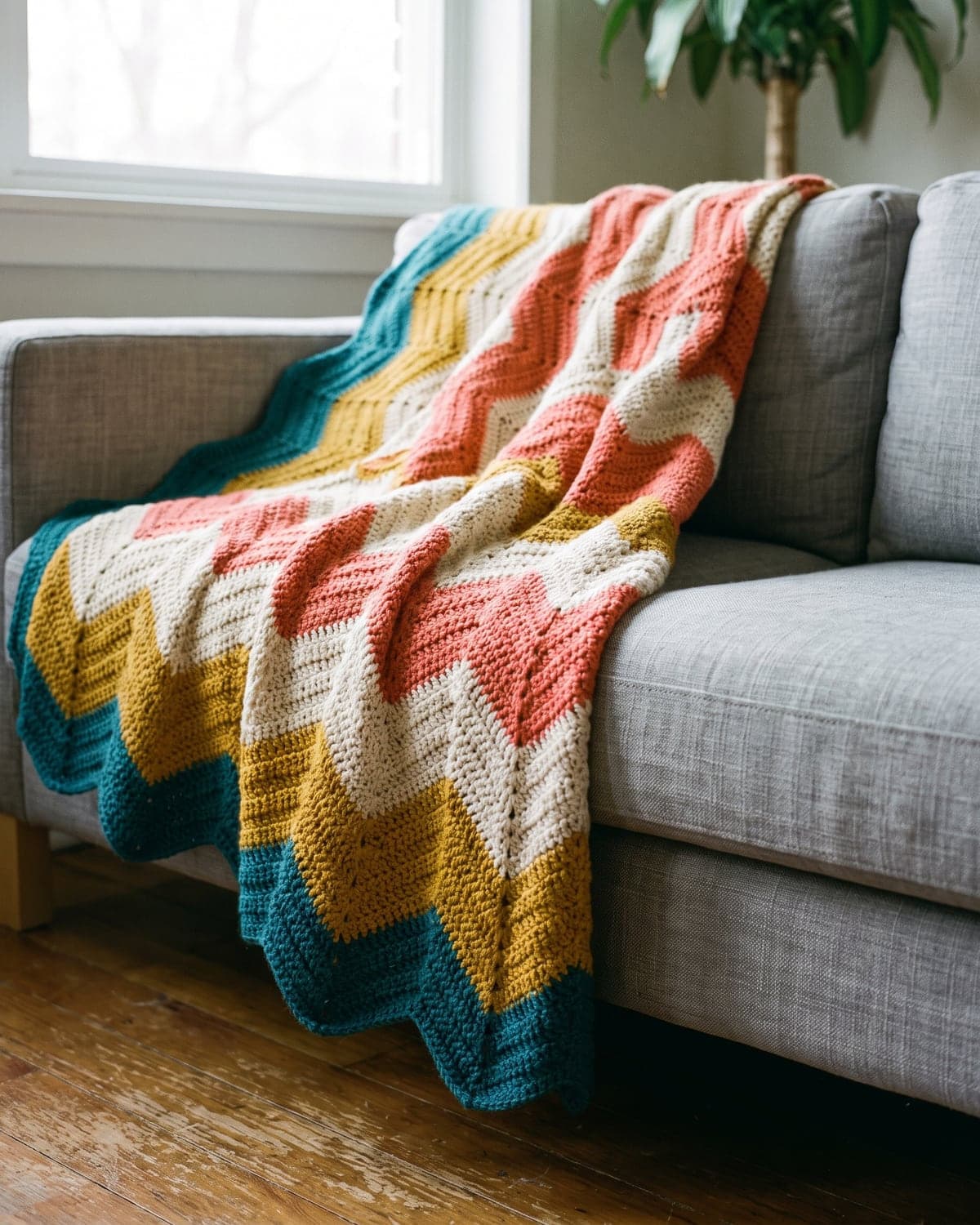
A ripple blanket, also called a chevron blanket, is the striped zigzag afghan that so many people remember from a grandparent's sofa. It looks clever, but it's made entirely of double crochet. The waves come from a simple trick: you add stitches at the peaks and take the same number away in the valleys. The stitch count never changes, and the fabric has nowhere to go but up and down.
This guide gives you a classic 14-stitch ripple in three sizes, explains exactly how each peak and valley is made, and covers stripes, weaving in ends and the mistakes that make a ripple drift.
Terms used here: US crochet terms. Double crochet (dc) is called treble crochet (tr) in UK terms.
About this pattern: it's a traditional ripple, written out for this guide. The stitch counts have been checked so that each row adds up. Sizes and yarn amounts are estimates. Make a swatch before you buy yarn for a large blanket.
At a glance
| Skill level | Confident beginner |
| Stitches | Chain, double crochet, double crochet two together (dc2tog) |
| Yarn | Worsted weight (weight 4) |
| Hook | 5.5 mm (US I-9) |
| Pattern repeat | 14 stitches, one row |
| Sizes | Baby 80 × 90 cm, throw 110 × 150 cm, large 135 × 180 cm |
What you need
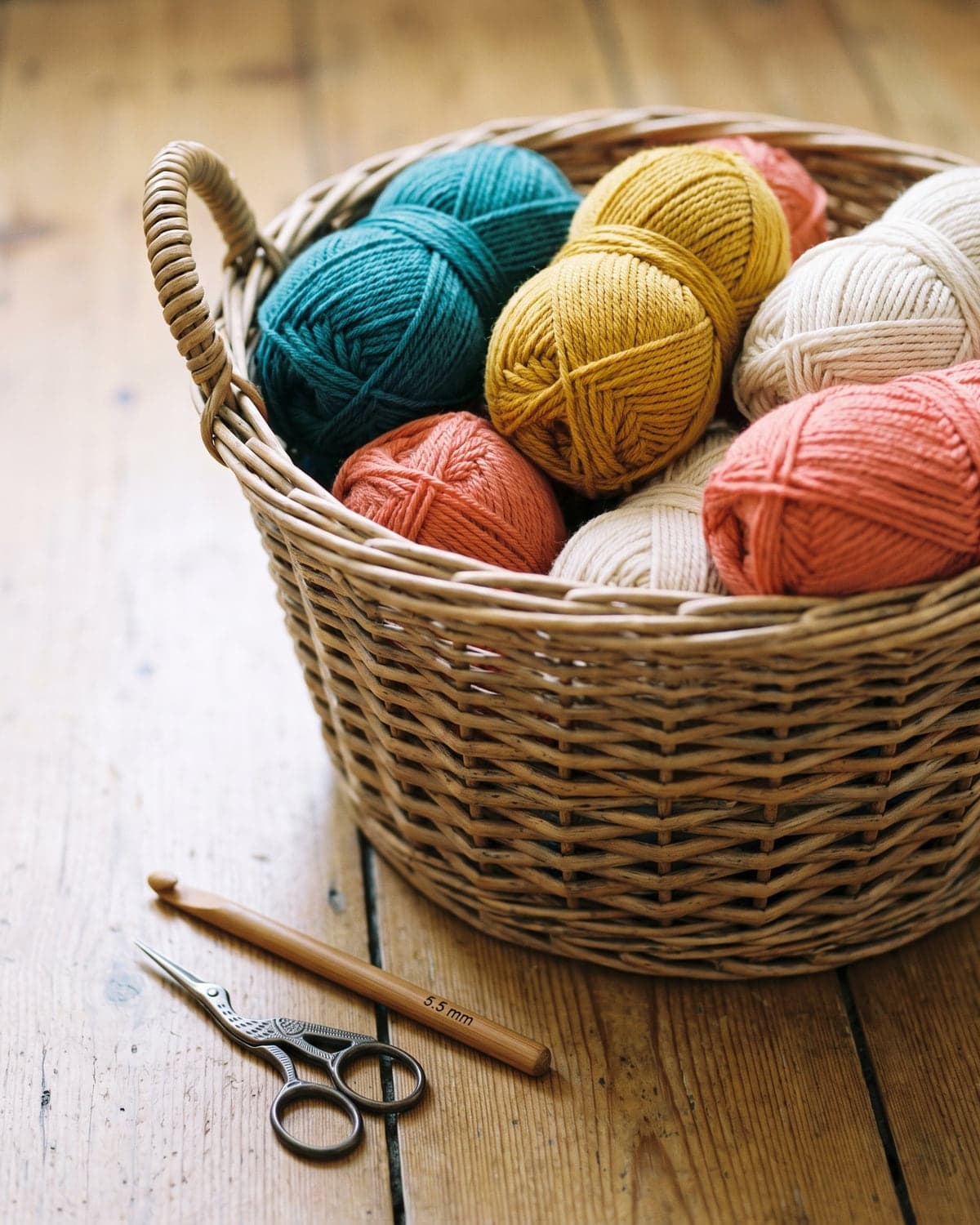
- Worsted weight yarn in two to five colours. Soft acrylic is the usual choice for a blanket that will be used and washed.
- A 5.5 mm (US I-9) hook.
- Stitch markers. One for each peak is a great help on the first few rows.
- Scissors, a tapestry needle and a tape measure.
Sizes, starting chains and yarn
One repeat of 14 stitches is roughly 9 cm (3.5 in) wide in worsted yarn with a 5.5 mm hook.
| Size | Finished size (approx.) | Repeats | Starting chain | Rows (approx.) | Yarn in total (estimate) |
|---|---|---|---|---|---|
| Baby | 80 × 90 cm (32 × 36 in) | 9 | 129 | 56 | 800 m (875 yd) |
| Throw | 110 × 150 cm (43 × 59 in) | 12 | 171 | 94 | 1,700 m (1,860 yd) |
| Large | 135 × 180 cm (53 × 71 in) | 15 | 213 | 112 | 2,500 m (2,730 yd) |
Divide the total by the number of colours you're using, and round up. Ripples use a little more yarn than plain rows of the same size.
For any other width: chain a multiple of 14, plus 3.
The two shaping stitches
Increase: 2 dc in one stitch
Work a double crochet, then work another into the same stitch. Two increases side by side make a peak.
Decrease: dc2tog
This joins two stitches into one.
- Yarn over, insert the hook into the next stitch, yarn over and pull up a loop. Yarn over and pull through two loops. Two loops are left on the hook.
- Yarn over, insert the hook into the following stitch, yarn over and pull up a loop. Yarn over and pull through two loops. Three loops are left on the hook.
- Yarn over and pull through all three loops.
Two decreases side by side make a valley.
If double crochet itself is new, practise with easy crochet stitches for beginners first.
How the repeat works
Every row is made of this 14-stitch sequence:
2 dc in the next stitch, dc in each of the next 4 stitches, dc2tog twice, dc in each of the next 4 stitches, 2 dc in the next stitch.
Count what happens. You use up 14 stitches: 1 + 4 + 4 + 4 + 1. You make 14 stitches: 2 + 4 + 2 + 4 + 2. Nothing is gained or lost.
Each repeat starts and ends with an increase. Where one repeat ends and the next begins, the two increases sit next to each other and form a peak. The two decreases in the middle form the valley. At the sides of the blanket there's a single increase, which is half a peak, so the edges stay straight.
Once the first row is in place, you don't really need to count. Increases go on top of increases, and decreases go on top of decreases. The peaks and valleys tell you where you are.
Ripple blanket pattern
Foundation
Chain the number for your size: 129, 171 or 213. Make the chain loosely. On a long chain, put a stitch marker every 20 chains so you only ever have to recount a short stretch.
Row 1
- Double crochet in the 4th chain from the hook. The skipped chains count as a double crochet, and together these two stitches are your first increase.
- Dc in each of the next 4 chains.
- Dc2tog twice, over the next 4 chains.
- Dc in each of the next 4 chains.
- 2 dc in the next chain.
That's the first repeat. Now work the full repeat to the end of the chain:
- 2 dc in the next chain, dc in each of the next 4 chains, dc2tog twice, dc in each of the next 4 chains, 2 dc in the next chain.
The row ends with 2 dc in the last chain. You should have 14 stitches for each repeat: 126, 168 or 210 in total. The row will already be zigzagging.
Row 2
- Chain 3 and turn. This counts as the first double crochet.
- Dc in the first stitch, the one at the base of the chain. That's your increase.
- Dc in each of the next 4 stitches, dc2tog twice, dc in each of the next 4 stitches, 2 dc in the next stitch.
- Work the full repeat across: 2 dc in the next stitch, dc in each of the next 4, dc2tog twice, dc in each of the next 4, 2 dc in the next stitch.
- The final 2 dc go into the top of the turning chain from the row below.
Every row after that
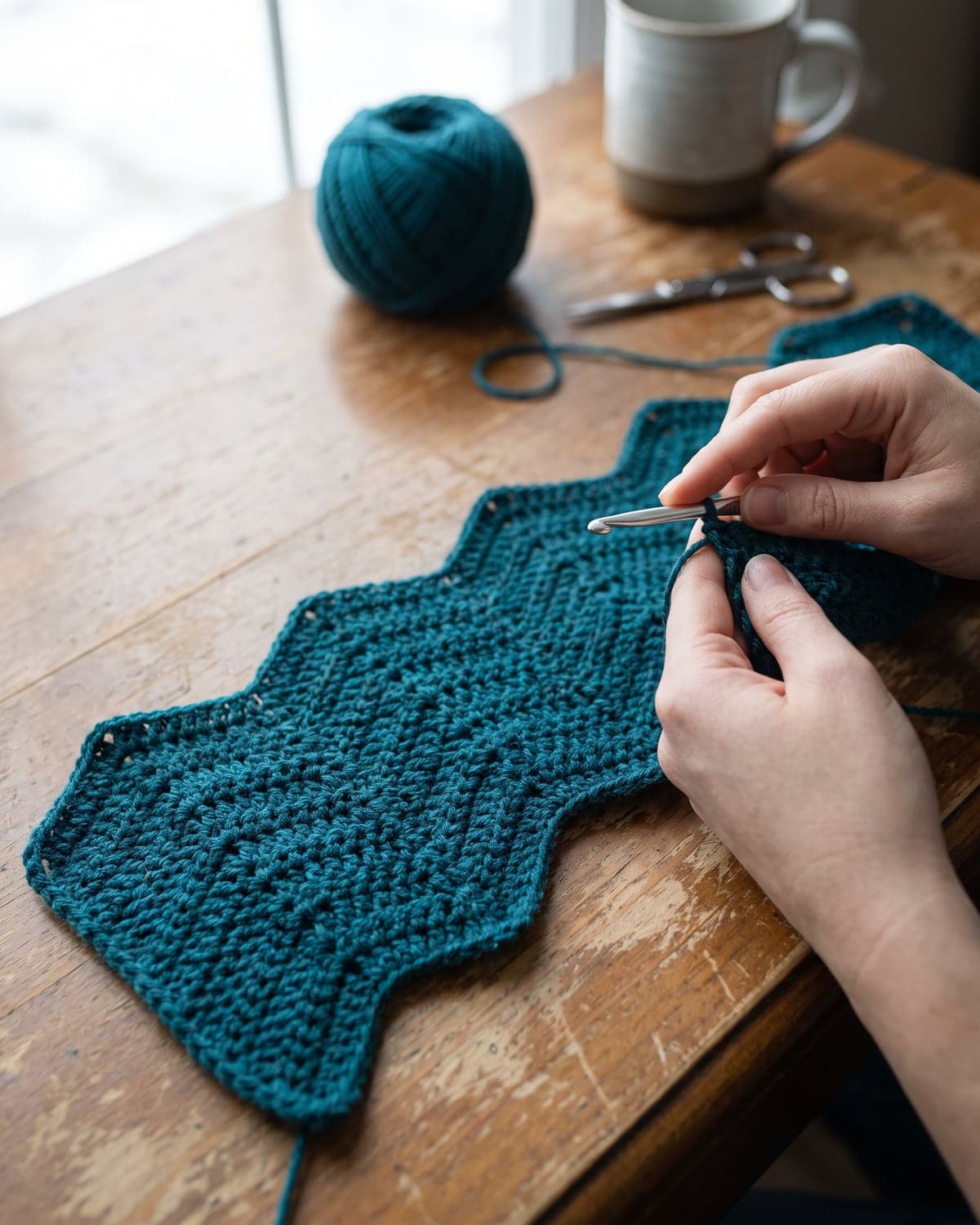
Repeat row 2. After three or four rows the peaks and valleys are obvious, and the blanket becomes relaxing, rhythmic work.
Checking your work
At the end of each row for the first ten rows, check three things:
- The row starts and ends with an increase.
- There are 4 plain stitches on each slope, between a peak and a valley.
- The valleys line up above the valleys below.
If a slope has 3 or 5 stitches, the mistake is right there. Fix it now. An error in a ripple travels sideways with every row.
Stripes and colour changes
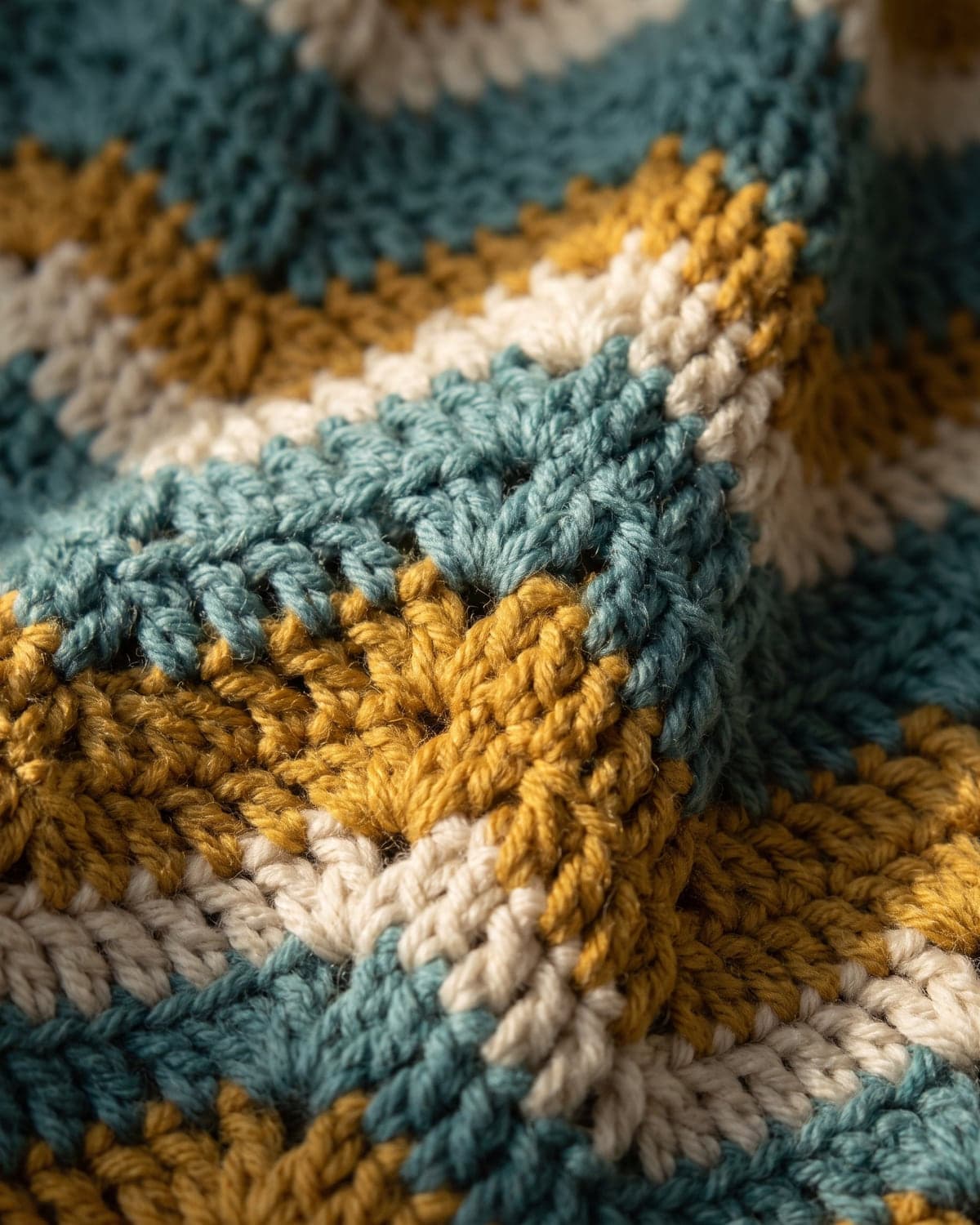
Stripes are what make a ripple. Each colour change shows up as a clean zigzag line.
How to change colour
Work the last double crochet of the row until two loops are left on the hook. Drop the old colour and pull the new one through both loops. Chain 3 with the new colour, turn, and carry on.
How many rows per stripe?
- Two rows is the classic. Both colour changes happen at the same edge.
- One row gives thin, lively stripes. You'll have ends on both edges.
- Four rows or more gives broad bands and fewer ends.
- Random widths suit a scrap blanket. Keep to one yarn weight.
Carrying yarn up the side
With two colours in two-row stripes, you don't need to cut. The colour you need is waiting at the edge. Lift it loosely up the side and keep going. With three or more colours, the carried strands get long, so it's neater to cut and weave in.
Colour ideas
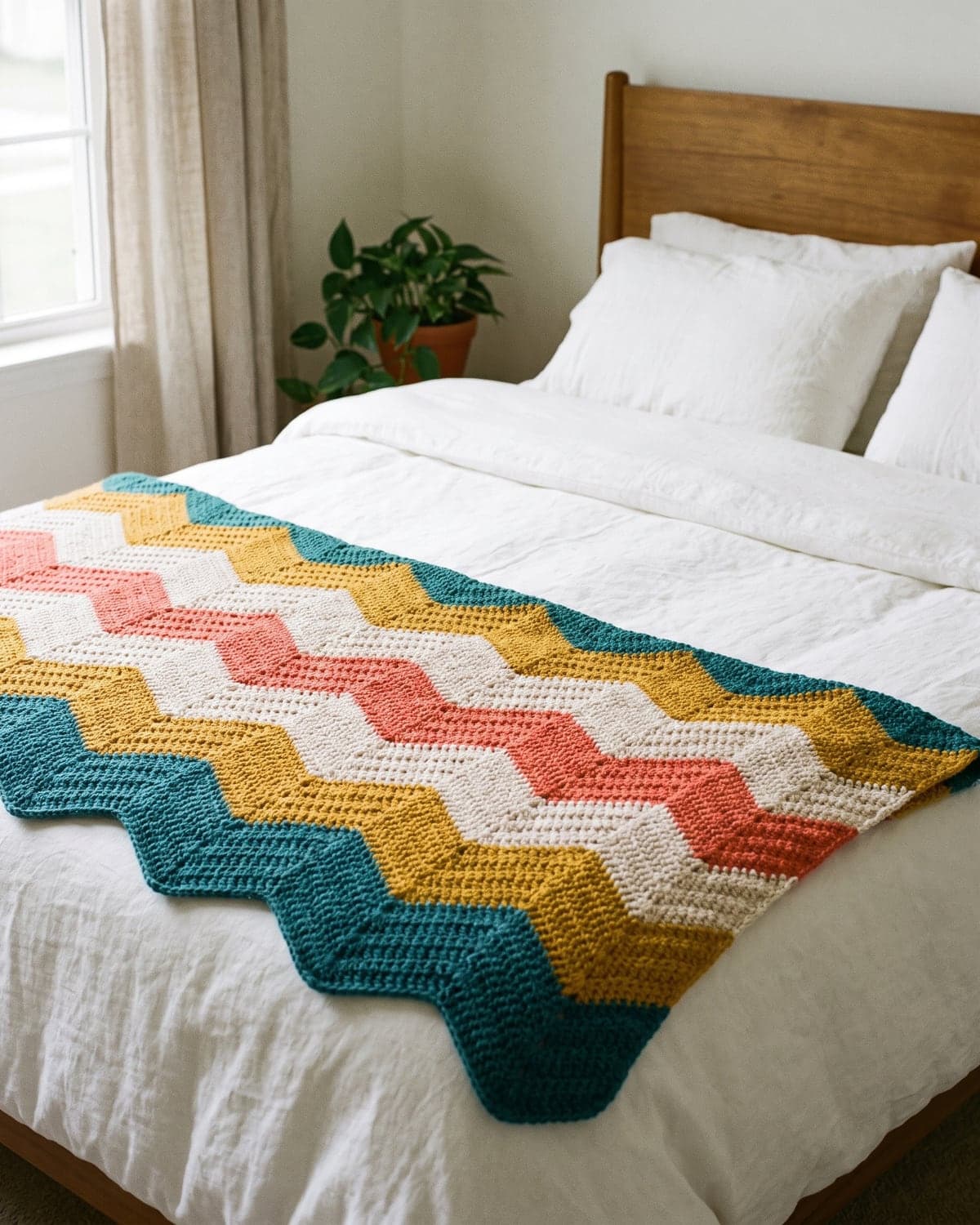
- Retro: teal, mustard, cream and coral, as shown here.
- Ocean: navy, three blues and white.
- Neutral: cream, oat, grey and charcoal.
- Baby: white alternated with one soft colour.
- Rainbow: two rows of each colour, repeated in order.
Weaving in the ends
A striped blanket has a lot of tails. Dealing with them as you go is far less painful than facing eighty at the end.
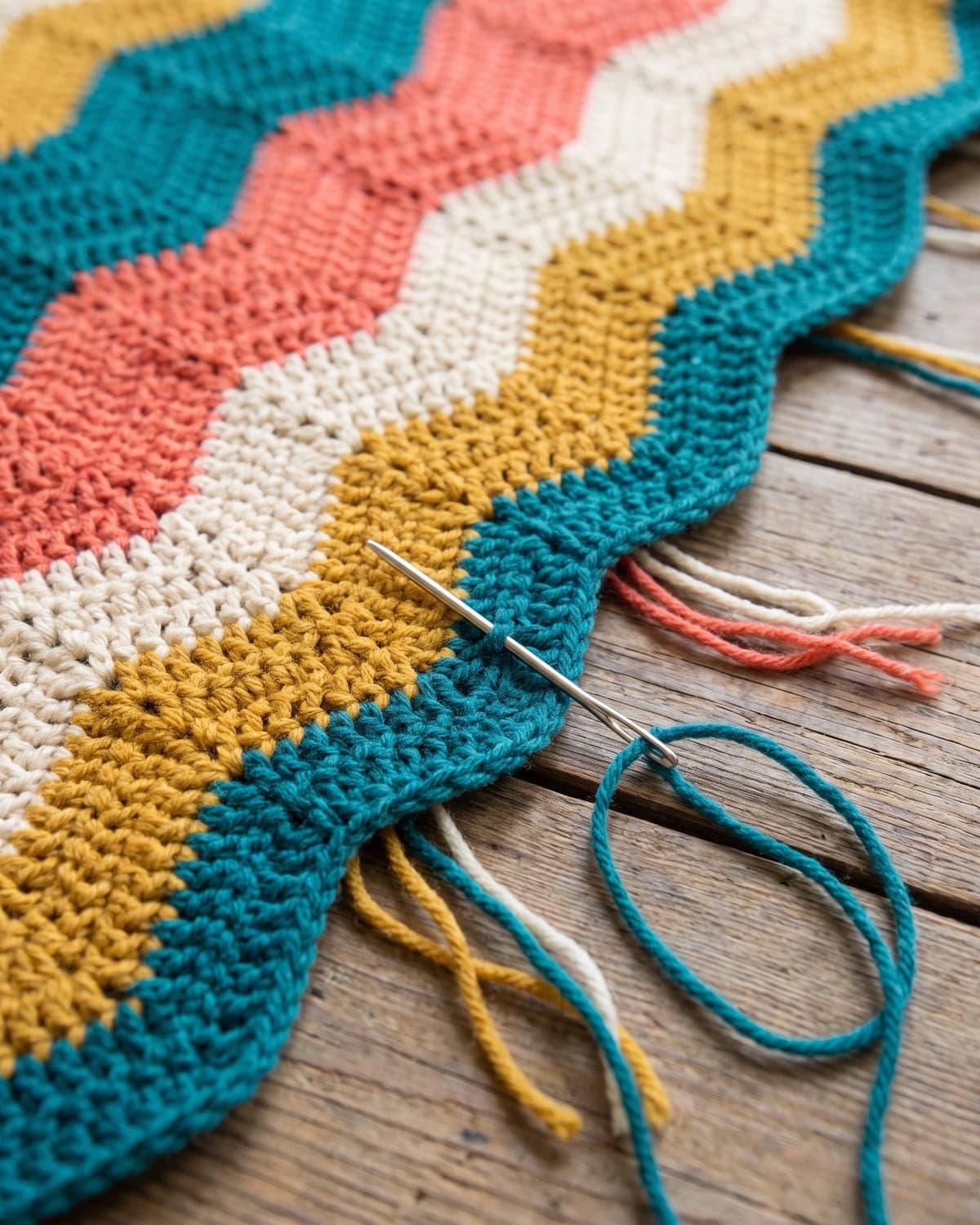
- Leave tails of 15 cm (6 in). Shorter tails are hard to sew in and work loose.
- Crochet over them where you can. Lay both tails along the top of the row and work the first eight or ten stitches of the new row around them.
- Then sew. Thread what's left onto a tapestry needle. Run it through the base of several stitches of the same colour, turn, and go back through three or four. The change of direction locks it.
- Do a few every time you sit down. Five minutes at the start of each session keeps the pile from building.
Finishing the blanket
Ripple blankets traditionally have no border. The zigzag top and bottom are the decoration, and the sides are straight.
If you'd like a neater side edge, work one row of single crochet along each long side: 2 single crochets around each row-end stitch. Use one of your stripe colours.
A light steam, with the iron held above the fabric and never touching acrylic, relaxes the stitches and sharpens the points.
Variations
Narrower or wider waves
Change the number of plain stitches on each slope. With 3 stitches on each slope, the repeat is 12 stitches: 2 dc in the next stitch, dc in each of the next 3 stitches, dc2tog twice, dc in each of the next 3 stitches, 2 dc in the next stitch. Chain a multiple of 12, plus 3. With 6 stitches on each slope, the repeat is 18 stitches and the waves are long and lazy. Chain a multiple of 18, plus 3.
Sharp points
Some patterns work 3 dc into one stitch at each peak and join three stitches together in each valley. The points are crisper, with a small hole at each peak. The edges are handled differently, so follow a pattern written for that version.
Single crochet ripple
The same idea in single crochet gives a thick, dense blanket with very neat stripes. It uses much more yarn and takes far longer.
Back loop only
Work every stitch into the back loop for a ridged, textured ripple.
Chunky
Use bulky yarn and an 8 mm hook. Each repeat becomes much wider, so you need fewer of them. Work a swatch of two repeats and measure it.
Common problems and fixes
My ripple is getting wider on one side. There's an extra increase, usually at the start of the row. The chain 3 counts as a stitch. You need just one more double crochet in that first stitch, not two.
My ripple is getting narrower. The last stitch of the row is being skipped. The final 2 dc go into the top of the turning chain. Mark it when you make it.
The peaks and valleys have drifted. A slope somewhere has the wrong number of stitches. Find the row where the valleys stop lining up, and pull back to there.
The bottom edge is tight. The foundation chain is tighter than the stitches. Chain with a 6.5 mm hook, then change to the 5.5 mm.
The fabric is stiff. Try a larger hook. A blanket should drape.
There are holes in the valleys. That's part of a double crochet ripple. For smaller holes, pull the first yarn-over of each dc2tog snug.
The sides aren't straight. Check that each row both starts and ends with an increase.
I lost count on the foundation chain. A few extra chains do no harm. Finish row 1, then undo the spare chains from the slip-knot end.
Frequently asked questions
Is a ripple blanket hard for beginners? It's a good second or third project. If you can double crochet and count to four, you can make it.
How many chains do I need for a ripple blanket? For this pattern, a multiple of 14, plus 3. For a throw about 110 cm wide in worsted yarn, that's 171.
What's the difference between ripple and chevron? Mostly the name. Some people call the pattern a chevron when the points are sharp and a ripple when they're rounded.
Why is my ripple blanket not straight? Stitches have been added or lost at the edges. Count 14 stitches per repeat, and make sure every row begins and ends with an increase.
How much yarn do I need? Roughly 1,700 metres of worsted yarn for the throw size. It's an estimate, so check with a swatch.
Can I make it in one colour? Yes. The texture of the waves still shows, and there are almost no ends to weave in.
How do I straighten the top and bottom edges? You can fill the valleys with progressively shorter stitches on a final row. It's an advanced finish, and most people leave the zigzag.
More blankets to try
- For a first blanket in a single stitch, see the chunky crochet blanket for beginners.
- For squares you can make anywhere, see the granny square blanket for beginners.
- For a soft gift, make the easy crochet baby blanket.
- For another wavy stitch, try the shell stitch.
More patterns are in the blankets section. If the abbreviation dc2tog or the asterisks in other patterns confuse you, how to read crochet patterns explains them, and the Craft Yarn Council's yarn weight system explains yarn labels.
Save it for later
Pin this to your Pinterest board so it's there when you're ready to stitch.
Keep stitching
Related crochet projects
Beginner tutorials How to Crochet a Granny Square: Easy Step-by-Step for Beginners
12 min read
Blankets Easy Crochet Baby Blanket for Beginners: Free V-Stitch Pattern
11 min read
Blankets Granny Square Blanket for Beginners: Easy Step-by-Step Pattern
12 min read
Blankets Chunky Crochet Blanket for Beginners: Easy One-Stitch Pattern
10 min read