Easy Crochet Tote Bag for Beginners: One-Piece Pattern
Crochet a sturdy cotton tote bag in one piece, from the base up, with handles built in and nothing to sew. Uses only chains and single crochet, with three sizes, stronger handle options and lining tips.
By AlixaPublished 11 min read
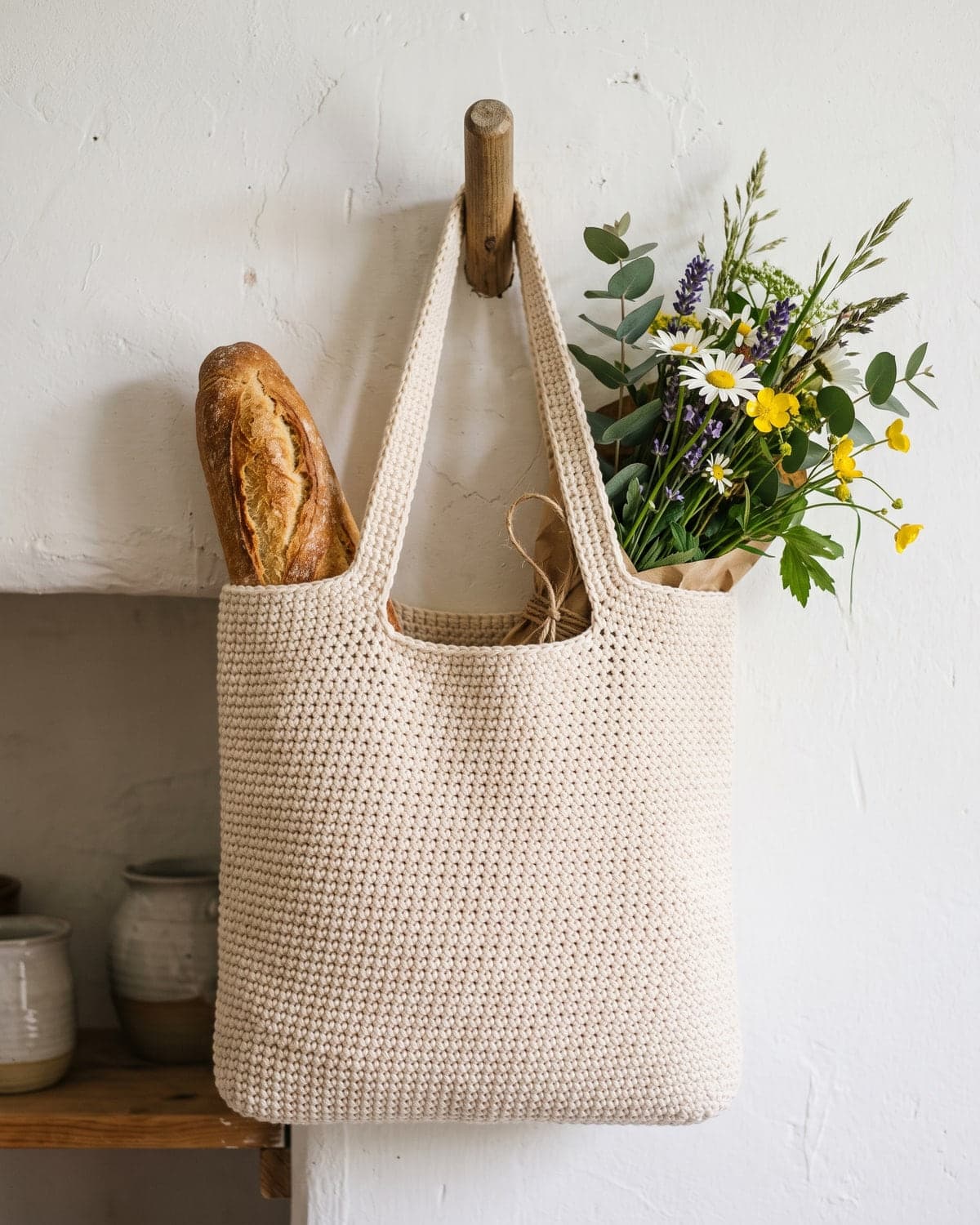
A crochet tote bag is one of the most useful things you can make with a hook. It carries shopping, a library haul or a beach towel, it folds up small, and it's a satisfying step up from scarves and dishcloths. This one is worked in a single piece from the bottom up, with the handles built in as you go, so there is nothing to sew.
The pattern uses only chains and single crochet. If you can do those and are ready to try working in the round, you can make this bag.
Terms used here: US crochet terms. Single crochet (sc) is called double crochet (dc) in UK terms.
About this pattern: it's a simple design written for this guide. The stitch counts for every round have been checked so they add up. Finished measurements and yarn amounts are approximate, because they depend on your yarn, hook and tension.
At a glance
| Skill level | Beginner (ready for rounds) |
| Stitches | Chain, single crochet, slip stitch |
| Yarn | Worsted-weight cotton (weight 4) |
| Hook | 4.5 mm (US 7) |
| Finished size | About 31 cm wide and 33 cm tall (12 × 13 in), plus handles |
| Construction | One piece, worked in a spiral from the base up |
What you need
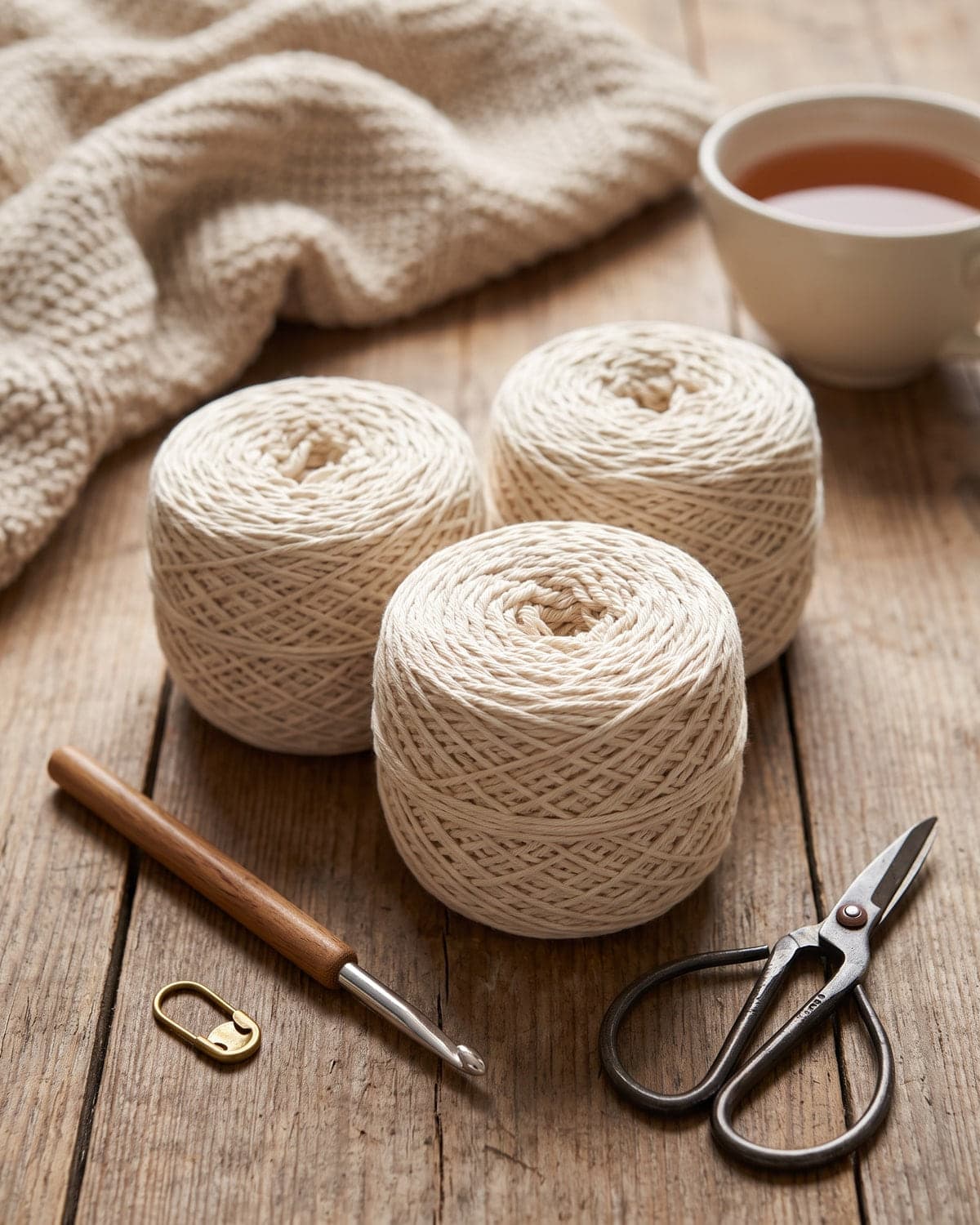
- Worsted-weight cotton yarn. As a rough estimate, allow about 220 to 300 m (240 to 330 yd) for the medium size. Ball lengths vary a lot between cotton yarns, so go by the metres or yards on your label, and buy an extra ball if you're unsure.
- A 4.5 mm (US 7) hook. That's slightly smaller than usual for this weight, which makes a firm fabric that doesn't sag.
- A locking stitch marker.
- A tapestry needle and scissors.
Why cotton?
A bag carries weight, and fibre decides how it copes.
- Cotton has almost no stretch, so the bag keeps its shape and the handles don't grow. It's strong, washable and cool to carry.
- Acrylic is lighter and cheaper, but it stretches under load. A full acrylic tote can end up much longer than it started.
- Cotton blends with a high cotton content work well and are a little softer.
- T-shirt yarn, raffia or cotton cord make sturdy bags too, with a larger hook and fewer stitches.
For your first bag, a smooth worsted cotton in a solid colour is the easiest to work with.
How the bag is made
The whole bag is three stages:
- The base: one round worked around both sides of a foundation chain, which makes a closed bottom edge.
- The body: plain single crochet, round and round in a spiral, until the bag is tall enough.
- The handles: two long chains that skip over a section of stitches, then two rounds worked over everything to strengthen them.
Because it's worked in a continuous spiral, there's no seam and no joining at the end of each round. A stitch marker shows where each round begins.
If single crochet is still new, how to crochet for beginners covers it from the first loop.
Crochet tote bag pattern
Base
Chain 46.
Round 1: Work 2 sc in the 2nd chain from the hook. Sc in each of the next 43 chains. Work 4 sc in the last chain. This takes you around the end.
Now turn the piece so you can work along the other side of the chain, into the loops you haven't used yet. Sc in each of the next 43 chains. Work 2 sc in the last chain, which is the one that already holds your first two stitches.
You have 94 stitches. Don't join. Put your stitch marker in the first stitch of the round.
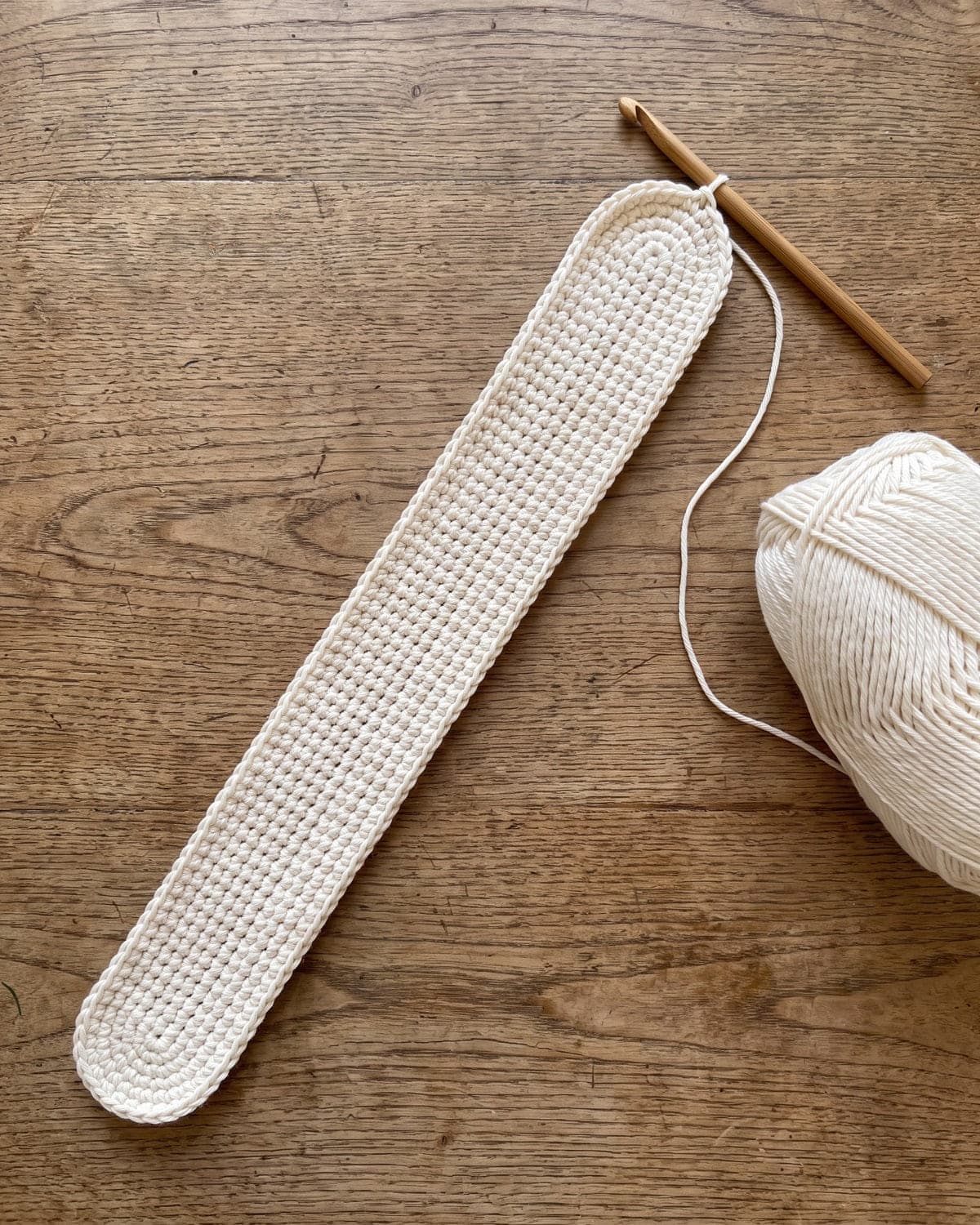 Check that the foundation isn't twisted before you go on. Lay it flat: it should look like a long, narrow oval with stitches on both sides of the chain.
Body
Round 2: Sc in each stitch around (94). Move the marker up into the first stitch of the new round.
Repeat Round 2 until the bag is about 30 cm (12 in) tall, measured from the base. In worsted cotton that's roughly 50 rounds, but go by the measurement, not the count.
That's all there is to the body. A few things help along the way:
- Move the marker every round. In a spiral there's no other sign of where a round starts.
- Count now and then. Check for 94 stitches every ten rounds or so. In a spiral the count only changes if you skip a stitch or work two into one.
- Keep your tension even. A bag looks best in a firm, regular fabric.
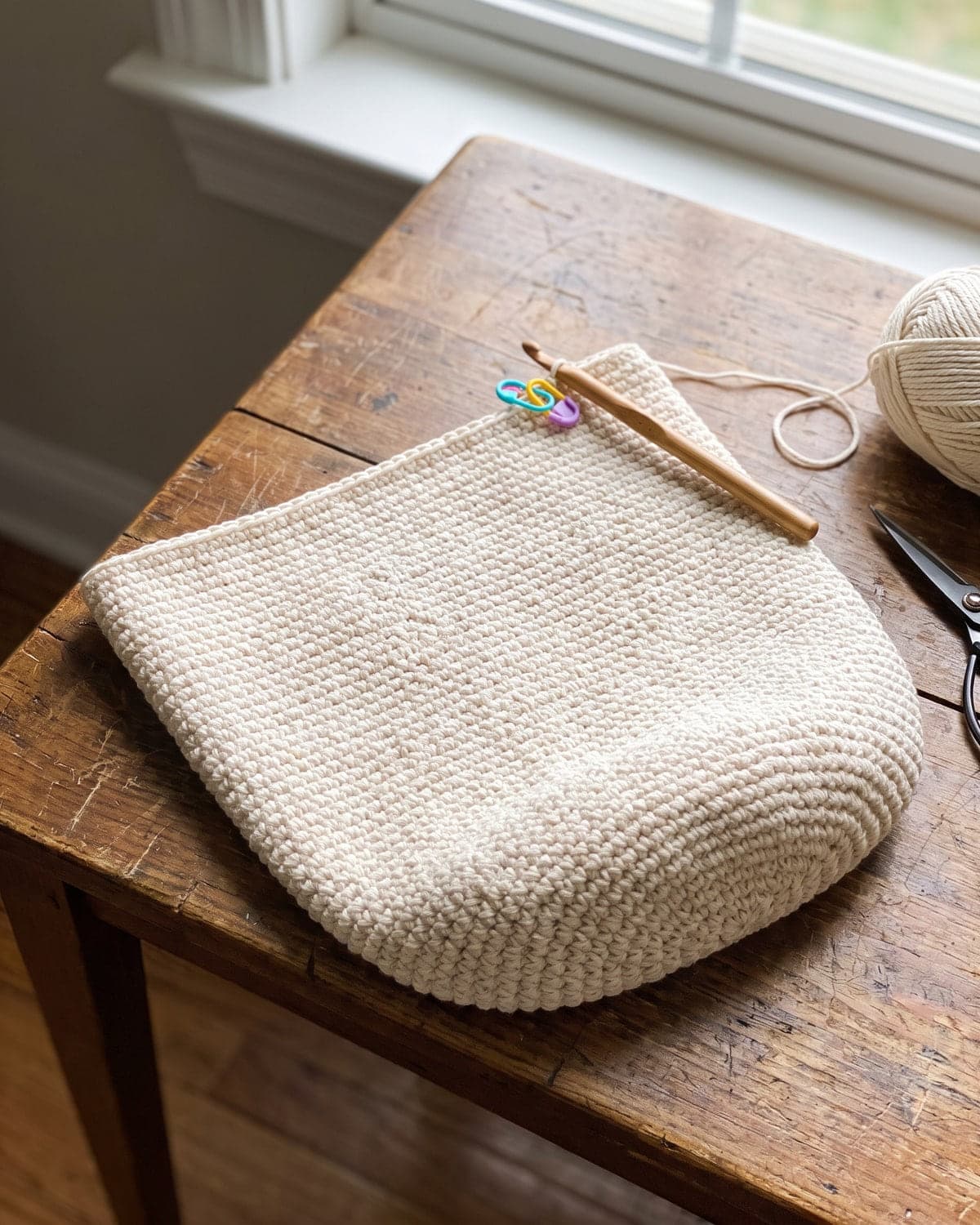
- Expect a slant. Stitches in spiral rounds lean slightly, so the start of the round drifts sideways as the bag grows. That's normal. Before the handle round, you'll reposition the marker so the handles sit centred.
Positioning the handles
Lay the bag flat with the base straight along the bottom, and smooth it so the two side folds are sharp. Find the stitch at one side fold. Work single crochet up to that stitch, so your hook is at the side of the bag, and place your marker there. This is the new start of the round.
Handles
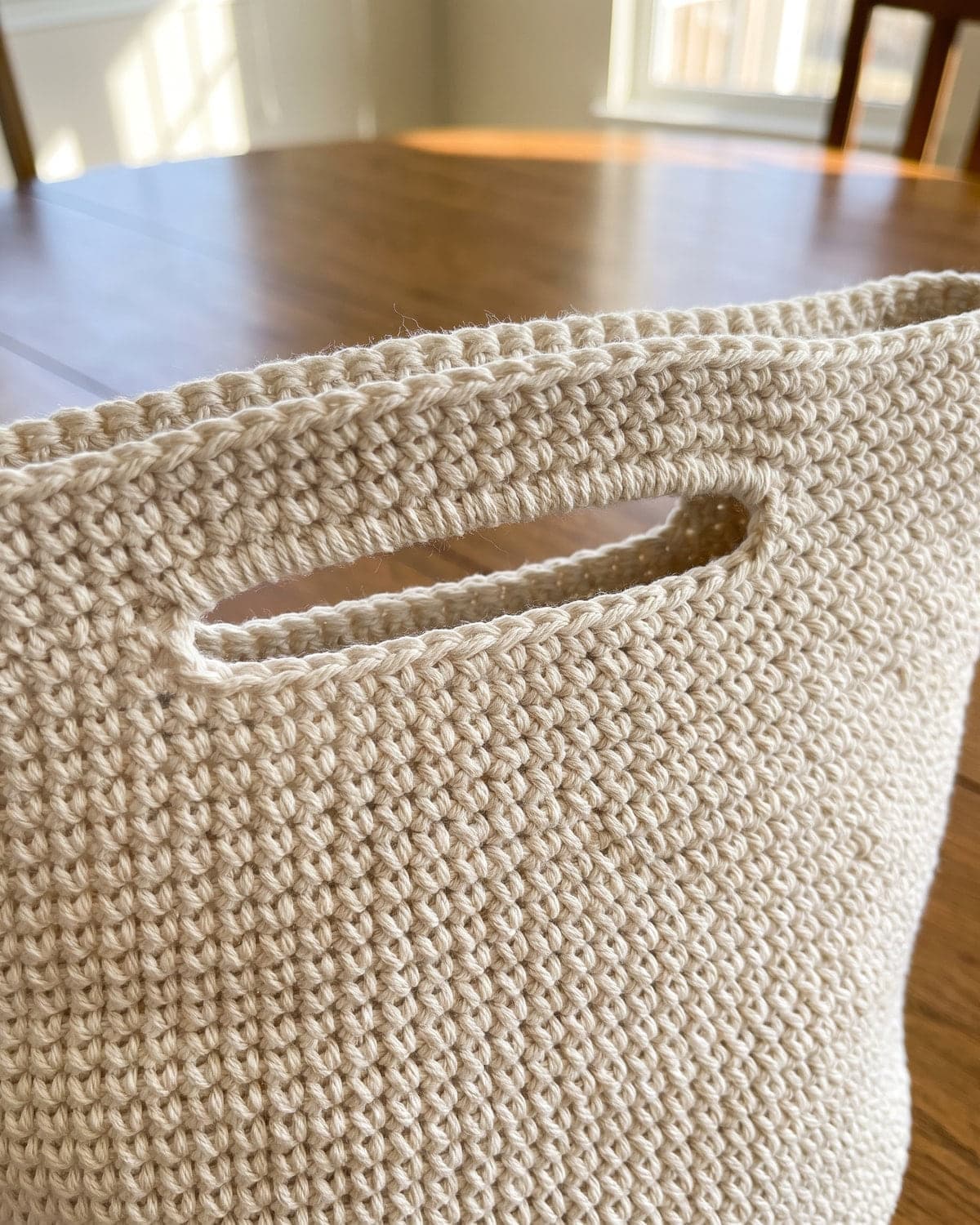
Handle round: Sc in the next 14 stitches. Chain 25, skip the next 19 stitches, and sc in the next 28 stitches. Chain 25, skip the next 19 stitches, and sc in the last 14 stitches.
Check the arithmetic if you like: 14 + 19 + 28 + 19 + 14 = 94.
Make sure neither chain is twisted before you carry on.
Next round: Sc in each stitch and in each chain around: 14 sc, then 25 sc along the first chain, 28 sc, 25 sc along the second chain, and 14 sc (106 stitches). Work into the chains by inserting your hook under the top loop of each one, or under the whole chain if you find that easier.
Final round: Sc in each stitch around (106). Slip stitch into the next stitch to smooth the end of the spiral.
Fasten off and weave in the ends securely. Bags get pulled about, so weave each end in two directions.
Making stronger handles
The two-round handle above is fine for light loads. For a bag that carries heavier things, strengthen it:
- Add rounds. Work two or three more rounds of single crochet around the whole top edge after the final round. Each one widens and reinforces the handles.
- Edge the handle openings. Join yarn at the base of a handle opening and work a round of single crochet around the inside edge: along the skipped stitches and along the underside of the chain.
- Crochet over a cord. On the round after the handle round, lay a length of cotton cord along the chain and work your stitches over it.
- Line the bag. A fabric lining takes the strain off the stitches. See below.
Cotton handles stretch a little with use, however they're made. If you want a shoulder bag, chain 45 or more for each handle and add the extra rounds to match.
Changing the size
The pattern scales easily, because every part depends on two numbers: the foundation chain and the number of rounds.
| Bag | Foundation chain | Stitches per round | Height |
|---|---|---|---|
| Small (lunch or project bag) | 31 | 64 | 20 cm (8 in) |
| Medium (as written) | 46 | 94 | 30 cm (12 in) |
| Large (beach or market) | 61 | 124 | 38 cm (15 in) |
For any size, the first round is: 2 sc in the 2nd chain from the hook, sc in each chain until one remains, 4 sc in the last chain, sc back along the other side until one chain remains, 2 sc in the last chain. The stitch count is always twice the foundation chain, plus 2.
Handle rounds for other sizes (the numbers add up to the stitches per round):
- Small (64): sc 9, chain 20, skip 14, sc 18, chain 20, skip 14, sc 9.
- Large (124): sc 19, chain 30, skip 24, sc 38, chain 30, skip 24, sc 19.
Adding a flat base
The bag as written is a flat envelope. For a bag that stands open, widen the base before starting the body by working two or three increase rounds. In each one, sc along the straight sides and put 2 sc into each of the stitches around both curved ends. Then carry on straight. Count your stitches after the last increase round and adjust the handle round so the two skipped sections are the same size and sit opposite each other.
Variations
- Stripes. Change colour every few rounds. In a spiral the colour change leaves a small step. To soften it, work the first stitch of the new colour as a slip stitch.
- Mesh market bag. After a few solid rounds, switch to mesh: *sc in the next stitch, chain 2, skip 2 stitches; repeat from * around. On the following rounds, work the sc into each chain space. Mesh is lighter and stretchier, and it uses much less yarn. Return to solid rounds for the top band and handles.
- Textured body. Swap the plain rounds for a stitch from textured crochet stitches. Lemon peel works well, and it needs an even stitch count, which this bag has.
- Granny square tote. Join thirteen squares into a bag shape instead. The squares are explained in granny square blanket for beginners.
- Decoration. Sew on a few easy crochet flowers, add a tassel, or stitch a leather label to the front.
- A closure. Sew a magnetic snap inside the top edge, or add a button and a chain loop.
How to line a crochet bag (optional)
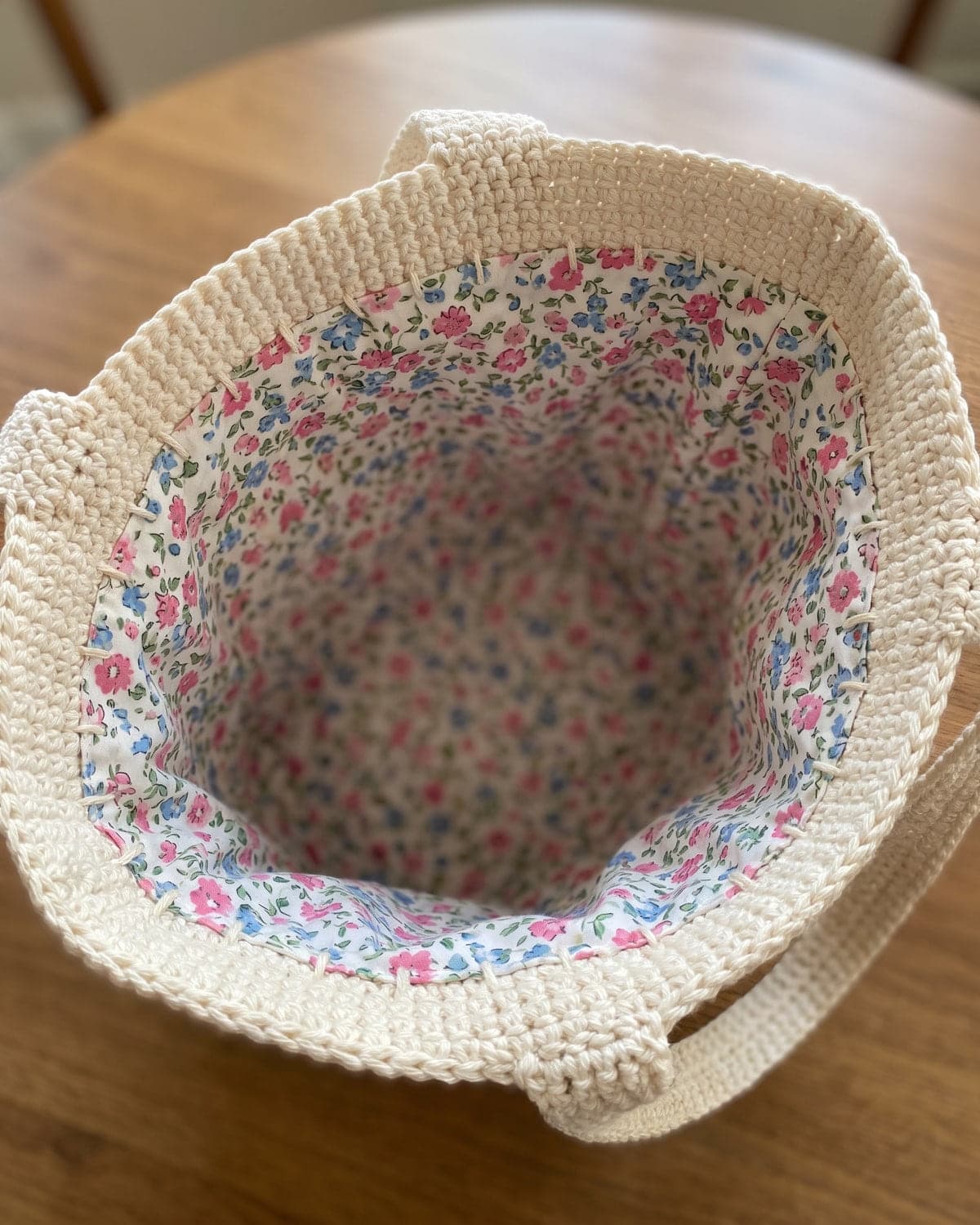
A lining stops small things poking through, protects the stitches and prevents stretching.
- Lay the finished bag flat on a piece of cotton fabric folded double. Trace around the body, adding 1.5 cm (0.5 in) on the sides and bottom and 3 cm (1 in) at the top.
- Cut out the two pieces. Sew the sides and bottom, right sides together.
- Fold the top edge down to the wrong side, so the lining sits just below the top of the bag. Press.
- Slip the lining inside the bag, wrong sides together, and hand-sew it to the inside of the top edge with small stitches in matching thread.
Washing and care
Most cotton bags can be machine washed on a cool, gentle cycle. Check your yarn label. Reshape the bag while it's damp and dry it flat, or hang it by the base rather than the handles so the handles don't stretch. Bright cottons can bleed in the first wash, so wash a new bag on its own the first time.
Common problems and fixes
My base is twisted. The foundation chain turned over before Round 1 was complete. It can't be fixed later, so pull it out and start again, keeping the chain flat.
My stitch count keeps changing. Move the marker every round and count. An extra stitch usually comes from working into the marked stitch twice.
The bag is getting wider or narrower. Your tension has changed, or the stitch count has. Count first. If the count is right, relax and keep your tension steady.
The fabric has gaps. Go down a hook size. A bag needs a denser fabric than a blanket does.
The handles aren't centred. The handle round began in the wrong place. Pull back to the start of that round, fold the bag flat and begin at a side fold.
One handle is twisted. Pull back to the chain and lay it flat before working over it.
The bag stretches when it's full. Use cotton, work firmly, add handle rounds, or add a lining.
The start of the round leans to one side. That's the natural slant of spiral rounds, and it's why the handle round starts from a side fold and not from the original marker.
Frequently asked questions
Is a crochet tote bag easy for beginners? Yes. This one is only chains and single crochet, with no shaping and no sewing.
What is the best yarn for a crochet bag? Cotton. It's strong and doesn't stretch. Worsted weight is easy to handle and gives a sturdy fabric.
How much yarn does a tote bag need? Roughly 220 to 300 m (240 to 330 yd) of worsted cotton for the medium size. That's an estimate, and it varies with tension.
How long does it take? The body is many rounds of the same stitch, so it's a good project for several evenings in front of the television.
Do crochet bags stretch? They can. Cotton yarn, a small hook, reinforced handles and a lining all reduce it.
What's the best stitch for a bag? Single crochet. It's dense and strong. Mesh stitches are used for lightweight market bags.
Can I sell bags made from this pattern? Yes. You're welcome to sell what you make.
More to make
A tote bag teaches working in a spiral, keeping a steady count over a large piece, and building openings into the fabric, which is the skill behind buttonholes, armholes and pockets too.
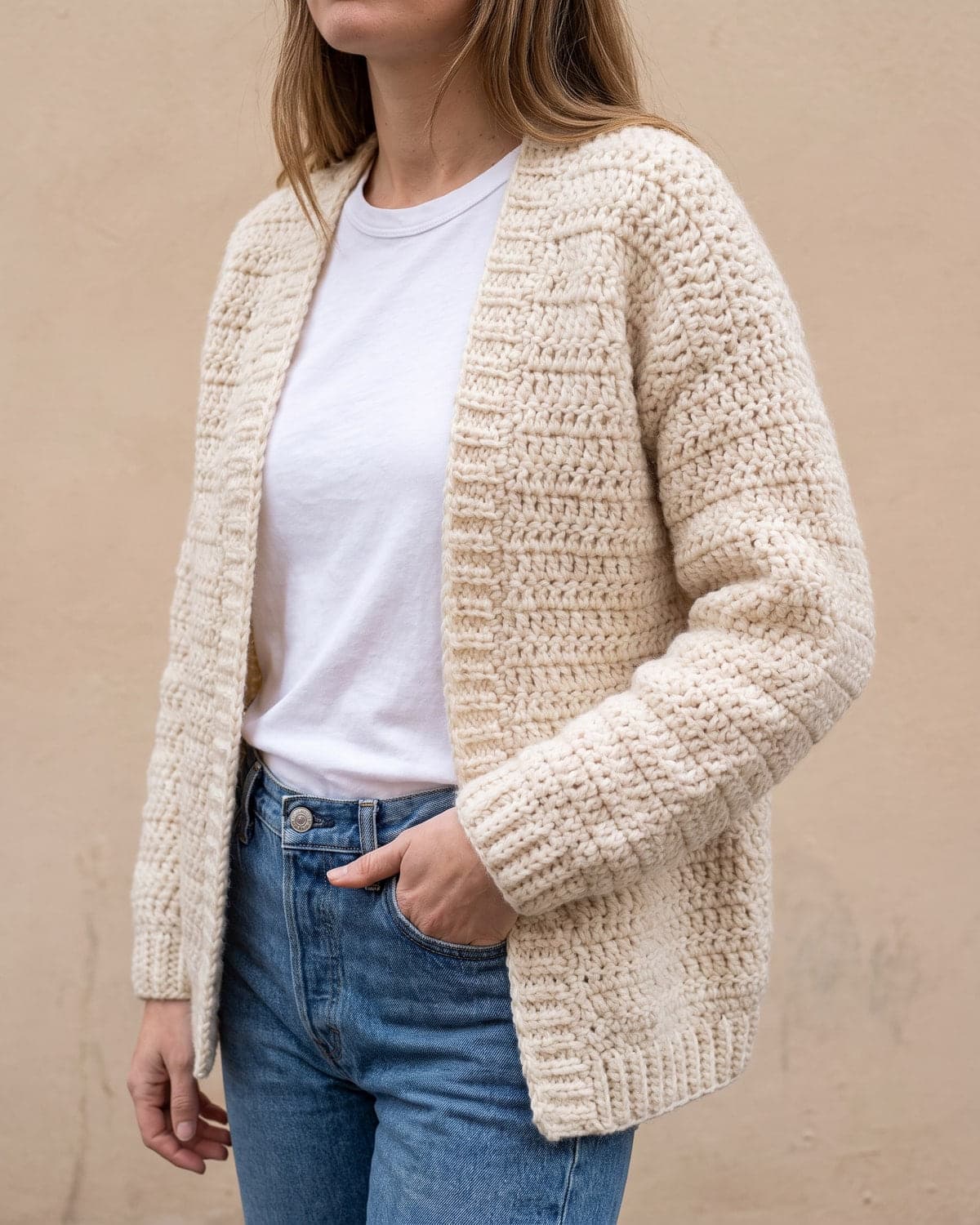
- Ready to make something to wear? Try the easy crochet cardigan for beginners.
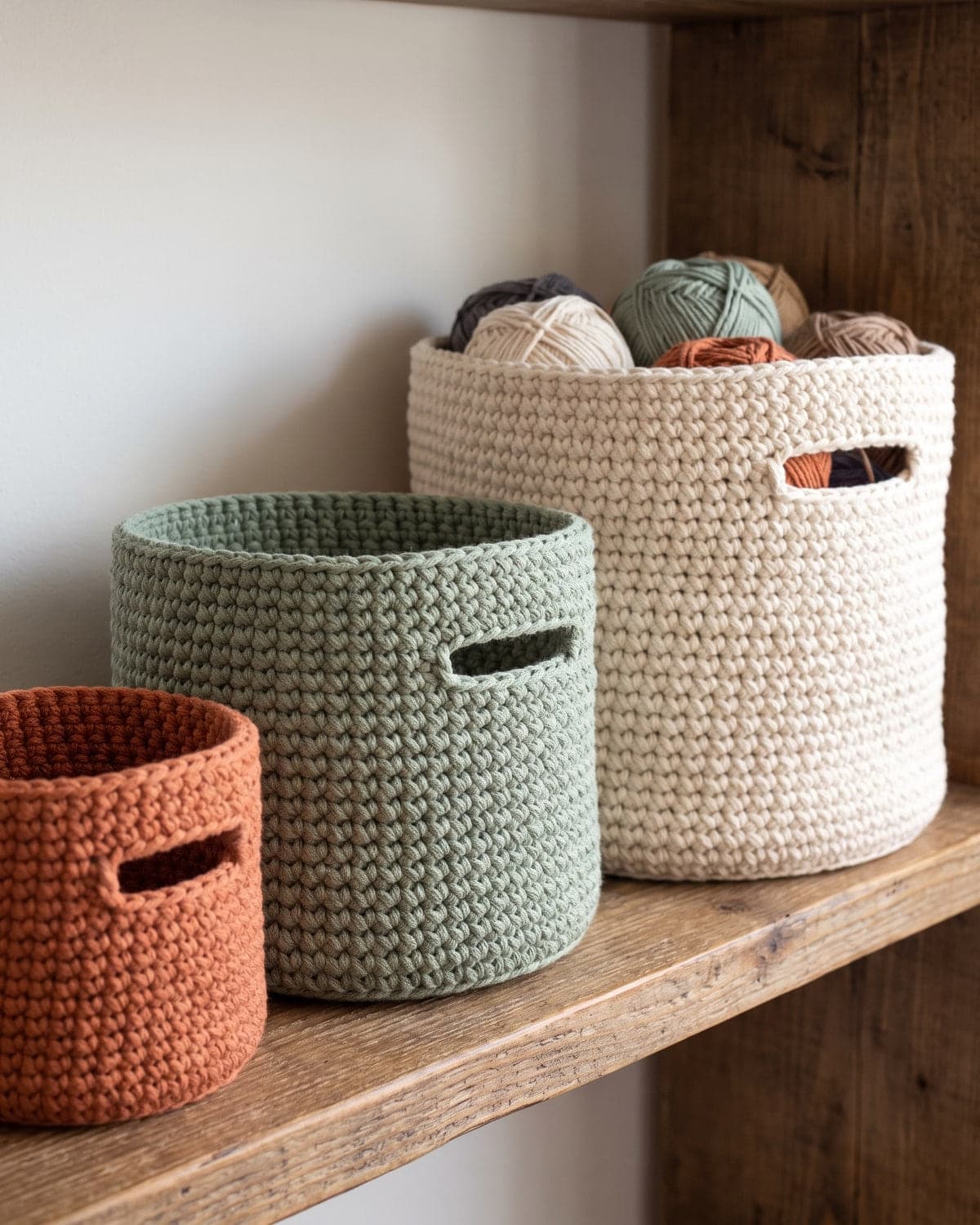
- Want a matching set for your home? Make a crochet basket with the same stitch.
- If the pattern shorthand was new to you, see how to read crochet patterns.
Browse the clothing section for more wearables and accessories. For help choosing a hook in a different sizing system, the Craft Yarn Council has a hook size chart.
Save it for later
Pin this to your Pinterest board so it's there when you're ready to stitch.
Keep stitching
Related crochet projects
Home decor Easy Crochet Basket: Beginner Pattern in Three Sizes
11 min read
Clothing Easy Crochet Cardigan for Beginners: Made from Simple Rectangles
10 min read
Amigurumi Easy Crochet Octopus: Free Amigurumi Pattern for Beginners
10 min read
Seasonal Crochet Christmas Ornaments: 4 Easy Patterns for Beginners
12 min read