Crochet Daisy Pattern: 3 Easy Free Daisies for Beginners
Three free crochet daisy patterns in one guide: a classic 12-petal daisy, a fuller double daisy and a mini daisy, plus a leaf, a stem, a daisy chain garland, size and colour ideas. Every round with stitch counts.
By AlixaPublished 15 min read

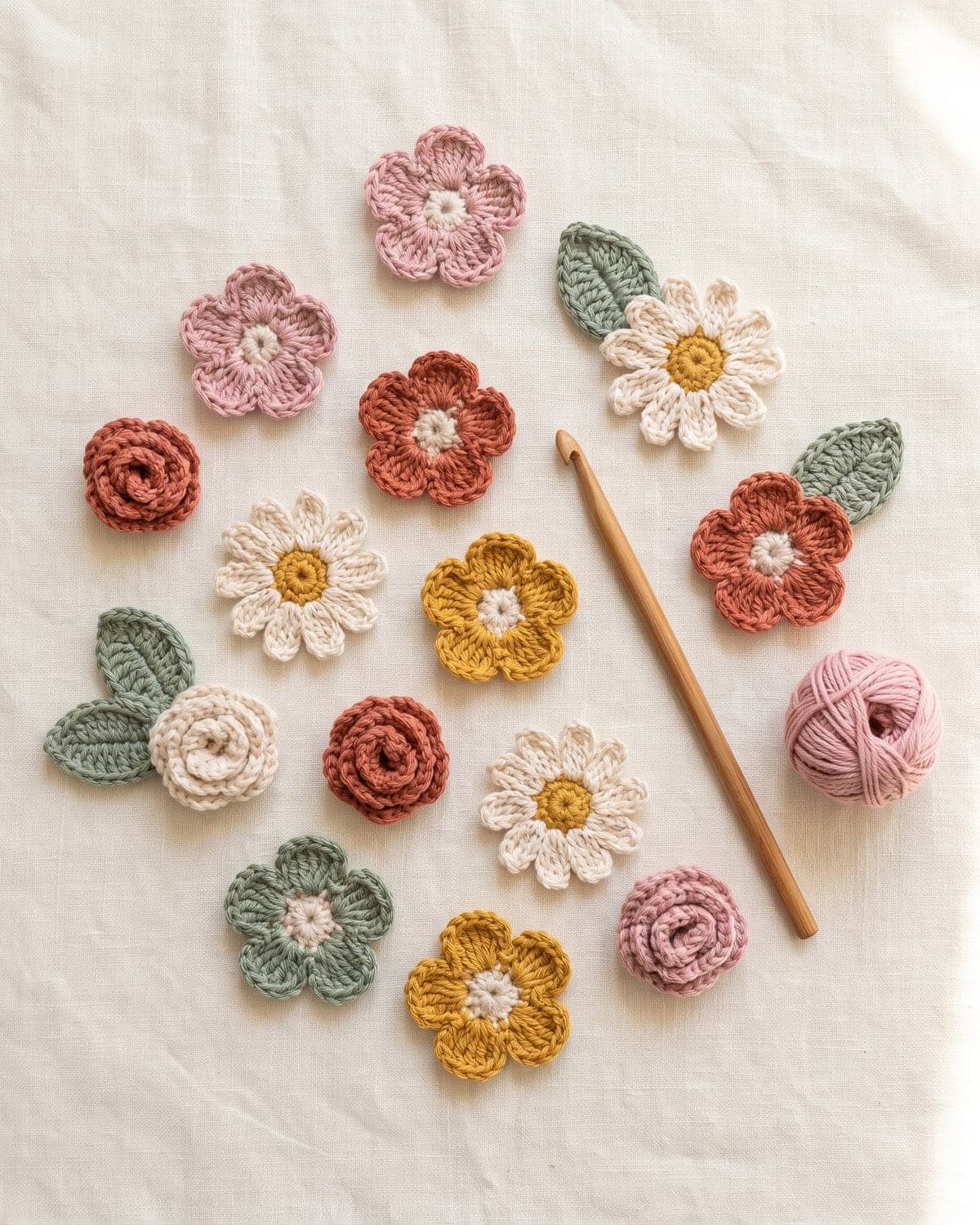
A crochet daisy is one of the first flowers most people learn to make, and it never stops being useful. A small yellow centre, a ring of white petals and a few minutes of work give you a flower you can sew onto a bag, clip into your hair, string into a garland or put on a stem in a jar. Because each daisy uses only a few metres of yarn, it's also one of the best ways to use up leftover cotton.
This free crochet daisy pattern gives you three daisies in one guide: a classic daisy with 12 petals, a fuller double daisy with two layers of petals, and a mini daisy for garlands and hair clips. You'll also find a leaf, a stem, a daisy chain garland, size changes, colour ideas and fixes for the most common problems. Every round has its stitch count, so you can check your work as you go.
Terms used here: US crochet terms. Single crochet (sc) is called double crochet (dc) in UK terms, half double crochet (hdc) is UK half treble, and double crochet (dc) is UK treble.
About this pattern: it's a simple design written for this guide. Each round's stitch count has been checked so the numbers add up. Finished sizes are approximate and depend on your yarn, hook and tension.
At a glance
| Skill level | Beginner (comfortable with chains, single crochet and a magic ring) |
| Stitches | Magic ring, chain, slip stitch, sc, hdc, dc, front and back loops |
| Yarn | DK cotton (weight 3) in yellow, white and green |
| Hook | 3.5 mm (US E-4) |
| Finished size | Classic daisy about 8 cm (3.25 in); double daisy about 10 cm (4 in) |
| Time | 15 to 30 minutes per flower |
| Construction | Centre worked in the round; petals chained out and worked back |
What you need
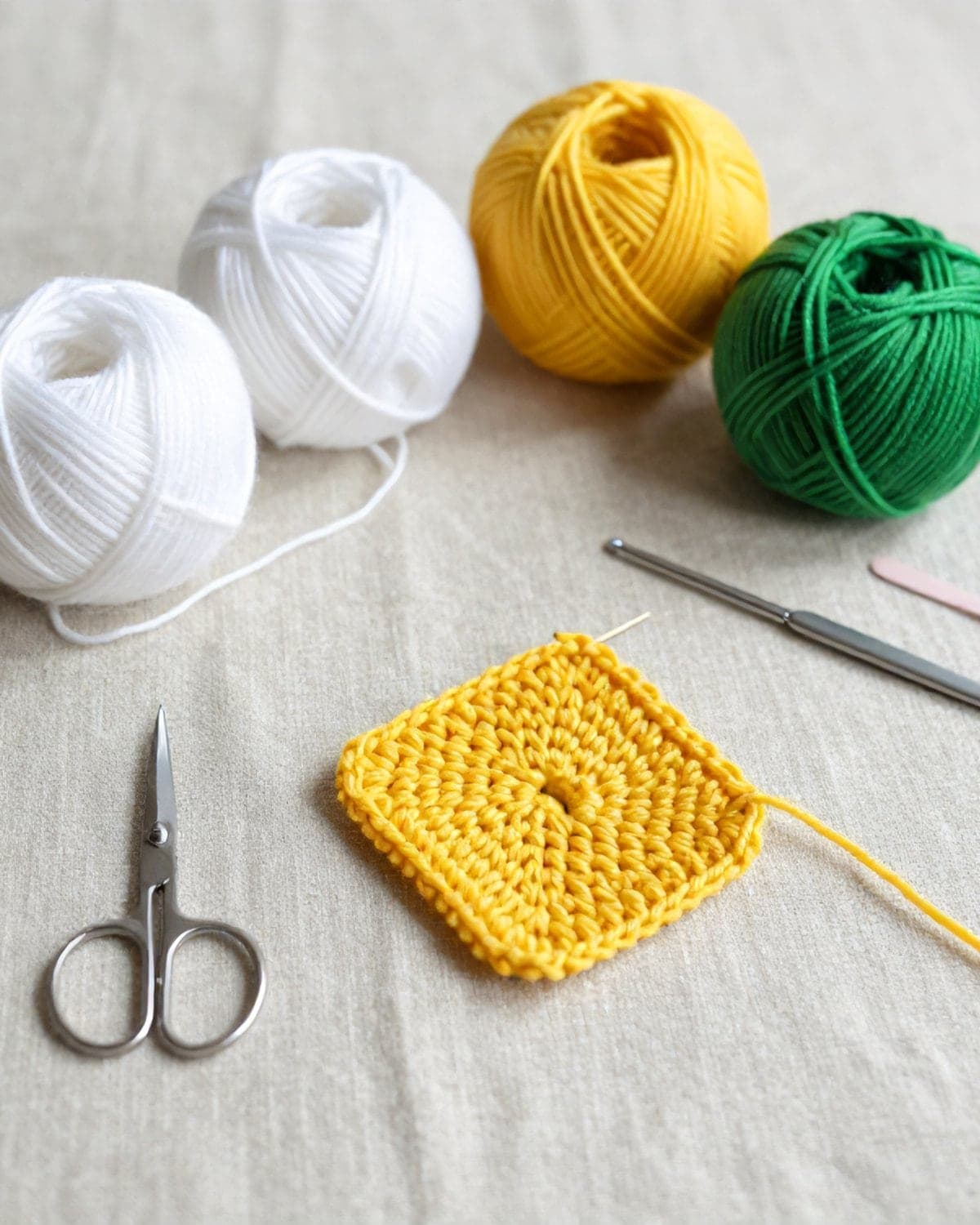
- DK cotton yarn in three colours: sunny yellow for the centre, white for the petals and green for the leaves. A classic daisy uses about 2 m (2 yd) of yellow and 8 m (9 yd) of white. A leaf takes about 3 m (3 yd) of green. Scraps are perfect.
- A 3.5 mm (US E-4) crochet hook. Use whichever size gives you a firm fabric with your yarn.
- A tapestry needle for weaving in ends and sewing.
- Scissors.
- A stitch marker (optional, but handy for marking the first stitch of the centre).
For stems, clips and garlands you may also want:
- Floral wire (18 gauge) and green floral tape for stemmed daisies.
- Hair clips or brooch backs and a little fabric glue.
- A felt circle to neaten the back of a clip or brooch.
Why cotton? Cotton yarn has a crisp stitch definition, so the petals stay flat and neat and keep their shape after washing. Acrylic is softer and cheaper and works well for toys and blankets, but its petals tend to curl. If you're unsure which weight you have, the Craft Yarn Council's yarn weight system explains the numbers on the label.
Techniques used
- Magic ring. An adjustable loop that you pull tight to close the centre with no hole. If you've never made one, follow how to crochet a magic ring first.
- Increase (inc). Two single crochets in the same stitch.
- Chain and work back. Each petal is a short chain. You turn and work stitches back down the chain towards the centre, then slip stitch into the next centre stitch. The different stitch heights shape the petal: short at the tip, taller in the middle, short again at the base.
- Front loop only (FLO) and back loop only (BLO). The top of a stitch is a sideways V. The loop nearer to you is the front loop, the one further away is the back loop. The double daisy uses the front loops for one layer of petals and the back loops for a second layer.
If any of these stitches are new to you, easy crochet stitches for beginners walks through each one with photos. And if you're still getting used to written instructions, how to read crochet patterns explains the abbreviations, brackets and stitch counts used below.
Pattern 1: Classic crochet daisy
This is the daisy most people picture: a flat yellow button in the middle and 12 slim white petals. It takes about 15 minutes.
The centre
Use yellow. Work in a continuous spiral without joining rounds.
- R1: 6 sc in a magic ring (6)
- R2: inc in each stitch around (12)
Slip stitch into the next stitch and fasten off. Pull the magic ring tight and weave the tail in on the back.
The centre should be a flat disc about 2.5 cm (1 in) across.
The petals
Use white. Join with a slip stitch in any stitch of round 2. You'll make one petal in each of the 12 stitches.
- Petal: ch 8. Starting in the 2nd chain from the hook, sl st in the next ch, sc in the next ch, hdc in each of the next 3 ch, sc in each of the next 2 ch. Sl st in the next stitch of the centre.
That's 7 stitches worked back along the 7 chains. Repeat the petal 12 times in total. The last slip stitch goes into the stitch where you joined the white yarn. Fasten off and weave in the ends on the back.
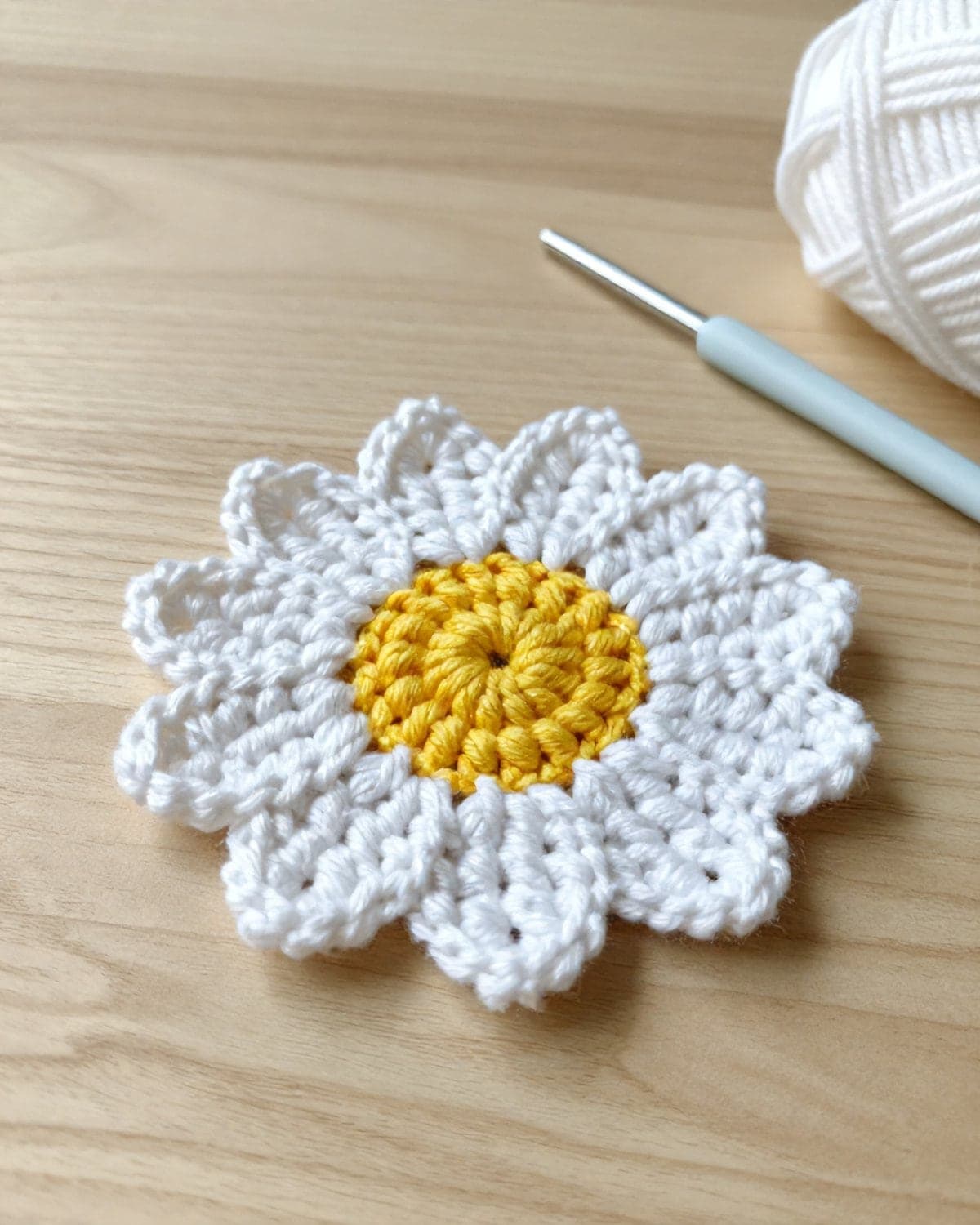 You now have a classic daisy with 12 petals. Press each petal flat between your fingers and straighten any that twisted as you worked back along the chain.
Why do the petals have a slip stitch at the tip? The slip stitch is the shortest stitch there is, so it makes the petal taper to a soft point. If you'd like rounder petals, replace it with a single crochet.
Pattern 2: Double daisy
The double daisy has 36 petals in two layers: short petals at the front and longer ones peeking out behind them. It looks more like an oxeye daisy or a chamomile flower, and it's lovely on a stem. It takes about 30 minutes.
The centre
Use yellow and work in a spiral.
- R1: 6 sc in a magic ring (6)
- R2: inc in each stitch around (12)
- R3: (sc, inc) × 6 (18)
Slip stitch into the next stitch and fasten off. The centre should measure about 3.5 cm (1.5 in) across.
For a domed centre, work one more round in yellow before fastening off: R4: sc in each stitch around (18). The straight round makes the centre cup forward slightly, just like a real daisy's raised middle.
Front petals
Use white. Join with a slip stitch in the front loop of any stitch of the last yellow round. Work this layer in front loops only.
- Front petal: ch 7. Starting in the 2nd chain from the hook, sl st in the next ch, sc in the next ch, hdc in each of the next 2 ch, sc in each of the next 2 ch. Sl st in the front loop of the next stitch of the centre.
That's 6 stitches back along 6 chains. Repeat 18 times, ending in the stitch where you joined. Don't fasten off.
Back petals
Fold the front petals towards you. Behind them you'll see a ring of back loops that you haven't used yet. Slip stitch into the back loop of the stitch you're on.
- Back petal: ch 9. Starting in the 2nd chain from the hook, sl st in the next ch, sc in the next ch, hdc in each of the next 2 ch, dc in each of the next 2 ch, hdc in the next ch, sc in the last ch. Sl st in the back loop of the next stitch of the centre.
That's 8 stitches back along 8 chains. Repeat 18 times. Fasten off and weave in the ends on the back.
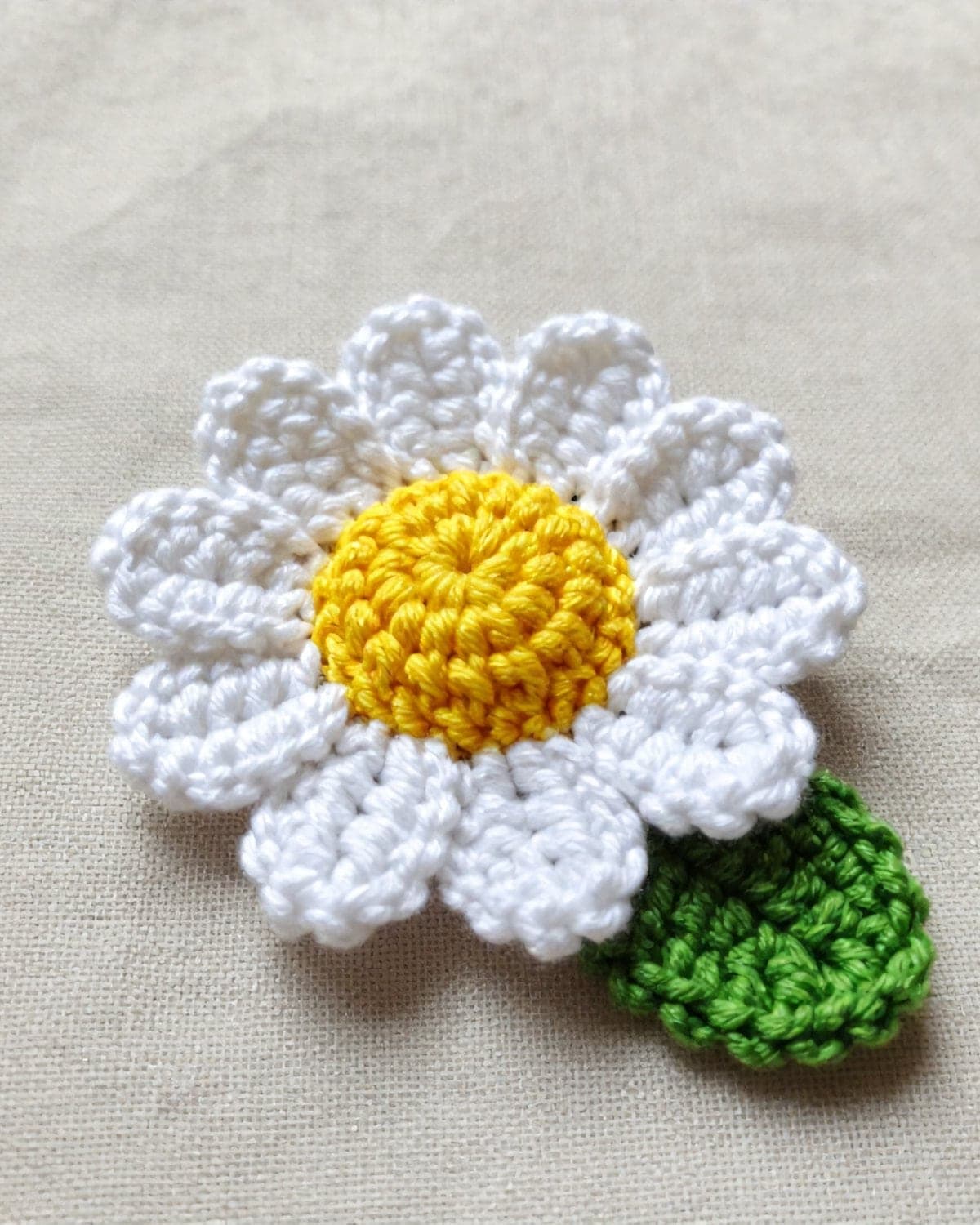 Gently pull the back petals outwards so they fan out between the front ones. The two double crochets in the middle of each back petal make it a little wider, so the layers fill the gaps between each other.
For a fluffier look, brush the white petals lightly with a soft toothbrush or a pet slicker brush. This works best with cotton-blend or acrylic yarn.
Pattern 3: Mini daisy
Mini daisies are about 5 cm (2 in) across and take less than 10 minutes. Use them for garlands, hair clips, gift tags, earrings and baby clothes.
The centre
Use yellow.
- R1: 10 sc in a magic ring (10)
Pull the ring tight, join with a slip stitch to the first stitch and fasten off.
The petals
Use white. Join with a slip stitch in any stitch of the centre.
- Mini petal: ch 5. Starting in the 2nd chain from the hook, sl st in the next ch, sc in the next ch, hdc in the next ch, sc in the last ch. Sl st in the next stitch of the centre.
Repeat 10 times in total. Fasten off and weave in the ends.
Can't fit 10 stitches into the ring? Leave the magic ring a little loose while you work, then pull it closed at the end. If it still feels crowded, make 8 single crochets and 8 petals instead.
The leaf
Make one or two leaves for each stemmed daisy, or a few to tuck behind daisies on a garland. Use green.
- Ch 9.
- Side 1: starting in the 2nd chain from the hook, sl st, sc, hdc, dc, dc, hdc, sc in the next 7 chains. Work 3 sc in the last chain to turn around the end.
- Side 2: working along the other side of the chain, sc, hdc, dc, dc, hdc, sc, sl st.
- Slip stitch into the first stitch to join.
Fasten off, leaving a 20 cm (8 in) tail for sewing. The leaf is about 5 cm (2 in) long.
A back for the daisy (optional)
A small green circle hides the ends on the back and gives you something solid to glue a clip or stitch a stem to. Use green.
- R1: 6 sc in a magic ring (6)
- R2: inc in each stitch around (12)
Slip stitch to join and fasten off with a long tail. Sew it to the back of the yellow centre with small whip stitches.
How to put a daisy on a stem
- Bend the wire. With small pliers, curl the top 1.5 cm (0.5 in) of an 18-gauge floral wire into a flat loop. The loop stops the stem from pulling through and covers the sharp end.
- Push it through the back circle. Thread the straight end down through the centre of the green back circle until the loop lies flat against it.
- Sew the back on. Hold the circle against the back of the daisy with the wire loop sandwiched in between. Whip stitch all the way around.
- Wrap the stem. Starting right under the flower, wrap green floral tape down the wire at an angle, stretching it slightly so it sticks to itself.
- Add a leaf. About a third of the way down, hold the base of a leaf against the stem and wrap the tape over its tail.
Floral wire is sharp, so stemmed flowers are decorations, not toys. For more on stems, mixing flowers and wrapping a finished bunch, see the crochet flower bouquet guide.
Daisy chain garland
A crochet daisy chain looks sweet along a mantel, across a window, on a nursery wall or around a birthday cake stand. You need mini daisies (about one for every 15 cm, or 6 in, of garland) and green yarn.
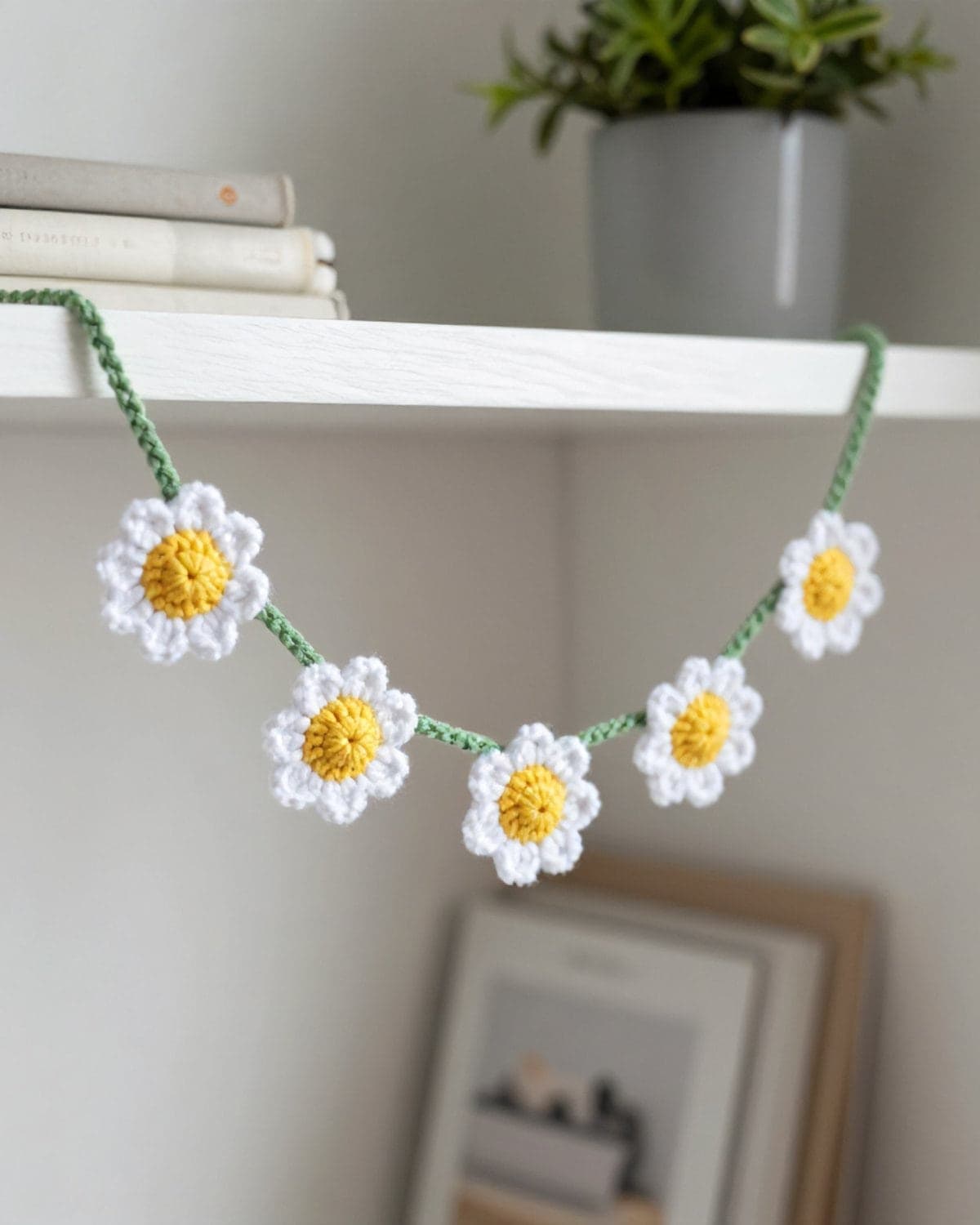
- Make the daisies. Crochet as many mini daisies as you need and weave in all the ends.
- Start the chain. With green, leave a 30 cm (12 in) tail for hanging and chain 25.
- Catch a daisy. Insert your hook from front to back through the yellow centre of a daisy, between two stitches of the ring. Yarn over and slip stitch to fix the daisy onto the chain.
- Keep going. Chain 25 and catch the next daisy. Repeat until the garland is as long as you like.
- Finish. Chain 25, fasten off and leave a 30 cm tail for hanging.
To add leaves, sew a leaf behind every second daisy before you catch it, or chain 6 and slip stitch back along the chain to make a tiny leaf spur between flowers.
Ways to use your crochet daisies
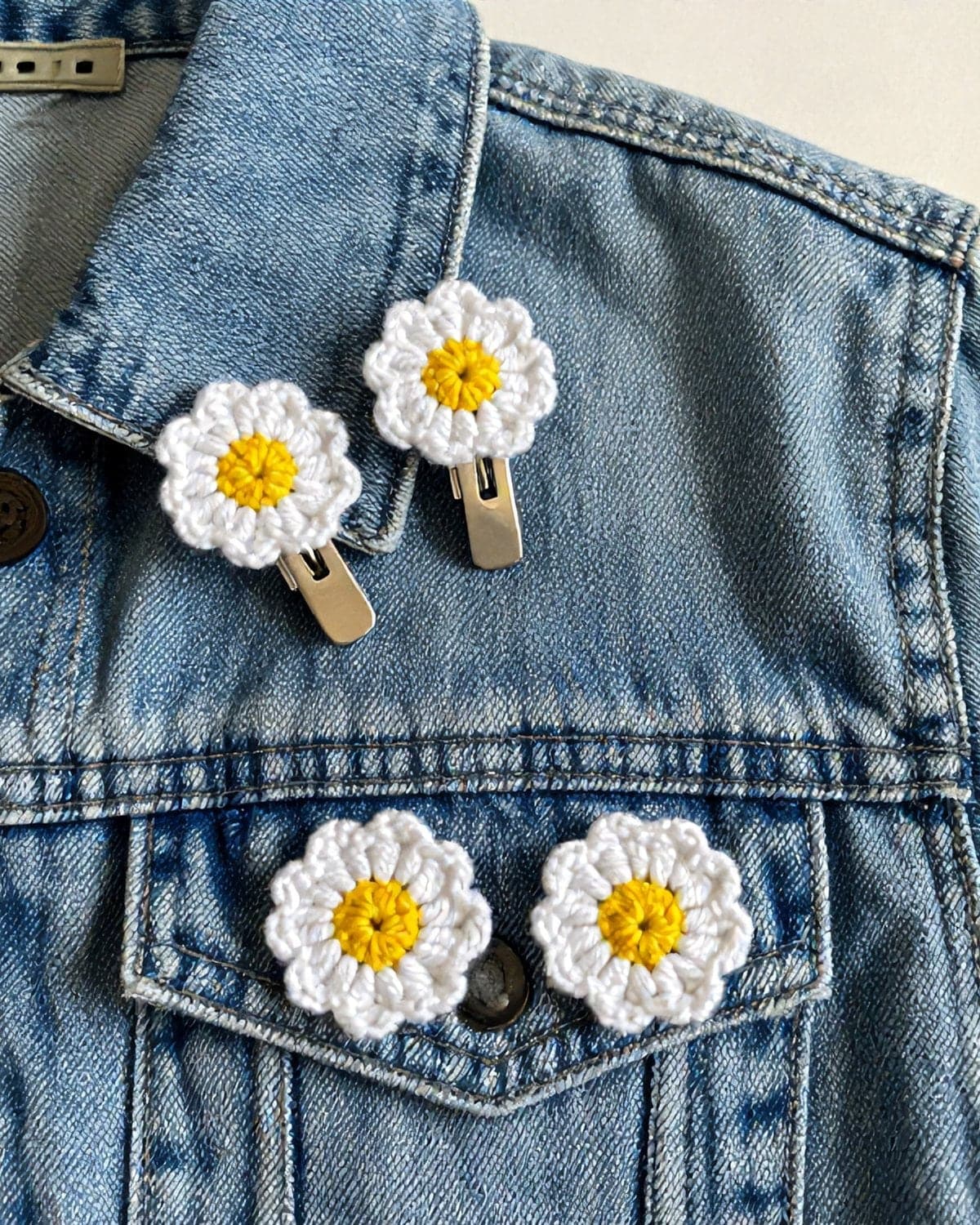
- Hair clips and headbands. Glue a mini daisy to a snap clip with a small felt circle on the back. Daisies on a soft headband make a lovely flower-girl accessory.
- Brooches. Sew a brooch pin onto the green back circle of a classic or double daisy.
- Appliqués. Stitch daisies onto a denim jacket, a cardigan, a baby blanket or a cushion. The easy crochet tote bag has a plain fabric that shows a cluster of daisies well.
- Gift toppers. Tie a daisy into the ribbon of a present instead of a bow.
- A vase of everlasting flowers. Five or seven stemmed double daisies in a small jar. Mix them with a crochet sunflower or a crochet rose for a fuller bunch.
- Coasters. Make the classic daisy in cotton, add a round of green single crochet behind the petals and press it flat. More ideas are in easy crochet coasters.
- Blanket squares. Work a daisy into the middle of a square: see the crochet flower granny square pattern.
- Bookmarks. Make a long green chain, about 25 cm (10 in), and sew a mini daisy to one end.
Changing the size
The petal count always matches the stitch count of the last yellow round, so you can make the daisy bigger or smaller and the maths still works.
- Smaller daisy. Use the mini daisy, or work the classic daisy in fine cotton thread with a 2 mm hook.
- Bigger daisy. Work the centre to round 3 (18 stitches) and make 18 classic petals with ch 10: sl st, sc, hdc, 2 dc, 2 hdc, 2 sc back along the 9 chains.
- Longer petals. Add one chain to the start of a petal and one extra hdc in the middle of the stitches you work back.
- Chunky daisy. Use worsted (weight 4) yarn and a 4.5 mm hook. The classic daisy grows to about 11 cm (4.25 in).
Choosing colours
Real daisies come in more colours than you might expect. The common lawn daisy, Bellis perennis, has white petals that are often tipped with pink, and garden varieties range from white to deep red. Some ideas:
- Classic: white petals with a golden yellow centre.
- Pink-tipped: white petals, then a round of pale pink slip stitches around the petal tips.
- Chamomile: cream petals with a domed, bright yellow centre.
- Gerbera: bold pink, orange or red petals with a dark brown or green centre.
- Blue daisy: sky blue petals with a yellow centre, a cheerful summer look.
- Boho: mustard, rust and cream daisies together on a garland.
Bright daisies on a pastel background are very popular for baby blankets and nursery decor. For tone-on-tone, try a white daisy on a cream square.
Tips for neat crochet daisies
- Keep the chain loose. If your petal chains are tighter than your other stitches, the petals will curl. Use a hook half a size larger for the chains only, or simply relax your grip.
- Work back into the bump. Working back along the chain through the back bump (the ridge on the back of each chain) gives a smoother edge on both sides of the petal.
- Count the petals. Use a stitch marker in the first centre stitch, so you know exactly where the round ends.
- Hide the ends behind the centre. Weave white ends through the back of the yellow disc, where they won't show.
- Block if you need to. For crisp, flat petals, pin the daisy out on a towel, spray it lightly with water and let it dry.
- Stiffen for decorations. For hanging ornaments or wreaths, brush the back with equal parts white glue and water and leave it to dry flat.
Common problems and fixes
The centre curls into a cup. Your tension is tight, or an increase was missed. Count 12 stitches in round 2. If the count is right, go up half a hook size.
The centre ruffles. There are too many stitches. Check you only increased in each stitch once.
The petals twist. This usually happens when you work into the wrong part of the chain. Always count from the hook, skip the first chain and work into each chain once.
The petals are different lengths. Count the chains before you start working back. One extra or missing chain makes a noticeable difference on such a small flower.
I end with a petal too many or too few. One petal slipped into two stitches, or two petals went into the same stitch. Undo back to the mistake: the petals are quick to redo.
I can't find the back loops for the double daisy. Fold the front petals right forward, towards you. The back loops are a neat line of single strands around the edge of the yellow centre.
The back layer hides the front. That's fine on a stemmed flower seen from the side. For a flatter daisy, shorten the back petals to ch 8.
Frequently asked questions
Is a crochet daisy good for beginners? Yes. The classic daisy uses only a magic ring, single crochet, half double crochet and slip stitches. It's small, so a mistake takes seconds to fix.
How long does it take to crochet a daisy? About 15 minutes for a classic daisy, 30 minutes for a double daisy and under 10 for a mini daisy.
How much yarn do I need for one daisy? Around 10 m (11 yd) in total for a classic daisy, and roughly 18 m (20 yd) for a double daisy. Scraps are ideal.
What is the best yarn for crochet flowers? DK or sport-weight cotton. It shows each stitch clearly and keeps the petals flat. Mercerised cotton has a slight shine that looks pretty on flowers.
Can I make a daisy without a magic ring? Yes. Chain 2 and work all the stitches of round 1 into the second chain from the hook, or chain 4 and join into a ring. The centre will have a small hole.
How do I attach crochet daisies to fabric? Sew them on with matching thread through the yellow centre and the base of a few petals. For items that will be washed often, sew rather than glue.
Can I wash crochet daisies? Cotton daisies can be hand washed or washed in a laundry bag on a gentle cycle. Reshape them and dry them flat. Remove wire stems before washing.
Can I sell daisies made from this pattern? Yes. You're welcome to sell the flowers you make. Please link back to this page instead of copying the pattern itself.
What to make next
- For a flower with a stem and rolled petals, try the crochet rose pattern.
- For a bold summer bloom, follow the crochet sunflower pattern.
- For four quick flowers in one guide, see easy crochet flowers.
- To turn your daisies into a gift, put them in a crochet flower bouquet.
- To put a flower in a blanket square, try the crochet flower granny square.
There are more free patterns in the flowers section.
Save it for later
Pin this to your Pinterest board so it's there when you're ready to stitch.

Keep stitching