Crochet Flower Granny Square: Easy Sunburst Pattern for Beginners
A free crochet flower granny square: a sunburst flower with two rings of petals, squared off into a neat 10 cm square. Every round with stitch counts, plus a daisy version, three ways to join, blanket sizes, borders and colour ideas.
By AlixaPublished 13 min read
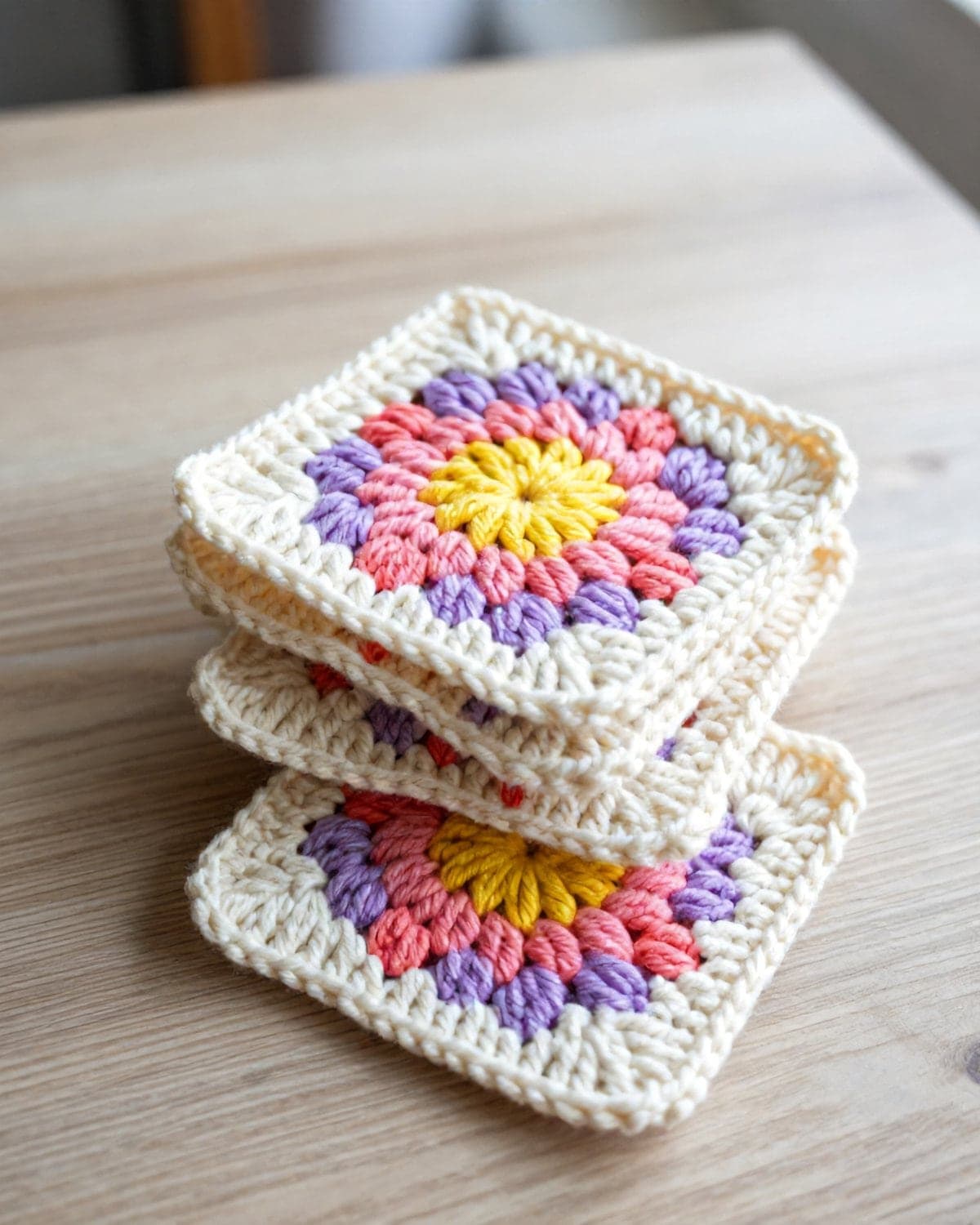
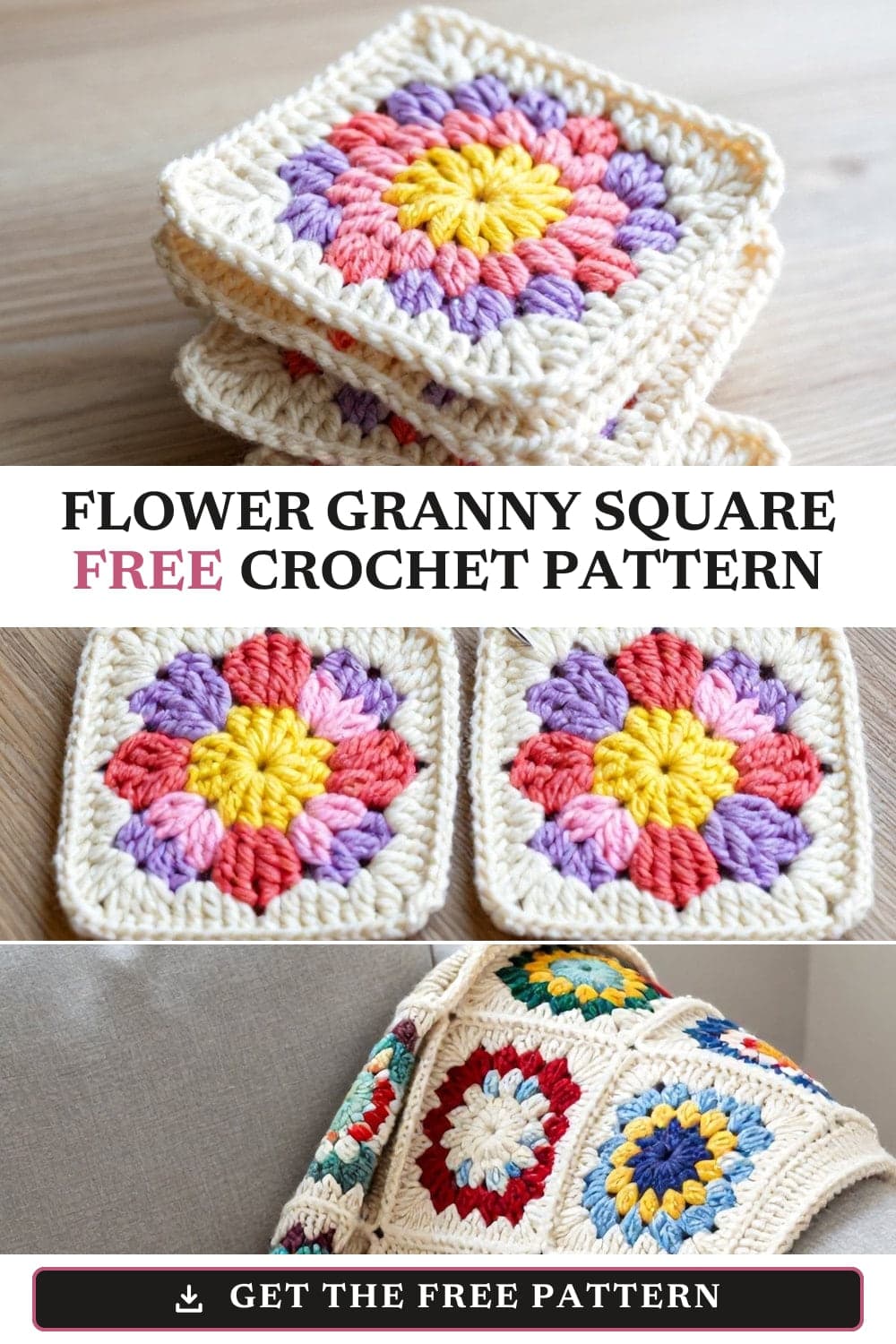
A crochet flower granny square starts as a little round flower and ends as a neat square, ready to join into a blanket, a cushion or a bag. This one is a sunburst granny square: a solid centre, a ring of 16 small petals, a ring of 16 bigger petals, then two rounds that square it off. It looks detailed, but it uses only chains, double crochet, simple clusters and single crochet, and each square takes about 30 minutes.
This guide gives you the full pattern round by round, with stitch counts, plus a version for a daisy look, three ways to join the squares, how many squares you need for different blankets, border and colour ideas, and fixes for the problems people usually run into.
Terms used here: US crochet terms. Double crochet (dc) is called treble (tr) in UK terms, half double crochet (hdc) is half treble, single crochet (sc) is UK double crochet, and treble crochet (tr) is UK double treble.
About this pattern: it's a version of the classic sunburst granny square, written out for this guide. The stitch counts have been checked so the numbers add up. Finished sizes are approximate and depend on your yarn, hook and tension.
At a glance
| Skill level | Advanced beginner (comfortable with double crochet) |
| Stitches | Magic ring, ch, sl st, sc, hdc, dc, tr, 2-dc and 3-dc clusters |
| Yarn | DK cotton or acrylic (weight 3) in four colours |
| Hook | 3.5 mm (US E-4) |
| Finished size | About 10 cm (4 in) square |
| Yarn per sq. | About 20 m (22 yd) in total |
| Construction | Worked in the round from the centre, a new colour on most rounds |
What you need
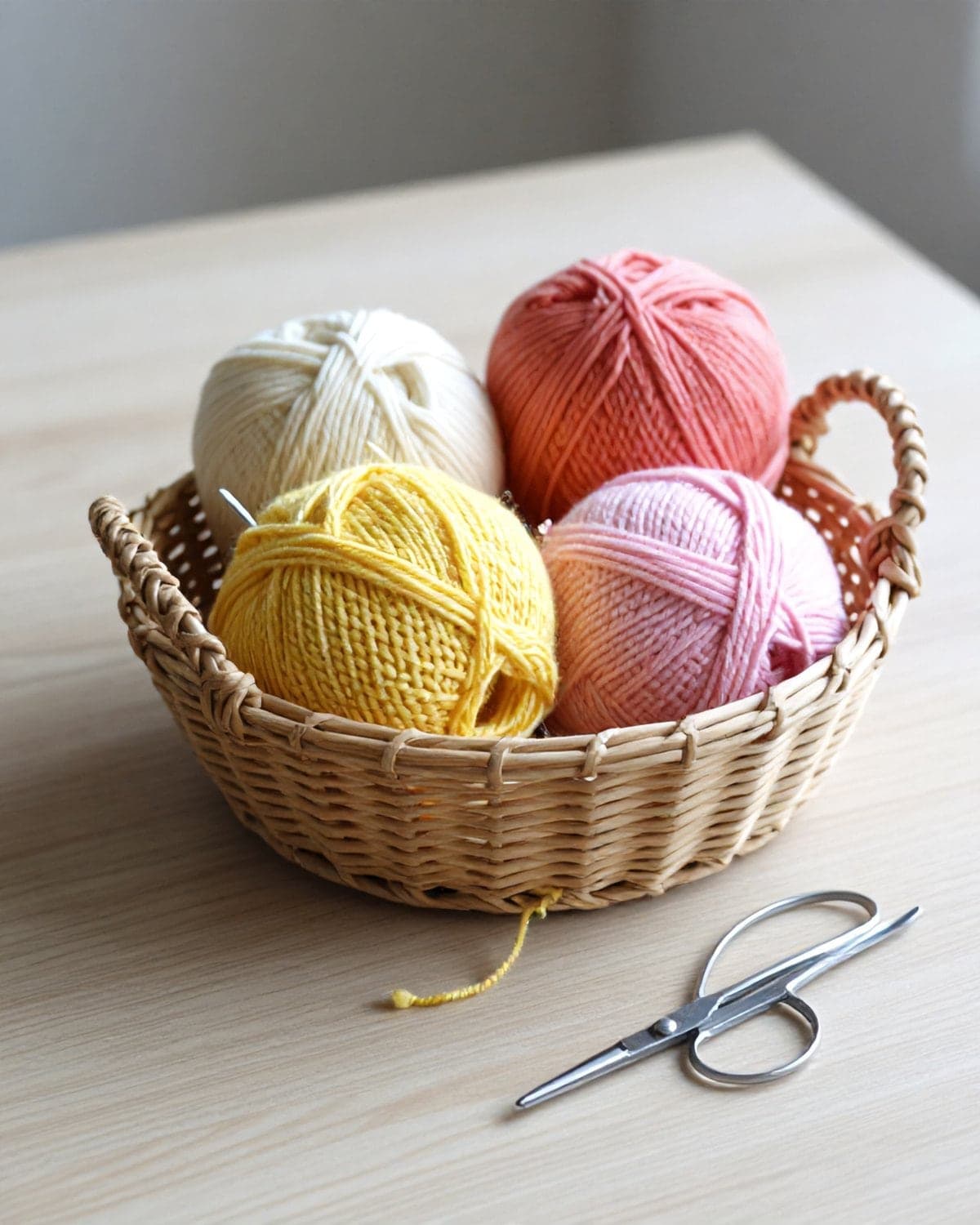
- DK yarn (weight 3) in four colours: one for the centre (A), one for the inner petals (B), one for the outer petals (C) and one for the background (D). Each square uses roughly 2 m of A, 4 m of B, 5 m of C and 9 m of D.
- A 3.5 mm (US E-4) hook.
- A tapestry needle for weaving in ends and joining squares.
- Scissors.
Cotton or acrylic? Cotton gives crisp petals and flat squares, which is ideal for cushions, bags and coasters. Acrylic is lighter, softer and warmer, which makes it the usual choice for blankets. Both work with this pattern. Stick to the same yarn for every square in a project so they all come out the same size.
Using another weight? The pattern works in any yarn. Worsted (weight 4) with a 5 mm hook makes a square of about 13 cm (5 in). If you're not sure which weight you have, the Craft Yarn Council's yarn weight system has a chart.
Stitches and techniques
- Magic ring. The adjustable loop that closes the centre. See how to crochet a magic ring.
- Space. In this pattern you mostly work into the gaps between stitches and the chain spaces, not into the tops of the stitches. It's quicker and makes the petals stand out.
- 2-dc cluster. Yarn over, insert the hook into the space, pull up a loop, yarn over and pull through 2 loops. Repeat once more in the same space. You have 3 loops on the hook. Yarn over and pull through all 3.
- 3-dc cluster. The same as the 2-dc cluster, but repeat the first part three times, so you have 4 loops on the hook before you pull through all of them.
- Beginning cluster. At the start of a round, ch 2 stands in for the first part of the cluster. Then make one dc less than the cluster needs.
- Treble crochet (tr). Yarn over twice, insert the hook, pull up a loop, then (yarn over, pull through 2 loops) three times.
All the abbreviations follow the Craft Yarn Council's standard crochet abbreviations. New to these stitches? Easy crochet stitches for beginners covers the basics. And if you've never made a granny square before, the classic how to crochet a granny square tutorial is a good warm-up.
Flower granny square pattern
Fasten off at the end of each round and join the next colour in a new place. Starting each round in a different spot spreads out the joins, so the square stays even.
Round 1: the centre (colour A)
- Make a magic ring. Ch 3 (counts as the first dc), then work 15 dc into the ring.
- Pull the ring tight and slip stitch into the top of the ch-3.
Stitch count: 16 dc. Fasten off.
The centre should be a flat circle about 3 cm (1.25 in) across. If it ruffles, pull the magic ring tighter. If it cups, your dc are short: try a looser tension.
Round 2: inner petals (colour B)
- Join colour B with a slip stitch in any space between two dc of round 1.
- Ch 2, dc in the same space (beginning 2-dc cluster), ch 1.
- (2-dc cluster in the next space between stitches, ch 1) × 15.
- Slip stitch into the top of the first cluster.
Stitch count: 16 clusters and 16 ch-1 spaces. Fasten off.
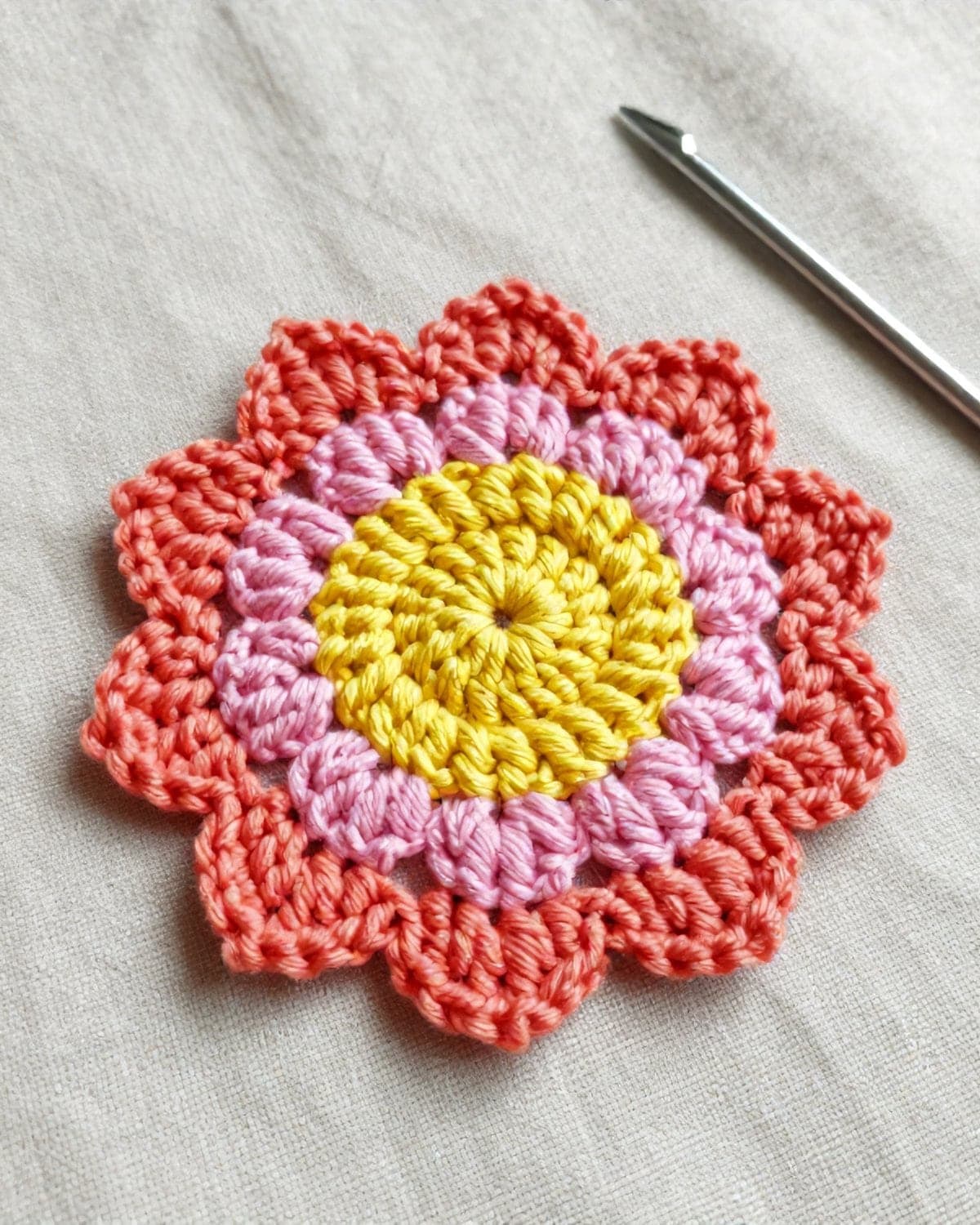
Round 3: outer petals (colour C)
- Join colour C with a slip stitch in any ch-1 space of round 2.
- Ch 2, 2-dc cluster in the same space (beginning 3-dc cluster), ch 2.
- (3-dc cluster in the next ch-1 space, ch 2) × 15.
- Slip stitch into the top of the first cluster.
Stitch count: 16 clusters and 16 ch-2 spaces. Fasten off.
You now have a round flower with two rings of petals, about 7 cm (2.75 in) across. If you only want flowers, stop here: these circles make lovely appliqués and coasters.
Round 4: squaring off (colour D)
The 16 ch-2 spaces become 4 sides of 4 spaces. One space on each side is a corner. The stitch heights change along each side, tallest in the corners and shortest in the middle, and that's what turns the circle into a square.
- Join colour D with a slip stitch in any ch-2 space. This is your first corner.
- Ch 4 (counts as the first tr), 2 tr, ch 2, 3 tr in the same space.
- *3 dc in the next ch-2 space, 3 hdc in the next ch-2 space, 3 dc in the next ch-2 space.
- (3 tr, ch 2, 3 tr) in the next ch-2 space (corner).*
- Repeat from * to * twice more.
- 3 dc in the next space, 3 hdc in the next space, 3 dc in the last space.
- Slip stitch into the top of the ch-4.
Stitch count: 60 stitches, 15 on each side, and 4 ch-2 corners. Don't fasten off.
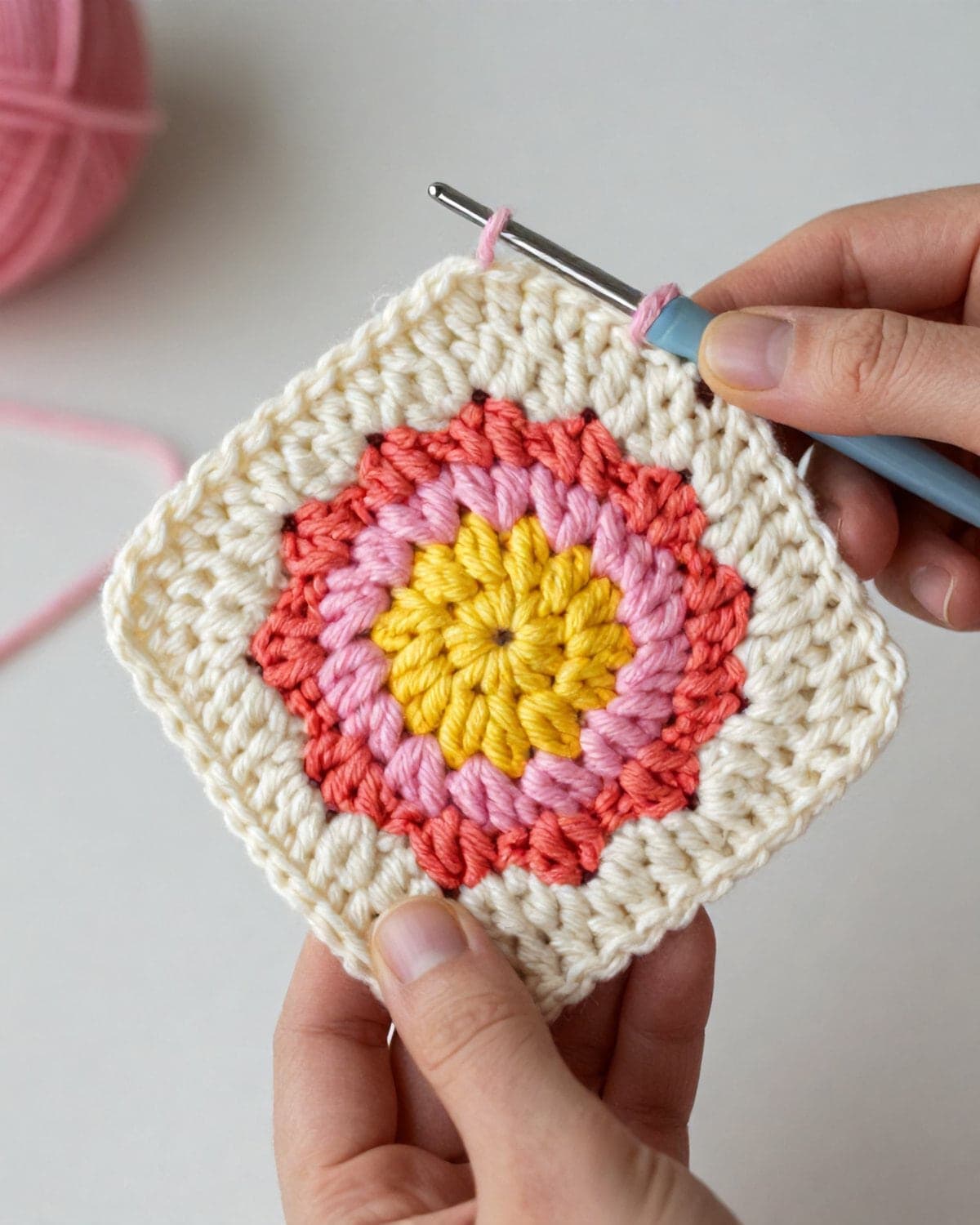
Round 5: the edge (colour D)
- Ch 1. Sc in the same stitch and in each stitch to the first corner.
- In each corner ch-2 space: (sc, ch 2, sc).
- Continue around, working 1 sc in each stitch and (sc, ch 2, sc) in each corner.
- Slip stitch into the first sc.
Stitch count: 68 sc, 17 on each side, and 4 ch-2 corners. Fasten off and weave in all the ends.
The single crochet round gives a straight, firm edge that makes the squares much easier to join.
Blocking the squares
Blocking makes every square the same size and lets the petals relax into shape. It's worth doing before you join.
- Pin. Pin each square to a foam mat or a folded towel, measuring the sides so they are all 10 cm (4 in). Pin each corner.
- Wet. Spray the squares with water until they're damp.
- Dry. Leave them until completely dry, then unpin.
For acrylic yarn, steam blocking works better than water. Hold a steam iron just above the pinned square without touching it, then let it cool before you remove the pins.
The daisy granny square
For a flower that reads as a daisy, change two things:
- Round 1 in yellow.
- Rounds 2 and 3 both in white, so the two rings of petals become one full flower.
- Rounds 4 and 5 in green, sage or a soft cream.
Worked in white, yellow and sage, the squares make a fresh, summery blanket. For a single standalone flower to sew onto other projects, try the crochet daisy pattern.
How to join flower granny squares
Lay all your squares out on the floor first and move them around until you like the colour balance. Take a photo so you can follow the layout as you join.
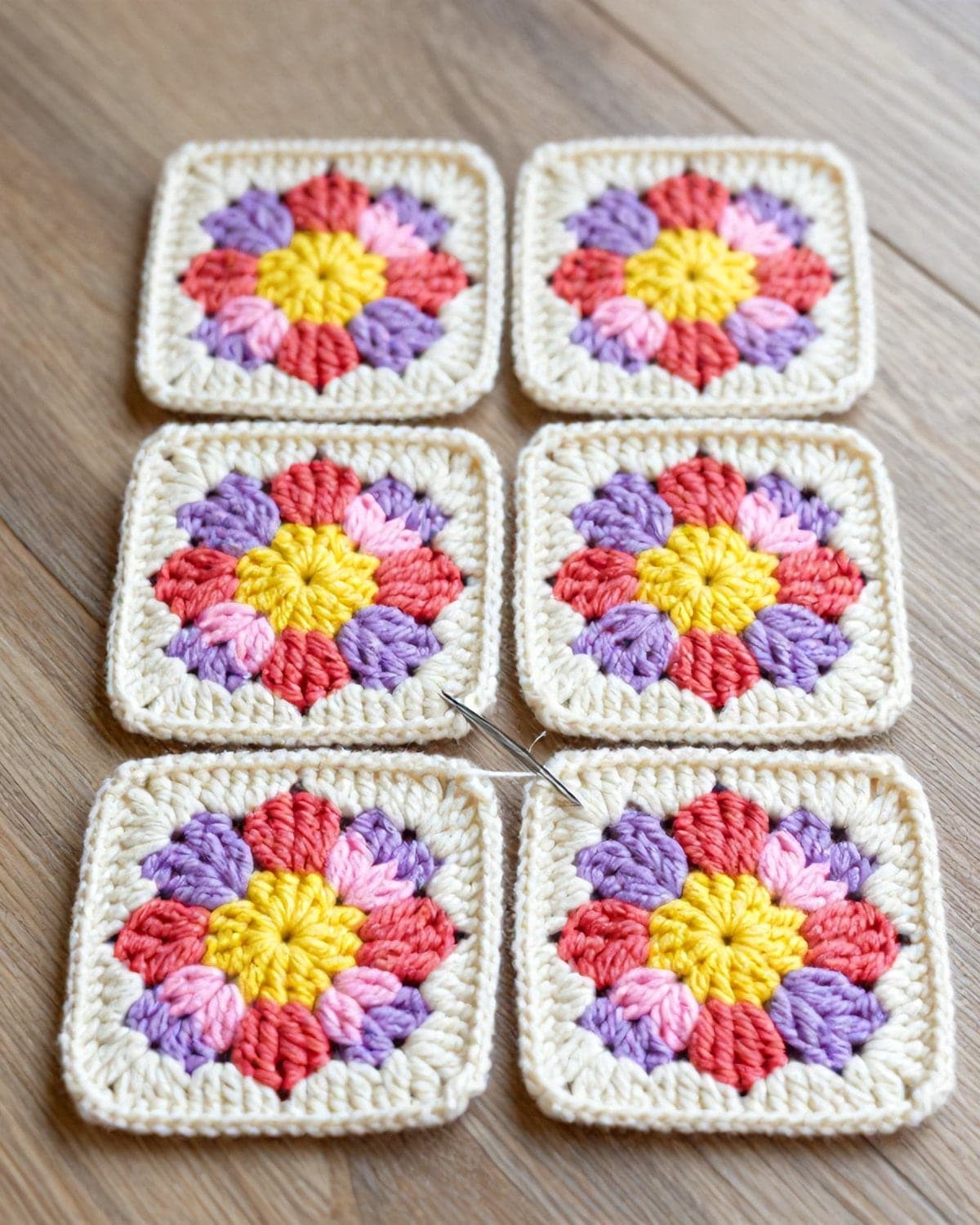
Whip stitch join
The easiest join. Hold two squares right sides together and sew through the back loops of the edge stitches with a tapestry needle and yarn in colour D. The seam is flat and almost invisible from the front. Join squares in strips, then join the strips together.
Slip stitch join
Hold two squares wrong sides together and slip stitch through both edges with your hook. This leaves a neat raised ridge on the front, which outlines each square. It's quick, and very strong.
Join as you go
Instead of working round 5 separately on every square, you join each new square to its neighbours while making round 5. When you reach a side that needs joining, work the corner as (sc, ch 1, sl st into the corner space of the neighbouring square, ch 1, sc), then work along that side as usual, but after every second sc, slip stitch into the matching stitch of the neighbouring square. It takes a little practice but saves a lot of sewing.
To join squares at a corner where four meet, slip stitch into the corner space of the square diagonally opposite, so the centre of the four corners stays closed.
How many squares do you need?
Each square is about 10 cm (4 in) in DK yarn. Here's a guide to common sizes, before adding a border.
| Project | Layout | Squares | Approximate size |
|---|---|---|---|
| Coaster | 1 | 1 | 10 × 10 cm (4 × 4 in) |
| Cushion front, 40 cm | 4 × 4 | 16 | 40 × 40 cm (16 × 16 in) |
| Tote bag (two panels) | 3 × 3 | 18 | 30 × 30 cm (12 × 12 in) |
| Baby blanket | 7 × 9 | 63 | 70 × 90 cm (28 × 36 in) |
| Lap blanket | 10 × 13 | 130 | 100 × 130 cm (40 × 52 in) |
| Throw for a sofa | 13 × 16 | 208 | 130 × 160 cm (52 × 64 in) |
In worsted yarn, each square is about 13 cm (5 in), so you need roughly 40% fewer squares for the same size.
How much yarn for a blanket? Multiply about 20 m (22 yd) by the number of squares, then add 10% for joining and a border. A baby blanket of 63 squares needs roughly 1,400 m (1,530 yd) in total, most of it in the background colour.
Borders for a flower granny square blanket
A border frames the squares and hides the slightly bumpy outer edge. Work it all around the joined blanket, with (sc, ch 2, sc) or 3 stitches in each corner.
- Simple: 3 rounds of sc in colour D.
- Classic granny: groups of 3 dc in every other stitch, with ch 1 between, then 2 rounds of sc.
- Scalloped: 1 round of sc, then a round of shells. See shell stitch crochet.
- Petal edge: 1 round of sc in colour D, then (sk 1, 5 dc in next, sk 1, sl st in next) all around in a petal colour.
For more on finishing a granny blanket, including how to keep it square, see granny square blanket for beginners.
Projects for flower granny squares
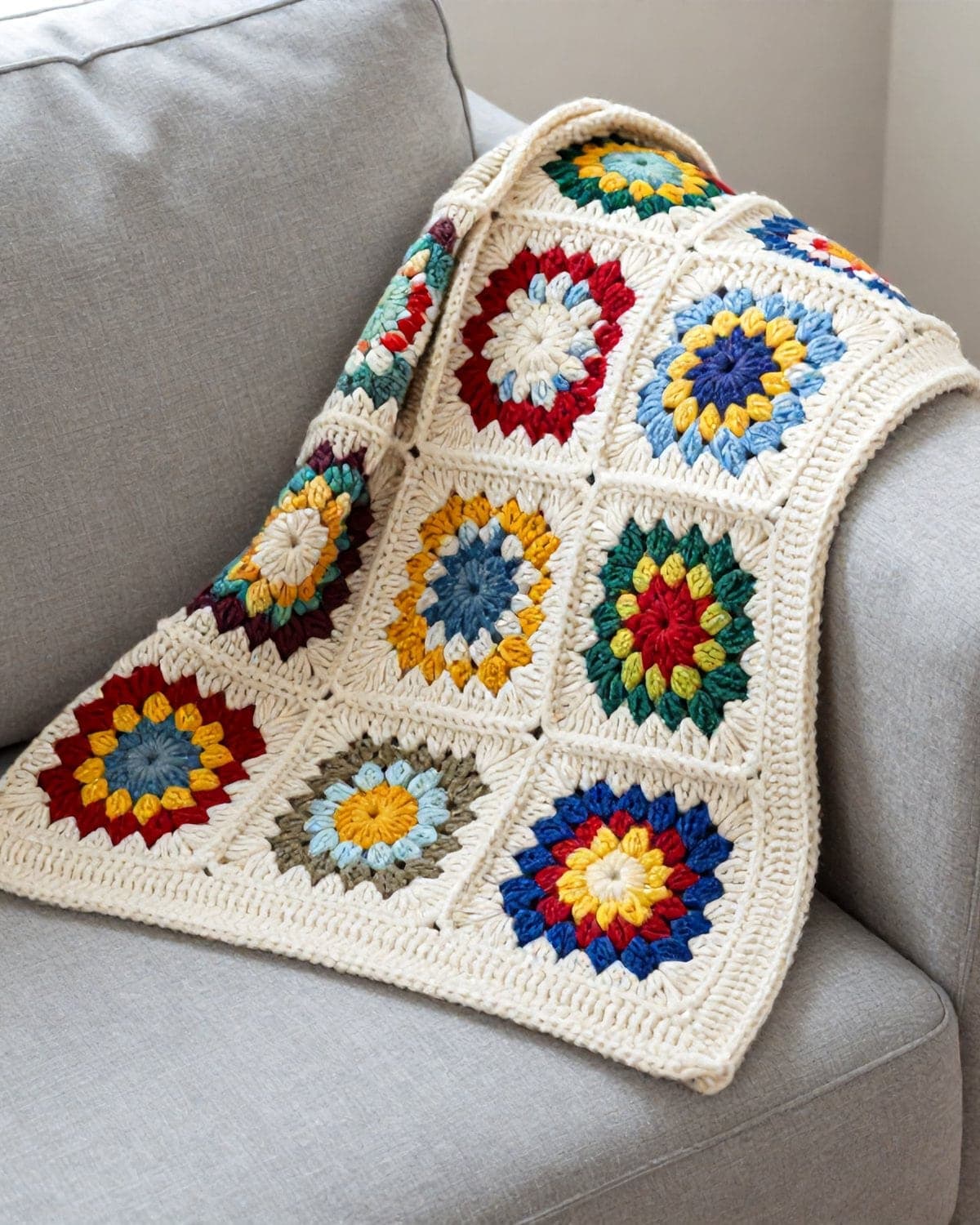
- Blankets. A baby blanket in pastels, or a bright scrap blanket where every flower is different. Wikipedia's granny square article shows how long people have been making them, and how many styles there are.
- Cushion covers. Sixteen squares on the front and a plain back. The easy crochet pillow cover shows how to make a back that needs no zip.
- Tote bags. Two panels of 3 × 3 squares, joined along three sides, with a strap. For a simpler bag, see the easy crochet tote bag.
- Coasters and placemats. One square is a coaster. In cotton, a 3 × 4 panel is a placemat. More ideas are in easy crochet coasters.
- Cardigans. Flower granny squares make a popular patchwork cardigan. The easy crochet cardigan for beginners explains how simple shapes come together into a garment.
- Baskets. Join five squares into an open box and line it with fabric. Or see the easy crochet basket for a sturdier one.
Colour ideas
The flower stands out best when the petals contrast with the background.
- Spring: yellow centre, pink and lilac petals, cream background.
- Daisy: yellow centre, white petals, sage green background.
- Retro: mustard, orange and brown petals on a cream background, a classic 1970s look.
- Boho: terracotta centre, rust and blush petals, oatmeal background.
- Monochrome: cream petals on a charcoal background.
- Scrappy: every flower in different leftovers, with one shared background colour to tie the blanket together.
Tip: the background colour (D) takes almost half the yarn, so choose it first and buy enough for the whole project in one dye lot.
Tips for neat squares
- Change colour in a new place each round. It spreads out the ends and keeps the square from leaning to one side.
- Weave ends in as you go. Work over the tails of the previous round as you crochet. It saves a lot of finishing time.
- Count the corners. Check that each side of round 4 has 15 stitches before you start round 5.
- Keep the clusters plump. Pull up each loop to the same height before you close the cluster.
- Make one square first. Measure it, block it, and adjust your hook before you make the rest.
- Store squares flat. Keep finished squares in a box or bag, stacked, so they don't stretch.
Common problems and fixes
The flower is cupping. Your stitches in round 3 are short, or your ch-2 spaces are tight. Loosen the chains, or go up half a hook size for that round.
The flower ruffles. You probably worked a cluster into the top of a stitch as well as the space. Count 16 clusters in rounds 2 and 3.
The square isn't square. Check the counts of round 4: (3 tr, ch 2, 3 tr) in each corner, then 3 dc, 3 hdc, 3 dc on each side. Blocking fixes small differences.
The corners curl. The corner chains are too tight. Make the ch-2 a little looser, or use ch 3 in the corners of round 4.
My squares are all different sizes. Your tension changes from day to day. Block every square to the same measurement before joining, and keep to the same hook.
There's a hole in the middle. The magic ring wasn't pulled tight enough, or the tail slipped. Thread the tail onto a needle, pull it tight and weave it through the back of round 1 in two directions.
The joining seams pull. You're joining too tightly. Use a looser tension, or a hook one size larger for slip stitch joins.
Frequently asked questions
Is a flower granny square good for beginners? Yes, if you can already make a double crochet. Clusters are just double crochet stitches finished together, and the pattern tells you exactly where each one goes.
How long does one square take? About 30 minutes once you've learned the rounds. The first one may take an hour.
How big is the square? About 10 cm (4 in) in DK yarn with a 3.5 mm hook, and about 13 cm (5 in) in worsted with a 5 mm hook.
Can I use only two colours? Yes. Work rounds 1 to 3 in your flower colour and rounds 4 and 5 in the background colour. You'll only change colour once per square.
Can I make it without changing colour? Yes. Instead of fastening off, slip stitch into the next space to move to the start of the next round. A one-colour square looks textured and calm, which is lovely for a large throw.
How do I stop the squares from looking messy at the back? Weave each end in at least 5 cm (2 in), changing direction once, and trim close. Ends woven through stitches of the same colour disappear completely.
Can I sell items made with these squares? Yes. You're welcome to sell what you make from this pattern. Please link to this page rather than sharing the pattern itself.
What to make next
- For a standalone flower to sew onto the squares or a bag, try the crochet daisy pattern.
- For a plain granny square to mix with the flowers, see how to crochet a granny square.
- For four more quick blooms, see easy crochet flowers.
- For a big bright flower, follow the crochet sunflower pattern.
There are more free patterns in the flowers section.
Save it for later
Pin this to your Pinterest board so it's there when you're ready to stitch.
Keep stitching
Related crochet projects
Flowers Crochet Poppy Pattern: Easy Free Flower With 4 Petals
10 min read
Blankets Crochet Hexagon Blanket: Free Granny Hexagon Pattern
8 min read
Beginner tutorials How to Crochet a Granny Square: Easy Step-by-Step for Beginners
12 min read
Flowers Easy Crochet Flowers: 4 Simple Patterns for Beginners
11 min read