Crochet Panda Pattern: Free Amigurumi Panda With a Watermelon Purse
Crochet a chubby amigurumi panda in soft velvet yarn with this free pattern: eye patches worked into the head, puffy cheeks, legs joined into the body and a tiny watermelon purse. Every round with stitch counts.
By AlixaPublished 13 min read

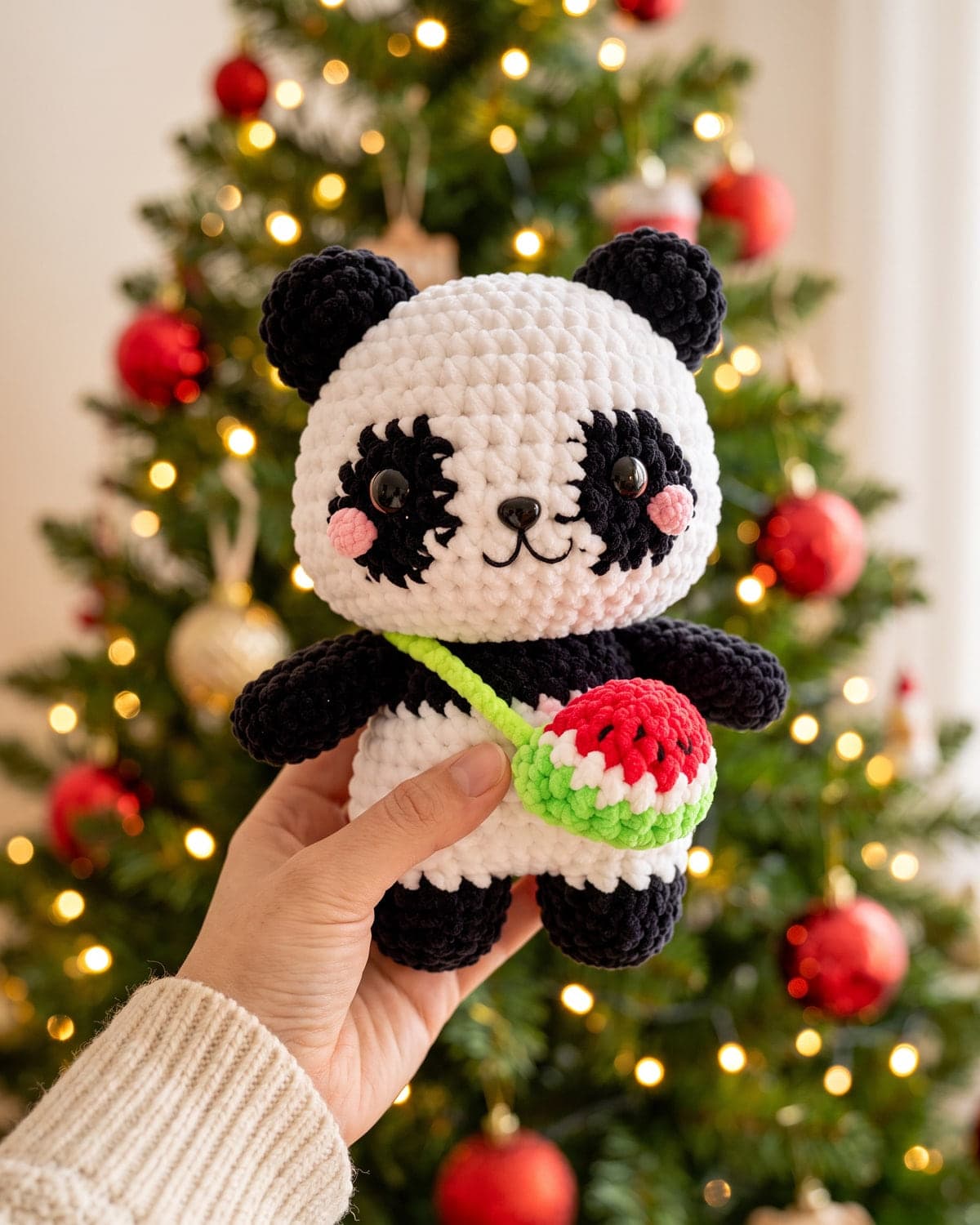
This crochet panda is a chubby little amigurumi with a big round head, black eye patches worked straight into the fabric, puffy cheeks and a tiny watermelon purse on a green strap. It's made in soft velvet yarn, so it works up quickly and feels like a shop-bought plush.
The free pattern below gives every round with its stitch count, including the colour changes for the eye patches. It also explains how the cheeks are shaped, how the legs join into the body, how to finish the face, and how to make and hang the purse.
Terms used here: US crochet terms. Single crochet (sc) is called double crochet (dc) in UK terms, and half double crochet (hdc) is called half treble (htr).
About this pattern: it's the Popo the Panda design. Each round's stitch count has been checked so the numbers add up. The finished size is approximate, because it depends on your yarn, your hook and how firmly you stuff.
At a glance
| Skill level | Advanced beginner (colour changes in the round) |
| Stitches | Magic ring, single crochet, increase, invisible decrease, half double crochet |
| Yarn | Chunky velvet yarn in white and black, small amounts of red, cream and green |
| Hook | 4 mm, or the size your yarn recommends |
| Finished size | Roughly 20 cm (8 in) tall in super bulky velvet yarn (an estimate) |
| Construction | Head, body with legs, ears, arms and a purse, worked in a spiral and sewn |
What you need
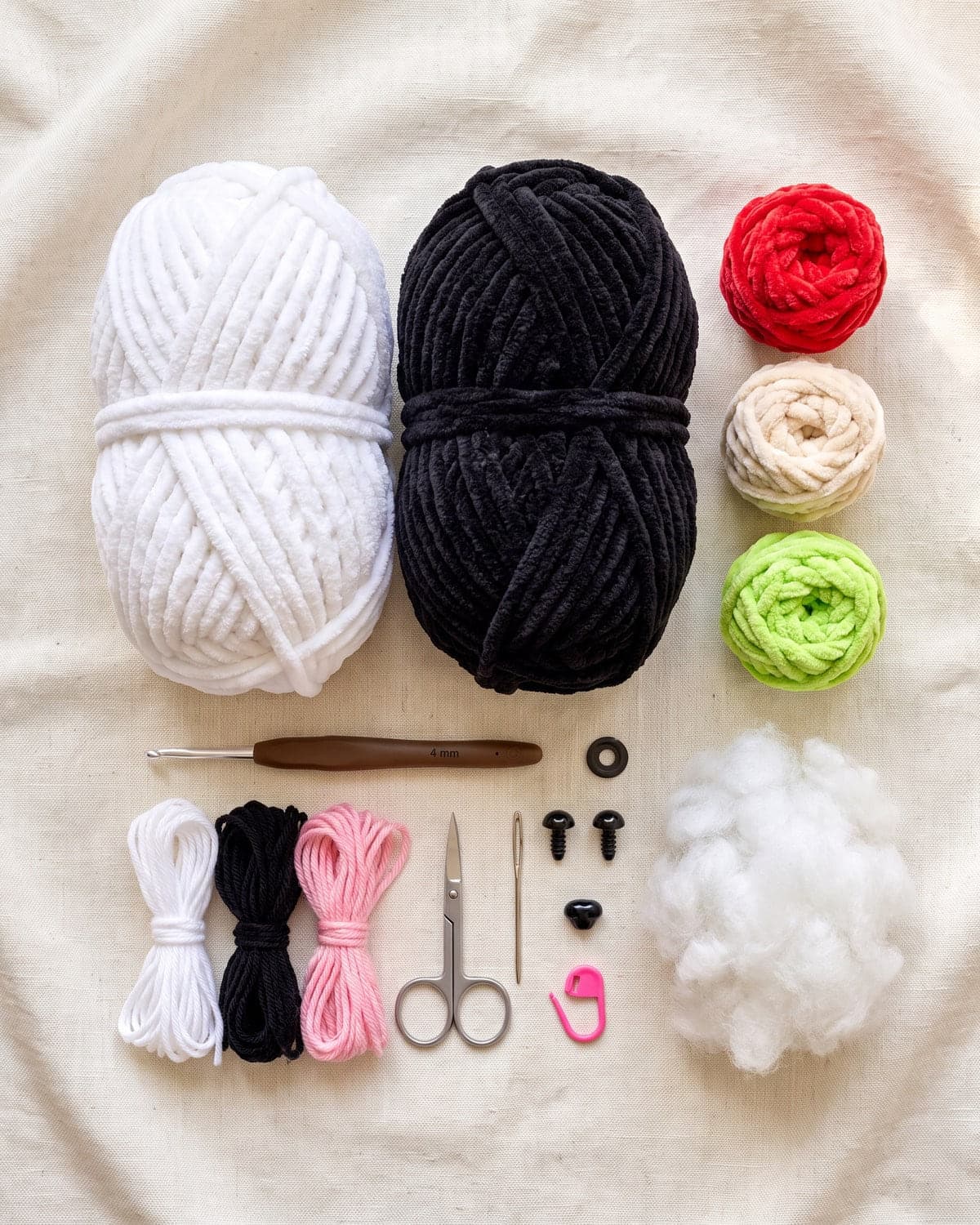
- Chunky velvet (plush) yarn, about 120 m per 100 g, in white and black. Himalaya Dolphin Baby, Bernat Blanket, Parfait and YarnArt velvet yarns all work. One ball of each colour is plenty. Most of these are labelled super bulky (weight 6) on the Craft Yarn Council's yarn weight system.
- Small amounts of velvet yarn in red, cream and green for the watermelon purse.
- A 4 mm crochet hook, or the size recommended for your yarn. Velvet yarn is crocheted on a small hook for its thickness, so the stitches are tight.
- Two 12 mm safety eyes and a safety nose.
- Worsted weight yarn in white, black and pink for the embroidery. Velvet yarn is too thick for fine details.
- Polyester fibrefill stuffing.
- A bright stitch marker, scissors and a large-eye yarn needle.
A safety note before you start
Safety eyes and safety noses are small parts, and they can come off. If the panda is for a baby or a young child, embroider the eyes and nose with yarn instead, and sew every piece on very firmly. The US Consumer Product Safety Commission explains the rules on small parts in toys for young children.
Working with velvet yarn
Velvet yarn makes beautifully soft toys, but it behaves differently from cotton. A few things help:
- Feel for the stitches. The pile hides the tops of the stitches. Run a fingertip along the edge and you'll feel each V. Push the hook in where the fabric gives.
- Count every round. It's easy to miss a stitch. Use a bright stitch marker in the first stitch of every round and move it up as you go.
- Don't undo too much. Velvet yarn sheds and can look worn after it's pulled out. If a round is wrong, undo just that round.
- Keep the tension even. If the yarn twists or the pile pulls out of the core ("worming"), you're pulling too hard. Let the yarn run loosely through your fingers.
- Use thin yarn for the face. Worsted weight yarn gives crisp lines for the smile and cheeks.
Techniques used
Everything here is explained in detail in amigurumi for beginners. A quick recap:
- Magic ring (MR). An adjustable loop that closes the centre of the first round. With thick velvet yarn, the ring can be hard to pull tight. You can instead chain 2 and work the first round's stitches into the first chain. Step-by-step photos of the ring are in how to crochet a magic ring.
- Working in a spiral. Rounds aren't joined.
- Increase (inc). Two single crochets in the same stitch.
- Invisible decrease (dec). Insert the hook under the front loop of the next stitch, then under the front loop of the one after. Yarn over and pull through both front loops. Yarn over and pull through the two loops on the hook.
- Half double crochet (hdc). Yarn over, insert the hook, yarn over and pull up a loop, then yarn over and pull through all three loops. It's taller than single crochet. Here, three hdc in one stitch make a little puff for each cheek. Easy crochet stitches for beginners has photos.
Changing colour
The eye patches are crocheted into the head, so you'll change between white and black a few times in rounds 9 to 12.
- Work the last stitch in the old colour until two loops are left on the hook.
- Drop the old colour, pick up the new one, yarn over and pull through both loops.
- Carry on in the new colour.
Carry the unused colour inside the head. Don't cut it each time. Let it lie across the inside of the work, and work over it with the next stitches so it doesn't make long loops. Because the head is still open, it's easy to check that the strands sit flat on the inside.
Reading the pattern
R4: (3 sc, inc) × 6 (30) means: single crochet in each of the next three stitches, then increase in the next stitch. Do that six times. The round ends with 30 stitches. A word in bold, such as black, means change to that colour. If the shorthand is new to you, how to read crochet patterns explains it.
Crochet panda pattern
Head
Start in white. Round 1 is the top of the head.
- R1: 8 sc in a magic ring (8)
- R2: inc in each stitch around (16)
- R3: (sc, inc) × 8 (24)
- R4: (3 sc, inc) × 6 (30)
- R5: 2 sc, inc, (4 sc, inc) × 5, 2 sc (36)
- R6: (5 sc, inc) × 6 (42)
- R7 and R8: sc in each stitch around, for 2 rounds (42)
Now the eye patches begin. The black stitches sit in the middle of the round, with four white stitches between the two patches.
- R9: 16 sc, black 3 sc, white 4 sc, black 3 sc, white 16 sc (42)
- R10: 15 sc, black 4 sc, white 4 sc, black 4 sc, white 15 sc (42)
- R11: 10 sc, inc, 3 hdc in the next stitch, 2 sc, black 5 sc, white 4 sc, black 5 sc, white 2 sc, 3 hdc in the next stitch, inc, 10 sc (48)
- R12: 18 sc, black 3 sc, white 6 sc, black 3 sc, white 18 sc (48)
The two groups of 3 hdc in round 11 make the cheeks puff out on each side of the face. The patches lean outwards as they go down, which gives the panda its sleepy, sweet look.
Cut the black yarn, leaving a tail to weave in later. Carry on in white.
- R13: 3 sc, dec, (6 sc, dec) × 5, 3 sc (42)
- R14: (5 sc, dec) × 6 (36)
- R15: 2 sc, dec, (4 sc, dec) × 5, 2 sc (30)
- R16: (3 sc, dec) × 6 (24)
- R17: sc, dec, (2 sc, dec) × 5, sc (18)
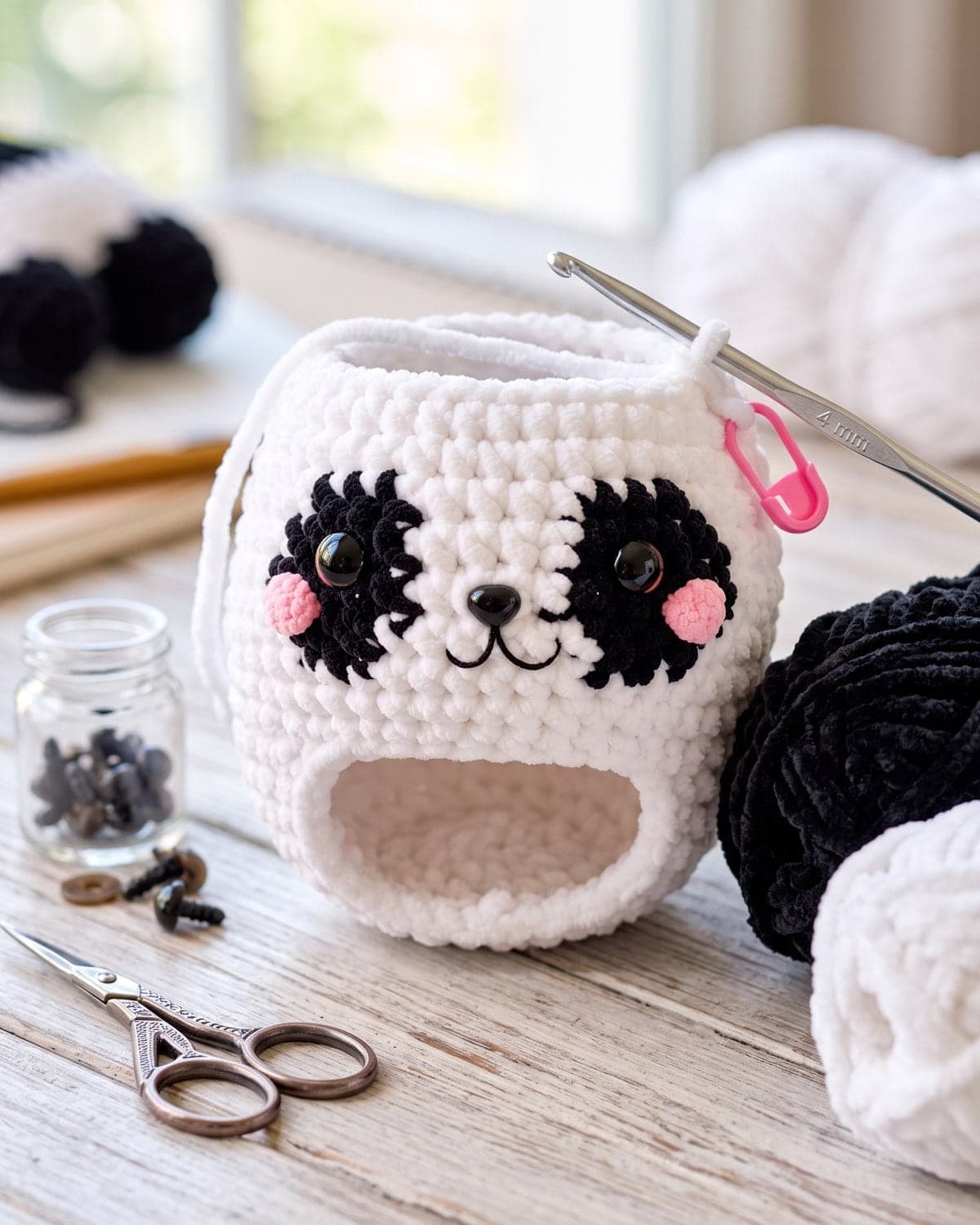
Fasten off and cut the yarn. The bottom of the head stays open, with 18 stitches. Don't stuff it yet. The face goes on first.
Face
Add the face while the head is still open, so you can reach the backs of the eyes and knot the embroidery inside.
- Eyes. Push the 12 mm safety eyes through between rounds 10 and 11, 6 stitches apart, one on each black patch. Look at the face from the front before you press the washers on. They don't come off again.
- Eye shine. With white worsted yarn, make one small stitch beside each eye. This little line makes the eyes look bright.
- Cheeks. With pink yarn, make a few short stitches on each cheek puff, just outside the patches.
- Nose. Fit the safety nose between rounds 11 and 12, in the centre of the face, between the patches.
- Mouth. With black worsted yarn, stitch a small mouth under the nose: one short line straight down, then a small curve to each side.
Knot all the embroidery ends inside the head. Then stuff the head nice and chubby, adding a little extra at the cheeks so they stay round.
Legs (make 2)
Use black.
- R1: 5 sc in a magic ring (5)
- R2: inc in each stitch around (10)
- R3 and R4: sc in each stitch around, for 2 rounds (10)
Fasten off the first leg. Make the second leg the same way, but don't cut the yarn.
Joining the legs
At the end of the second leg, change to white. Chain 3, then join to the first leg with a single crochet in any stitch. The legs are now linked by a short chain, and the rest of the body is worked around both legs and the chain in one piece.
Body
Continue in white.
- R5: 10 sc around the first leg, 3 sc along one side of the chain, 10 sc around the second leg, 3 sc along the other side of the chain (26)
- R6: (3 sc, inc) × 6, 2 sc (32)
- R7 to R12: sc in each stitch around, for 6 rounds (32)
- R13: 7 sc, dec, 14 sc, dec, 7 sc (30)
Change to black for the shoulders.
- R14: black sc in each stitch around (30)
- R15: (3 sc, dec) × 6 (24)
Stuff the body firmly now, right down into the legs, so the panda stands up well.
- R16: (2 sc, dec) × 6 (18)
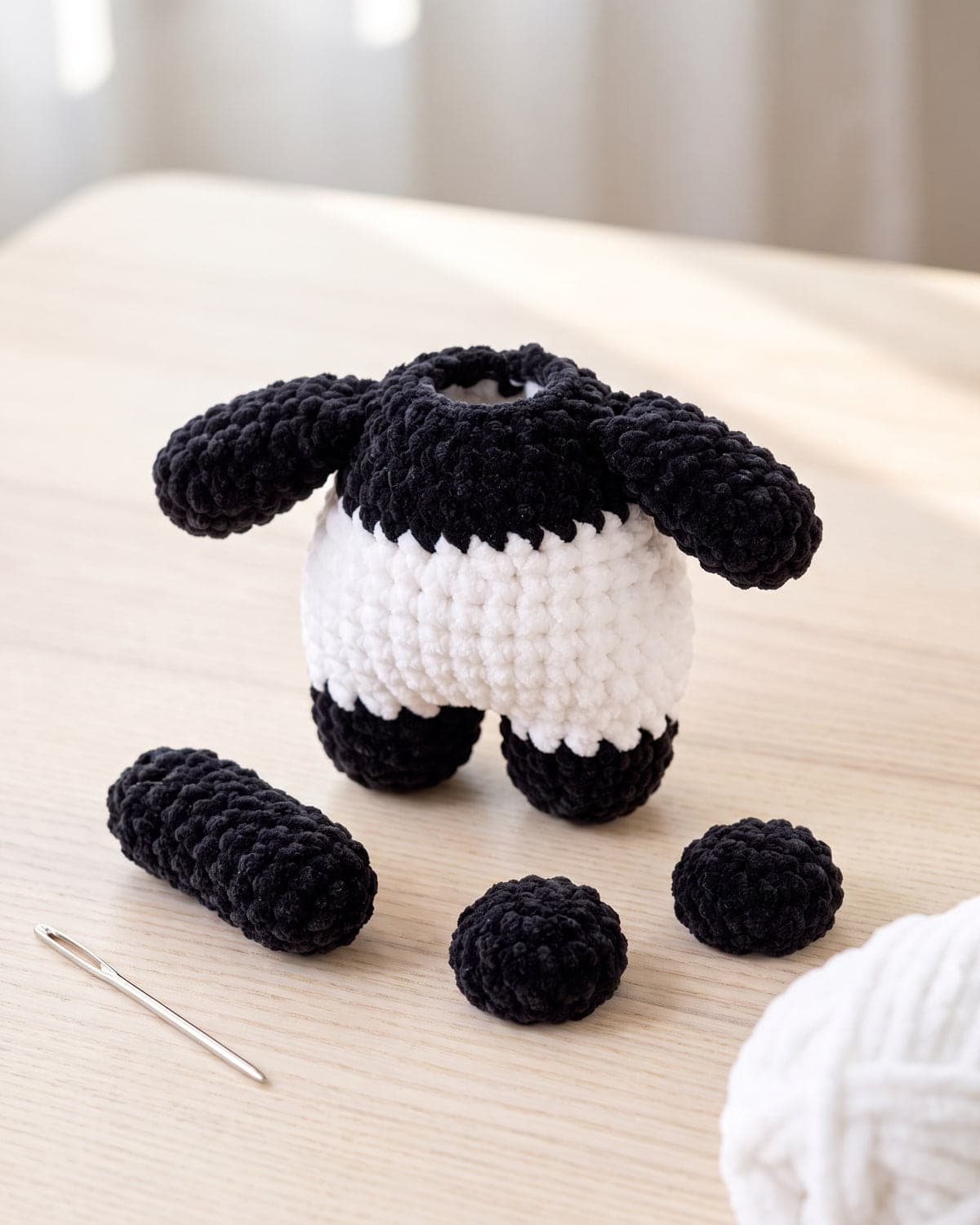
Fasten off, leaving a long black tail for sewing the body to the head. Top up the stuffing before you sew.
Ears (make 2)
Use black. No stuffing.
- R1: 6 sc in a magic ring (6)
- R2: inc in each stitch around (12)
- R3: sc in each stitch around (12)
Fasten off with a long tail. Press each ear flat into a half circle.
Arms (make 2)
Use black. No stuffing.
- R1: 4 sc in a magic ring (4)
- R2: inc in each stitch around (8)
- R3 to R7: sc in each stitch around, for 5 rounds (8)
Fasten off with a long tail. Flatten the open end.
The watermelon purse
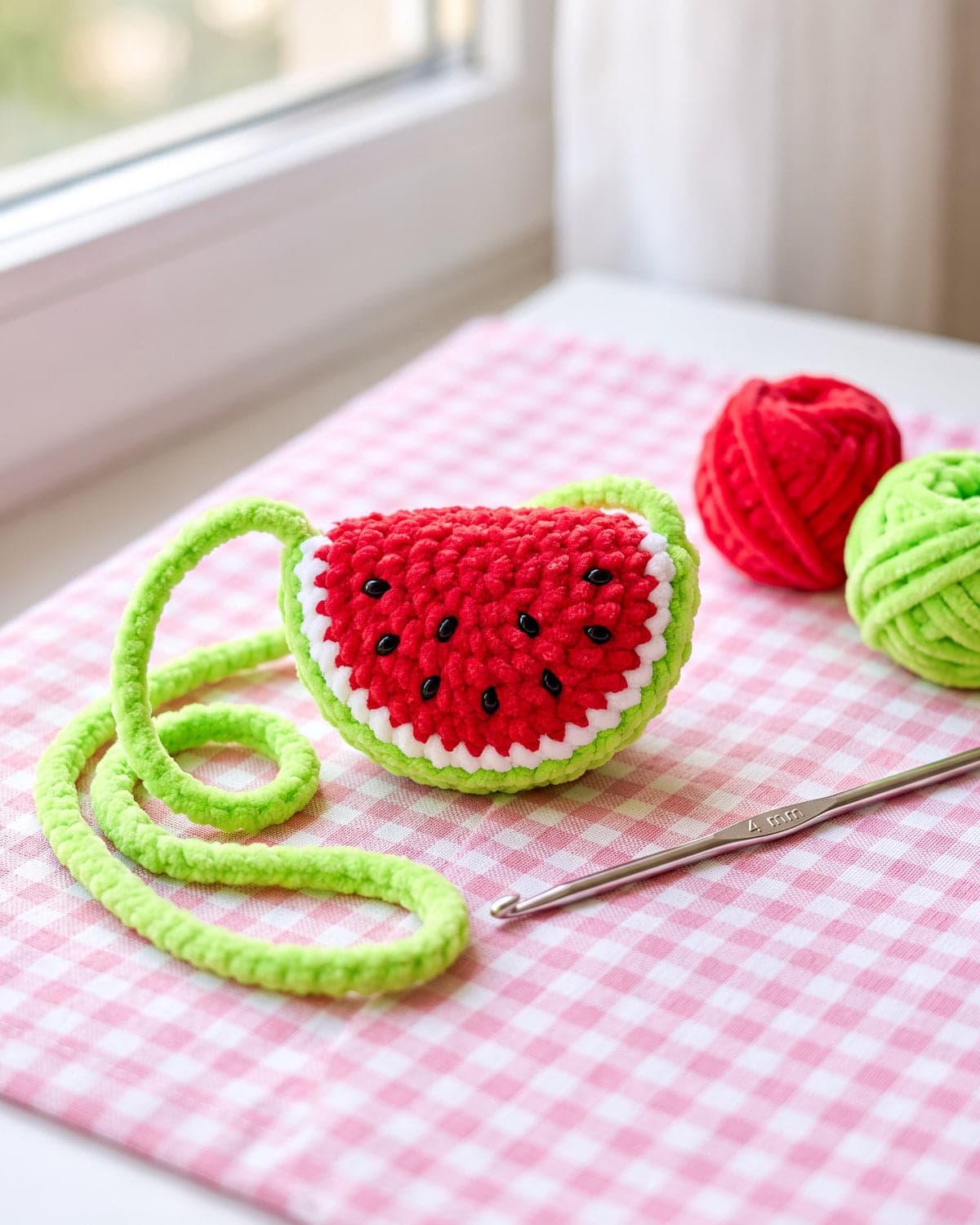 Start in red.
- R1: 5 sc in a magic ring (5)
- R2: inc in each stitch around (10)
- R3: sc in each stitch around (10)
- R4: cream (sc, inc) × 5 (15)
- R5: green (4 sc, inc) × 3 (18)
Fasten off with a long green tail. Flatten the purse so the green edge forms a straight line at the bottom and the red forms the top of the slice. Sew the opening closed with the tail. A little stuffing inside is optional. It makes the purse rounder.
The strap. With green yarn, make a chain long enough to go from one shoulder, across the body, to the opposite hip. Try it on the panda as you go. Sew one end to each side of the purse. A few black stitches on the red part make watermelon seeds, if you like.
Assembly
Pin each piece before you sew it, and look at the panda from the front and the sides.
- Head to body. Line up the open bottom of the head (18 stitches) with the closed top of the body (18 stitches). Sew them together with the long black tail, taking one stitch from each piece all the way around. Go around twice. Push in a little extra stuffing before the last few stitches, so the neck is firm and the head doesn't flop.
- Ears. Pin them to the top of the head between rounds 3 and 6, one on each side, slightly towards the front. Sew around the flat edge.
- Arms. Sew one arm to each side of the body at round 15, the black shoulder round. Angle them slightly forwards.
- Purse. Hang the strap over one shoulder so the purse sits at the opposite hip.
Check that the ears and arms are level. Then hide every yarn end by passing it through the stuffed body and trimming it close.
Variations
A red panda
Use rust orange for the head and body, cream for the patches and black for the legs and arms. Make a long striped tail by working a tube of 12 stitches, changing between rust and cream every two rounds.
A bamboo snack
Instead of the purse, make a small green tube of 6 stitches and about 10 rounds, with a slip stitch ring every few rounds, and sew it into one paw.
Other purses
- Strawberry: red body and a green top, with yellow seed stitches.
- Lemon: yellow, with a white round.
- Kiwi: green and cream, with black seed stitches.
A cotton panda
With DK cotton and a 2.5 mm hook, the same rounds make a much smaller panda, roughly half the size. Use 9 mm safety eyes. The stitches show more clearly, so it's easier to count.
A Christmas panda
Sew a little red scarf around the neck and a pompom hat on top. It makes a lovely gift under the tree. More festive makes are in crochet Christmas ornaments.
Tips for a neat finish
- Use a smaller hook than you think. Velvet yarn needs a tight fabric, or the stuffing shows.
- Keep the colour strands loose. If you pull the carried yarn tight, the eye patches pucker.
- Fit the eyes before stuffing. You can't press the washers on once the head is full.
- Stuff the cheeks well. The hdc puffs only show if there's stuffing behind them.
- Stuff the legs firmly. A soft leg bends, and the panda won't stand.
- Brush the seams. Rub a seam gently with your fingertip and the velvet pile hides the stitches.
Common problems and fixes
The eye patches look jagged. That's normal for colour changes in a spiral. Work the colour-change stitches firmly, and use the tail ends to tidy the edges with a stitch or two on the inside.
The patches are lopsided. Count the white stitches before the first black group in rounds 9 to 12. If one round is off by one, the patches lean.
White shows black fluff. Velvet yarn sheds. Pick off black fibres with sticky tape before you stuff the head.
The head wobbles. The neck needs more stuffing, or more stitches. Sew around the join once more.
The panda falls over. The legs need more stuffing, or they're at different lengths. Push stuffing into both legs and press the bottoms flat.
The purse won't sit flat. Flatten it before sewing it closed, and sew straight across the green round.
The magic ring won't close. Velvet yarn grips itself. Use the chain-2 start instead.
Frequently asked questions
Is this crochet panda pattern good for beginners? It's a good second or third toy. The shaping is simple single crochet, but the eye patches need colour changes in the round.
How long does it take? About four to five hours, including the purse and sewing. Velvet yarn is quick to crochet.
Can I use regular yarn instead of velvet? Yes. Worsted acrylic or cotton with a 3 to 3.5 mm hook works with the same rounds. The panda will be smaller and less fluffy.
Why does the head have hdc stitches? The two groups of 3 hdc in round 11 make the cheeks puff out on each side.
Can I embroider the eyes and nose? Yes. This is the safer choice for young children. Use black worsted yarn, and make each eye a small oval of satin stitches on the patch.
How do I wash it? Hand wash in cool water with a little mild soap. Squeeze out the water in a towel, reshape it and let it dry flat. Don't tumble dry velvet yarn.
Can I sell pandas made from this pattern? Please check the terms that came with your copy of the pattern. Don't copy, share or resell the pattern itself.
What to make next
- For a tiny charm to hang on a bag or keys, try the crochet turtle keychain.
- For long ears and a pompom tail, make the crochet bunny pattern.
- For a toy with almost no sewing, see the easy crochet octopus.
- For your first bear and a full explanation of the basics, go back to amigurumi for beginners.
More toys are in the amigurumi section. The history of the craft is covered in Wikipedia's article on amigurumi, and the real animal in its article on the giant panda.
Save it for later
Pin this to your Pinterest board so it's there when you're ready to stitch.
Keep stitching